
Blog · wildlife of Peru
Corals, sea anemones and sea fans of Peru
Six sea anemones, eleven octocorals and three deep-water stony corals make up this group of twenty species with accounts in the guide. Some are common in tide pools, others are known from Peru by a single museum specimen and a few by one deep-water record.
Published

What this group brings together
The review of the published literature on Peru's sea anemones gathered 22 species cited in Peru, but only 7 with well-documented records.2 Its preliminary version had counted 23 species, and among them Anthothoe chilensis had 37 references, Phymanthea pluvia 27 and Oulactis concinnata 18.3
With the octocorals the picture is different: several species are known in Peru from a single museum specimen or from material collected in the nineteenth century.458 Eugorgia daniana has one specimen from Cabo Blanco collected in 1941, Eugorgia nobilis one from Paita from 1926 and Eugorgia beebei two specimens from Piura.45 Leptogorgia pumila was described from material collected at Zorritos in 1866.8
The stony corals in this article are known from few records, all from deep water.1012
Sea anemones: who is who
Anthothoe chilensis, of the family Sagartiidae, is the anemone with the most references in the Peruvian literature and appears in almost every coastal region.3 Shallow observations place it from the intertidal down to about 15 m, in tide pools, crevices and exposed areas.3 The authors of the review write its name with the author to avoid confusing it with Actinostola chilensis.3
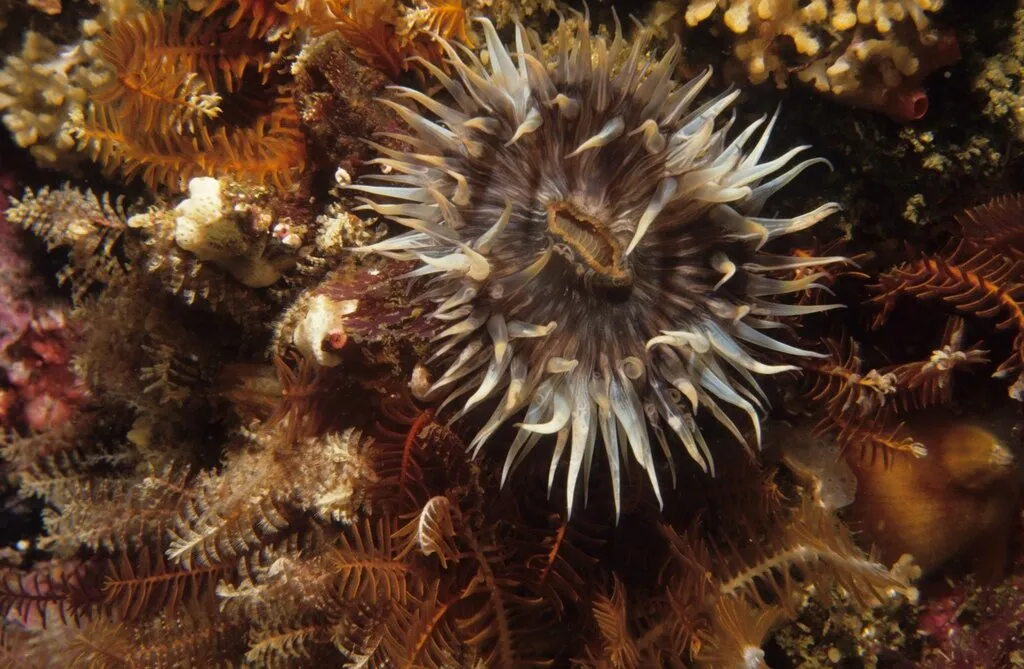

Oulactis concinnata is a robust anemone of the family Actiniidae: in life the column reaches 70 mm high and more than 180 mm across, and the oral disc exceeds 220 mm.1 Its column bears adhesive warts to which stones and shell fragments stick, so that the animal ends up almost hidden.1 Four of the 10 specimens examined had fighting tentacles, an uncommon trait in the family.1
Phymanthea pluvia is among the five most cited anemones in the review, on rocky coasts, in the lower intertidal and the subtidal, inside small caves or attached to vertical walls.3 Phymactis papillosa lives on the rocky intertidal shores of the American Pacific and shows several colour phenotypes, among them a red one and a green one.2117 In Peru the venom of specimens collected in the bay of Ancón has been studied.29
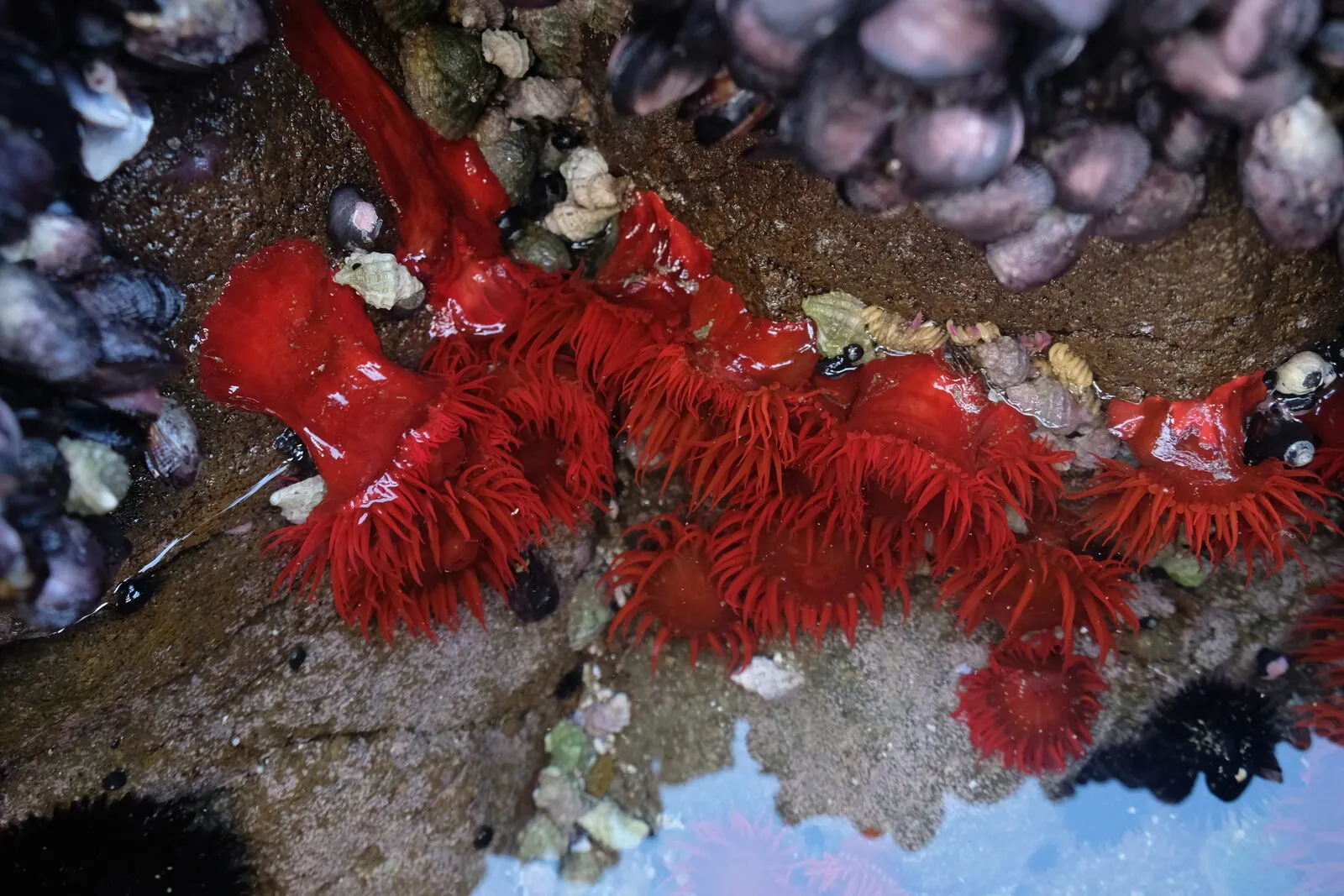

Bunodosoma grande has been cited for Peru only in the north, at Zorritos and Paita, and is not among the seven well-documented species.232 Anemonia alicemartinae, by contrast, is a cryptogenic anemone, that is, of unknown origin, whose range has spread southwards from northern Chile.18

Sea fans and other octocorals
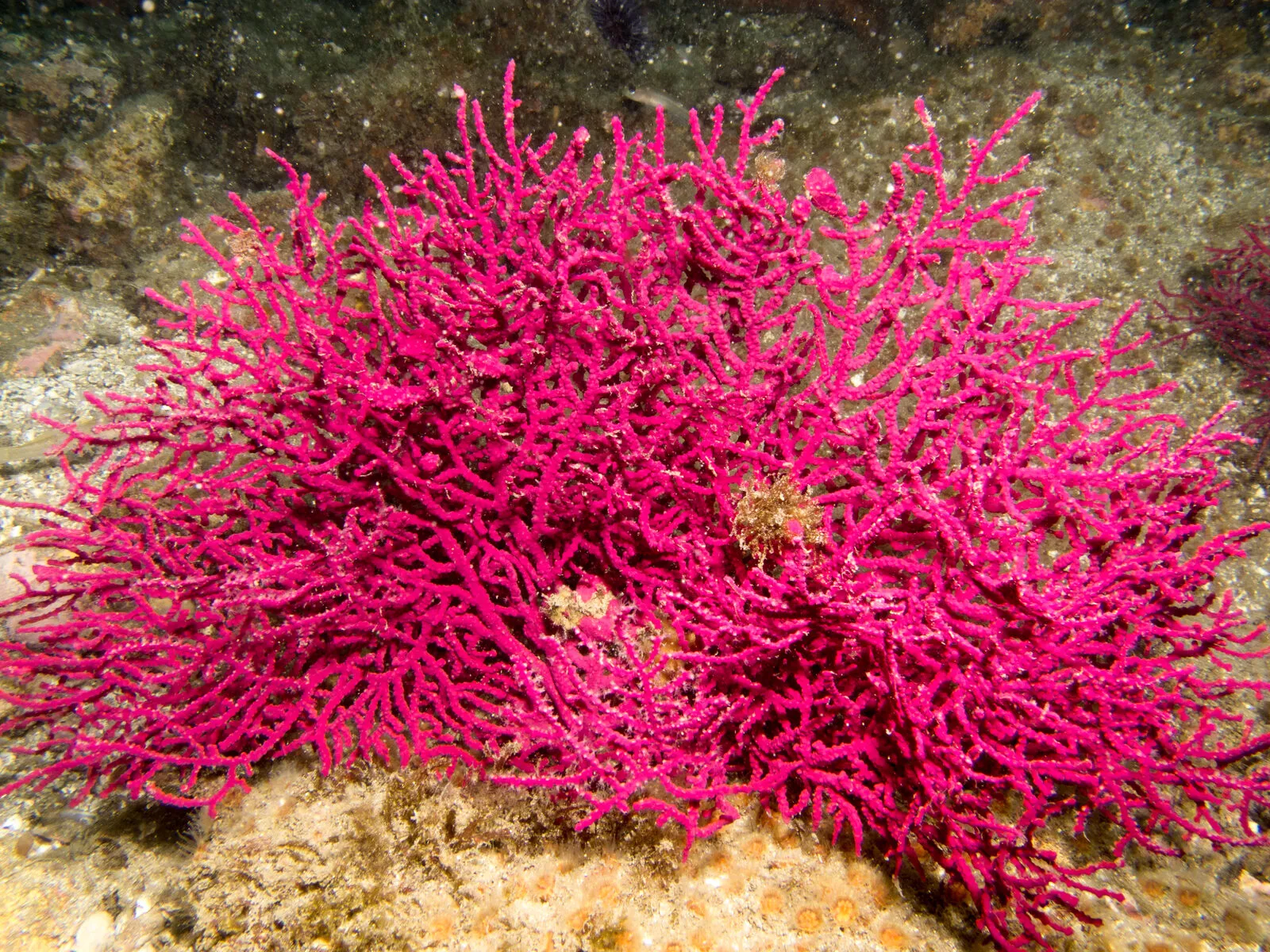
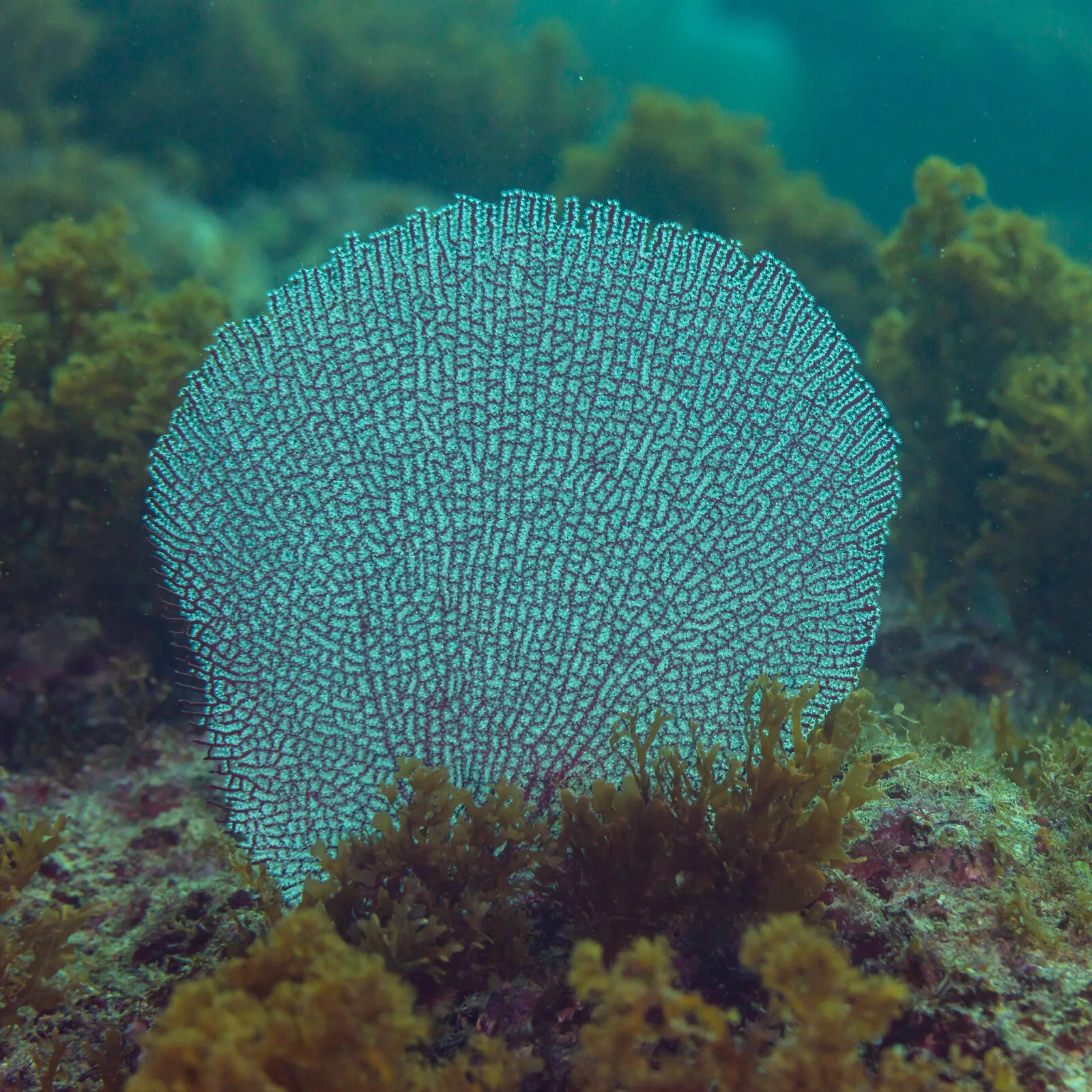
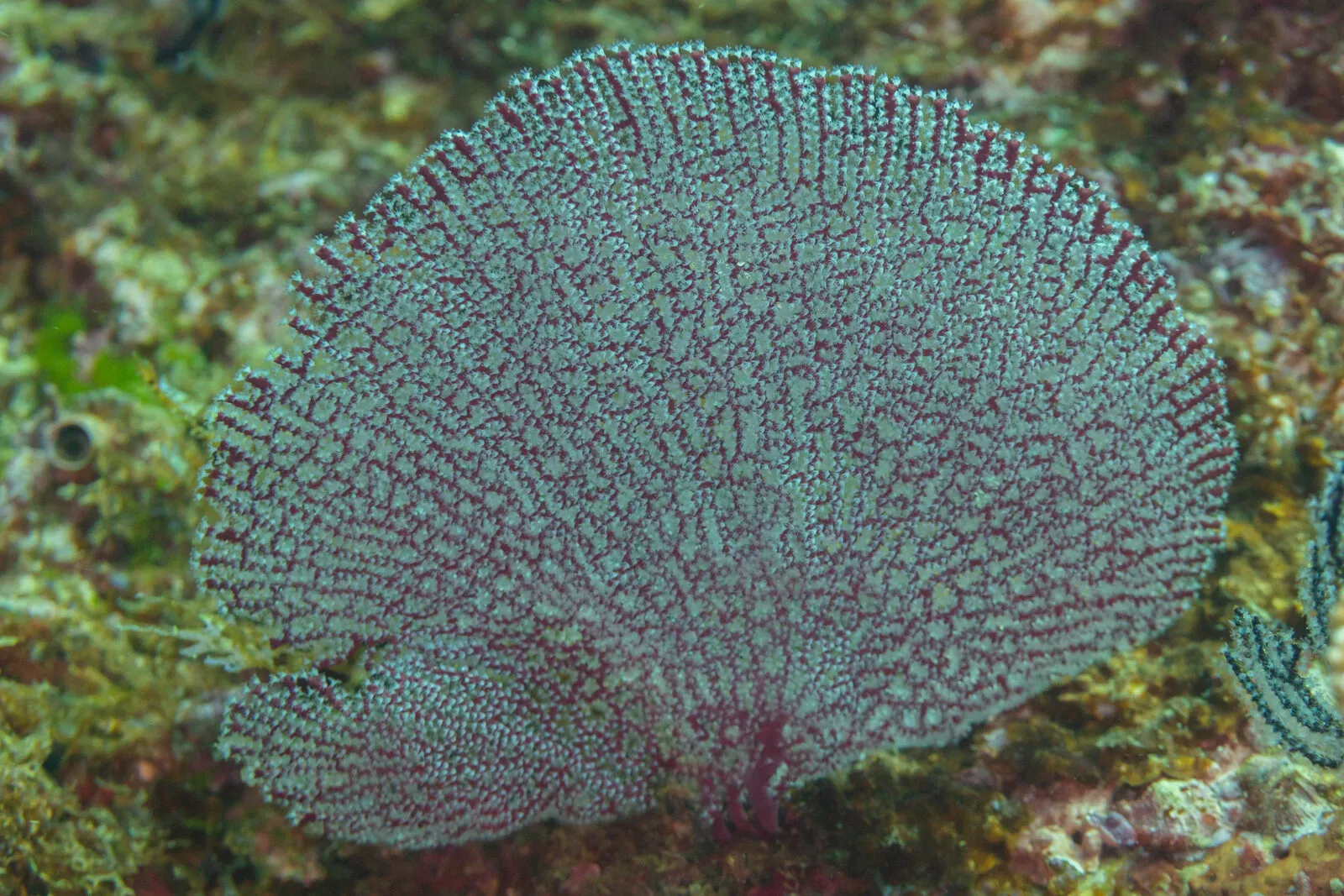
Octocorals are colonies of polyps with eight pinnate tentacles joined by a common tissue, the coenenchyme, in which calcareous sclerites are embedded.28 The sea fans in this article belong to two families: Gorgoniidae, with Eugorgia daniana, Eugorgia nobilis, Eugorgia beebei, Eugorgia rubens, Leptogorgia exigua, Leptogorgia pumila and Pacifigorgia adamsii, and Plexauridae, with Muricea fruticosa, Muricea formosa and Muricea plantaginea.452627897
The genus Eugorgia is exclusive to the eastern Pacific, from southern California to Peru, and is defined by the double discs of its sclerites.4 Eugorgia rubens was described from material from Paita, in Piura, and is also known from Costa Rica, Mexico and California.426 It is the only species of its own morphological group within the genus, with pink, sparse colonies and lateral branching.5 A colony photographed at Point Lobos, California, was at 66.5 m depth.26
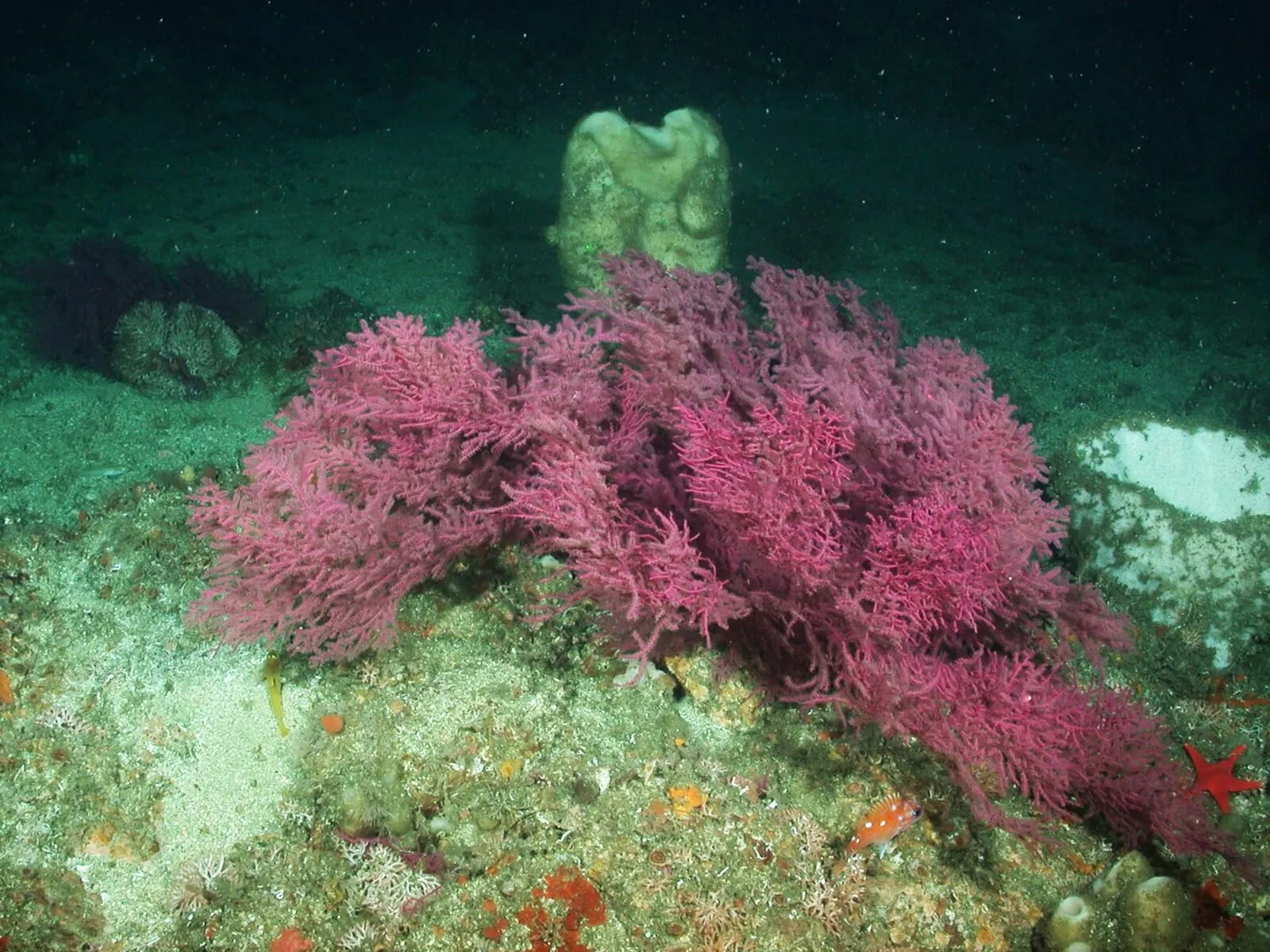

Eugorgia daniana forms bright red fans up to 25 cm high.4 Eugorgia nobilis is reddish brown and its studied colonies reach 25 cm in height.4 Eugorgia beebei, with a white colony, has no live records described in the literature.5
Muricea formosa is white and its type locality is Zorritos, in Tumbes; the material reviewed also comes from Canoas de Punta Sal, Cabo Blanco and El Ñuro, at 10–13 m depth.7 Muricea plantaginea is a fan that on the coast of Ecuador reaches 1.20–1.30 m high and is known from Mexico to Peru, between 10 and 65 m.7 Muricea fruticosa forms bushy, highly branched colonies with spiny calyces and is distributed from Mexico to Peru.7
Leptogorgia pumila is a bushy sea fan, light purple to pink, up to 10 cm high.8 Leptogorgia exigua has as its only Peruvian datum a list from 1870 that extends its range to Zorritos, with no depth or habitat.27 Pacifigorgia adamsii is a small fan, purple to golden ochre, up to 210 mm long and wide, with records published in 1868 that reach as far as Zorritos.9


Deep-water stony corals
Truncatoflabellum truncum is a solitary wedge-shaped coral that has been obtained between 595 and 1896 m, and its presence off Peru rests on a single record at 8°S.10 It belongs to the family Flabellidae, made up exclusively of azooxanthellate corals, that is, without symbiotic algae.30 Polymyces montereyensis, of the same family, has been recorded in the eastern Pacific between 69 and 212 m and between 4°S and 37°N.12 Deltocyathus parvulus is cited down to 5080 m, which makes it the deepest species of its genus.35
Of the roughly 700 known species of azooxanthellate corals, only 21 are found off Chile, and of the 23 species of Chilean scleractinians only 6 live at diving depths.10 The Chilean records of Truncatoflabellum truncum, at 950–1896 m, lie far below that depth.10 The authors of the review of ahermatypic corals note that the literature on these corals is limited by the difficulty of obtaining and observing them.12
How to identify them
The clearest case of uncertain identity is that of anemones with vesicles on the column: non-adhesive vesicles and acrorhagi identify Bunodosoma, but Phymactis and Phymanthea share them, and this has been the main cause of misidentifications.24 The anemones of Argentina that were attributed to Phymactis papillosa turned out to be a new species of Bunodosoma.21 An anemone with vesicles found on the Peruvian coast may belong to those genera and not to Bunodosoma, and they are told apart by the shape of the marginal sphincter.24
In Phymactis papillosa colour is associated with the degree of aggressiveness, and in Portugal DNA sequencing was needed to confirm the specimens.1720 In Costa Rica three colour morphotypes were distinguished within Bunodosoma grande.23 Many Peruvian anemones are recorded only as Cnidaria or Actiniaria without identification, which may have caused under-recording or errors.3
The white form of Eugorgia daniana observed in Costa Rica and Mexico was described in 2013 as a separate species, Eugorgia mutabilis.45 Before 2013 the name Eugorgia beebei existed only on a museum label, which treated the specimen as a variety of Eugorgia rubens.5 Verrill took Pacifigorgia adamsii for the juvenile form of another species, later identified as Pacifigorgia irene.9
A specimen of Eugorgia beebei from El Alto is listed with a depth of 1860–1815 m, almost certainly an error, because a curator's note indicates that it probably comes from an earlier shallow station.5 A specimen from the bay of Paracas that appeared in collections as Leptogorgia pumila does not correspond to that species.8
Where and at what depth they are recorded in Peru
Oulactis concinnata is known from Playa Las Salinas, in central Peru, to the region of Valdivia, in southern Chile, and was not found between Tumbes and the Bayóvar peninsula.1 That range falls within the Peruvian zoogeographic province, which runs from Bayóvar to the Chacao channel.1 It lives from the intertidal down to about 8 m, in water measured at between 12 and 23 °C.1
In November 2016, an assessment of the marine biodiversity of Los Chimus bay and of La Viuda and Tortuga islands saw, down to 11 m, stone blocks mostly covered by beds of Anthothoe chilensis.22 At the same place large actinians such as Phymanthea pluvia and scattered sea fans were also seen.22 For Peruvian anemones as a whole, about 55 % of the records come from rocky substrates, including exposed vertical walls, crevices, caves and areas under rocks.2
The Peruvian sea fan records gathered from these sources come from Tumbes and Piura, on the north coast.74589 Except for Muricea formosa, whose Peruvian material was collected at 10–13 m, the depth ranges are those of specimens collected in other countries: the genus Eugorgia is cited from shallow water down to about 65 m (a colony of Eugorgia rubens in California was a little deeper, at 66.5 m), and depths of 40 to 150 m, the mesophotic zone, are poorly known in the eastern Pacific.56 The deepest record of Muricea fruticosa, 102 m, comes from seamounts off Isla del Coco, and elsewhere it is found at 8 to 25 m.7
The Humboldt Current appears in the sources mainly as the setting for the spread of Anemonia alicemartinae: an ecological niche model along that marine ecosystem found that surface salinity and the annual variation of sea temperature were the variables that best explained where it lives.16 A study cited in the review of Peruvian anemones reports that, during the El Niño events of 2015 and 2017, Phymanthea pluvia sharply reduced its latitudinal range.3 The authors caution that each species' response depends on its thermal tolerance and its diet, among other factors.3 The taxonomic revisions of the sea fans describe specimens and localities, not the ecology of Peruvian populations.478
How they live: feeding, symbioses and reproduction
Oulactis concinnata swallows food by bringing its thick lips to the prey, and one individual was seen trying to swallow a whole crab, too large to fit in its gastric cavity.1 Ahermatypic corals, which do not build reefs, by contrast, generally do not need sunlight and capture plankton, which lets them live at greater depths.12 Carijoa riisei, an invasive shallow-water octocoral, is a generalist filter feeder that eats mainly phytoplankton, diatoms and zooplankton larvae.13
The porcelain crab Allopetrolisthes spinifrons lives as a symbiont of Phymactis papillosa, feeds by suspension and may ingest the mucus and faeces of its host.36 On Oulactis concinnata that same crab was seen perched on the column.1 The population of Anthothoe chilensis at Mar del Plata, in Argentina, harboured 54 macrobenthic taxa, mostly crustaceans.33
In Oulactis concinnata the sexes appear to be separate, and only one case of asexual reproduction was observed.1 It is long-lived: the same individuals were observed at the same places for 7 years.1 In Anemonia alicemartinae fission seems to be the main form of reproduction, which probably compensates for the scarcity or absence of fertile males.18
Among the corals, the genus Truncatoflabellum reproduces by transverse division, and in Truncatoflabellum truncum the scar at the base of its free phase shows that it detached asexually from a fixed anthocaulus.3010 Carijoa riisei reaches sexual maturity in a few months, grows about half a centimetre a week for several months and also reproduces vegetatively.15 For the sea fans Eugorgia daniana, Eugorgia beebei and Leptogorgia pumila, the revisions do not describe feeding or reproduction.458
Peruvian anemones have been studied for the toxins in their venom, with possible pharmaceutical and medical applications in mind.3 The only Peruvian study of the venom of Anthothoe chilensis, with 78 specimens collected off Lima, yielded a filtrate with haemolytic, phospholipase and proteolytic activity.25 Its exudate, tested against bryozoan larvae, is being studied as a possible natural alternative to antifouling paints.34
Species on the move
Anemonia alicemartinae was first recorded in northern Chile, cited as Actinia sp. in 1979, and over the last 50 years its range has spread southwards to cover more than 1900 km of coast.18 A genetic study cited in the literature suggested that the present population descends from a small ancestral population, probably from southern Peru, and that maritime transport helped its advance.17 In the laboratory it lost 80 % of its contests with an individual of green Phymactis papillosa, so its success might be explained rather by escape, asexual reproduction and high dispersal capacity.17
Phymactis papillosa has travelled much farther: a 2022 paper confirmed it with DNA at Cascais, Portugal.20 At Cabo Raso it is locally abundant and is considered confined to the rocky intertidal.19 In aquaria, survival after 14 days averaged 96.3 % at 15 °C and 87.0 % at 27 °C, and all died at 31 °C, although the authors caution that the test did not mimic tidal variation.19 In 108 contests with six native anemones it dominated three species of Actinia, so the authors propose that it could compete for space with them.19
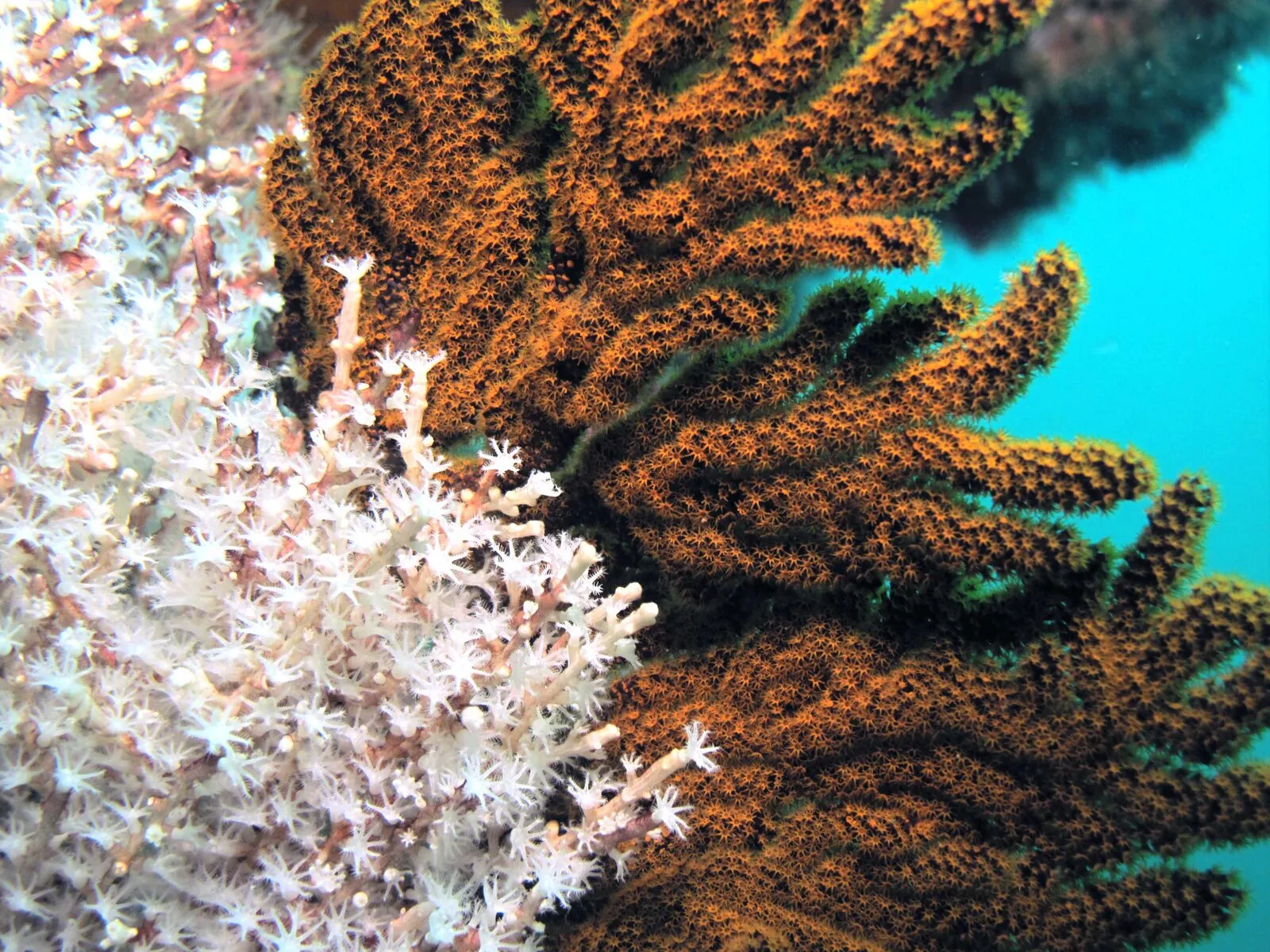
Carijoa riisei is a colonial octocoral with orange colonies and white polyps, probably native to the Indo-Pacific although described from the Atlantic and the Caribbean.1415 The sources reviewed document no record in Peru, and the nearest one they cite is from Ecuador, where it was first detected in 2010 and by 2020 had been found at 22 sites.13 At two sites on Gorgona island, in Colombia, more than 87 % of 77 marked octocoral colonies died between 2011 and 2013 through interaction with Carijoa riisei or being overgrown by it.14 It colonises rocks, caves and artificial structures, and on three Brazilian shipwrecks the areas with the octocoral had 54 macroinvertebrate taxa against 36 in adjacent areas without it.1337

Conservation status and threats
The sources read for Anemonia alicemartinae give no assessment of its threat status: they treat it as a cryptogenic, expanding species.1816 In a niche model, the areas most suitable for it were positively related to the number of ship calls, taken as a measure of human activity.16
For octocorals, the main causes of mortality are mechanical damage and some fishing gear, which tear out or weaken colonies.28 On rocky mesophotic reefs of the Chocó, in Colombia, where Muricea plantaginea was recorded, the authors note that coral gardens lack protection and that ghost fishing gear detaches colonies.31 A specimen of Eugorgia daniana from Oaxaca, from 40 to 70 m, arrived in a fishing net.4
In anemones, the Peruvian review indicates that under thermal stress the rate of detachment from the substrate rises in Anthothoe chilensis and that it seems less heat-resistant than Anemonia alicemartinae.3 Its authors suggest that it could tolerate El Niño events less well, although they warn that long-term data are lacking.3
What is still unknown
For Deltocyathus parvulus only one Chilean specimen is described, small and damaged, 6.2 mm in diameter, so those characters are not enough to describe the variation of the species.10 Truncatoflabellum truncum is said to be known only from its original description.11 The feeding and reproduction of Eugorgia daniana, Eugorgia beebei and Leptogorgia pumila are not described in the revisions consulted, and their Peruvian records depend on museum specimens.458
For anemones, the authors of the Peruvian review point to doubts about cryptic species in the group and a vertical distribution still poorly described for several species.3
The species in this article
- Oulactis concinnata
- Phymanthea pluvia
- Phymactis papillosa
- Bunodosoma grande
- Anemonia alicemartinae
- Eugorgia daniana
- Anthothoe chilensis
- Muricea fruticosa
- Eugorgia beebei
- Eugorgia rubens
- Truncatoflabellum truncum
- Polymyces montereyensis
- Carijoa riisei
- Eugorgia nobilis
- Leptogorgia exigua
- Muricea formosa
- Muricea plantaginea
- Leptogorgia pumila
- Pacifigorgia adamsii
- Deltocyathus parvulus
Sources (36)
- Häussermann, V. (2003). Redescription of Oulactis concinnata (Drayton in Dana, 1846) (Cnidaria: Anthozoa: Actiniidae), an actiniid sea anemone from Chile and Perú with special fighting tentacles; with a preliminary revision of the genera with a “frond-like” marginal ruff. Zoologische Verhandelingen 345, 173-207. repository.naturalis.nl
- Durand, A.; Valdivia-Chávez, D.; Aramayo, V. (2024). Biodiversity and distribution of sea anemones (Cnidaria, Anthozoa, Actiniaria) in Peru. Journal of the Marine Biological Association of the United Kingdom. doi.org
- Durand, A.; Valdivia-Chávez, D.; Aramayo, V. (2022). Biodiversity and distribution of sea anemones (Cnidaria, Anthozoa, Actiniaria) in Peru. bioRxiv (preprint). doi.org
- Breedy, O.; Guzman, H.M.; Vargas, S. (2009). A revision of the genus Eugorgia Verrill, 1868 (Coelenterata: Octocorallia: Gorgoniidae). Zootaxa 2151, 1-46. doi.org
- Breedy, O.; Williams, G.C.; Guzman, H.M. (2013). Two new species of gorgonian octocorals from the Tropical Eastern Pacific Biogeographic Region (Cnidaria, Anthozoa, Gorgoniidae). ZooKeys 350, 75-90. doi.org
- Breedy, O.; Guzman, H.M. (2013). A new species of the genus Eugorgia (Cnidaria: Octocorallia: Gorgoniidae) from mesophotic reefs in the eastern Pacific. Bulletin of Marine Science 89, 735-743. doi.org
- Breedy, O.; Guzman, H.M. (2016). A revision of the genus Muricea Lamouroux, 1821 (Anthozoa, Octocorallia) in the eastern Pacific. Part II. ZooKeys, 1-69. doi.org
- Breedy, O.; Guzman, H.M. (2007). A revision of the genus Leptogorgia Milne Edwards & Haime, 1857 (Coelenterata: Octocorallia: Gorgoniidae) in the eastern Pacific. Zootaxa, 1-90. doi.org
- Breedy, O.; Guzman, H.M. (2003). Octocorals from Costa Rica: The genus Pacifigorgia (Coelenterata: Octocorallia: Gorgoniidae). Zootaxa, 1-60. doi.org
- Cairns, S.D.; Häussermann, V.; Försterra, G. (2005). A review of the Scleractinia (Cnidaria: Anthozoa) of Chile, with the description of two new species. Zootaxa, 15-46. doi.org
- Cairns, S.D. (2016). A key to the genera and species of the transversely-dividing Flabellidae (Anthozoa, Scleractinia, Flabellidae), with a guide to the literature, and the description of two new species. ZooKeys, 1-48. doi.org
- Reyes-Bonilla, H.; Cruz-Piñón, G. (2000). Biogeography of the ahermatypic corals (Scleractinia) of the Mexican Pacific. Ciencias Marinas, 511-531. doi.org
- Cárdenas-Calle, M.; Pérez-Correa, J. (2021). Invasion and current distribution of the octocoral Carijoa riisei (Duchassaing & Michelotti, 1860) in the Ecuadorian coast (Eastern Tropical Pacific). Aquatic Invasions, 62-76. doi.org
- Sánchez, J.A.; Ballesteros, D. (2014). The invasive snowflake coral (Carijoa riisei) in the Tropical Eastern Pacific, Colombia. Revista de Biología Tropical, 199-207. doi.org
- Easton, E.E.; Hicks, D. (2020). Complete mitochondrial genome of Carijoa riisei (Duchassaing & Michelotti, 1860) (Octocorallia: Alcyonacea: Stolonifera: Clavulariidae). Mitochondrial DNA Part B, 1826-1827. doi.org
- Pinochet, J.; Rivera, R.; Neill, P.E.; Brante, A.; Hernández, C.E. (2019). Spread of the non-native anemone Anemonia alicemartinae Häussermann & Försterra, 2001 along the Humboldt-current large marine ecosystem: an ecological niche model approach. PeerJ, e7156. doi.org
- Brante, A.; Riera, R.; Riquelme, P. (2019). Aggressive interactions between the invasive anemone Anemonia alicemartinae and the native anemone Phymactis papillosa. Aquatic Biology, 127-136. doi.org
- López, D.N.; Arancibia, P.A.; Neill, P.E. (2013). Potential dispersal mechanisms of the cryptogenic anemone, Anemonia alicemartinae. Revista chilena de historia natural, 369-372. doi.org
- Pereira, A.M.; Teixeira, N.; Torrão, T.; Ferbus, J.; Silva, M.; Robalo, J.I. (2025). Invasive potential of Phymactis papillosa: assessing environmental tolerance and ecological impact on the Portuguese intertidal ecosystems. NeoBiota, 81-91. doi.org
- Pereira, A.M.; Silva, M.M.; Mateus, O. (2022). First record of Phymactis papillosa (Lesson, 1830), a Pacific south sea anemone in European shores. Journal of the Marine Biological Association of the United Kingdom, 350-353. doi.org
- Gomes, P.B.; Schama, R.; Solé-Cava, A.M. (2011). Molecular and morphological evidence that Phymactis papillosa from Argentina is, in fact, a new species of the genus Bunodosoma (Cnidaria: Actiniidae). Journal of the Marine Biological Association of the United Kingdom, 895-910. doi.org
- Uribe, R.; Perea, A.; García, V.; Huerto, M. (2019). Biodiversidad marina en el norcentro de la costa de Perú: un enfoque para la evaluación de planes de manejo. Boletín del Instituto del Mar del Perú 34(2), 332-350. revistas.imarpe.gob.pe
- Acuña, F.H.; Garese, A.; Excoffon, A.C.; Cortés, J. (2013). New records of sea anemones (Cnidaria: Anthozoa) from Costa Rica. Revista de biología marina y oceanografía. doi.org
- Beneti, J.S. (2018). Revisão sistemática do gênero Bunodosoma Verrill, 1899 (Cnidaria: Actiniaria: Actiniidae) e estudo de populações do Atlântico Sul. Universidade de São Paulo (tese de doutorado). doi.org
- Retuerto, F.; Arbaiza, E.; Quiroz-Garrido, Y.; Estrada, R.; Zavala, J. (2007). Actividad biológica del veneno de Anthothoe chilensis (Lesson, 1830) (Actiniaria: Sagartiidae). Revista Peruana de Biología, 277-282. doi.org
- Horvath, E.A. (2019). A review of gorgonian coral species (Cnidaria, Octocorallia, Alcyonacea) held in the Santa Barbara Museum of Natural History research collection: focus on species from Scleraxonia, Holaxonia, Calcaxonia – Part II: Species of Holaxonia, families Gorgoniidae and Plexauridae. ZooKeys 860. doi.org
- Verrill, A.E. (1870). Notes on Radiata in the Museum of Yale College, with descriptions of new genera and species. No. 6. Review of the corals and polyps of the west coast of America. Transactions of the Connecticut Academy of Arts and Sciences 1, 377-558. archive.org
- Breedy, O.; Cortés, J. (2015). Gorgonias (Octocorallia: Gorgoniidae) de las aguas someras del Pacífico Norte de Costa Rica. Revista de Biología Tropical, 43-62. doi.org
- Cuya, A.; Escobar, E. (2017). Estudio bioquímico del veneno de la anémona de mar Phymactis papillosa (Actiniidae). Revista Peruana de Biología, 303-310. doi.org
- Kitahara, M.V.; Cairns, S.D.; Stolarski, J.; Blair, D.; Miller, D.J. (2010). A Comprehensive Phylogenetic Analysis of the Scleractinia (Cnidaria, Anthozoa) Based on Mitochondrial CO1 Sequence Data. PLoS ONE, e11490. doi.org
- Mejía-Quintero, K.; Chasqui, L. (2020). Octocorals and Antipatharians in the Mesophotic Rocky Reefs of Colombian Pacific (Eastern Tropical Pacific). Frontiers in Marine Science. doi.org
- Excoffon, A.C.; Genzano, G.; Zamponi, M. (1999). Macrobenthos associated with a population of Anthothoe chilensis (Lesson, 1830) (Cnidaria, Actiniaria) in Mar del Plata Harbor, Argentina. Ciencias Marinas, 177-191. doi.org
- Pinochet, J.; Placencia, R.; Brante, A. (2025). Chemical arsenal of sea anemones: antifouling effects on bryozoan larvae and interspecific interactions. Biofouling, 33-41. doi.org
- Bribiesca-Contreras, G.; Santodomingo, N.; Kitahara, M.V.; Simon-Lledó, E.; Fleming, B.F.M.; Dahlgren, T.G.; Jones, D.O.B.; Wiklund, H.; Glover, A.G. (2025). Hidden gems of the abyss: first species of azooxanthellate scleractinian coral (Scleractinia: Deltocyathidae) attached to polymetallic nodules in the eastern Pacific Ocean. Zoological Journal of the Linnean Society. doi.org
- Valdivia, N.; Stotz, W.B. (2006). Feeding Behavior of the Porcellanid Crab Allopetrolisthes Spinifrons, Symbiont of the Sea Anemone Phymactis Papillosa. Journal of Crustacean Biology, 308-315. doi.org
- de Pádua, S.M.F.; Botter-Carvalho, M.L. (2021). The alien octocoral Carijoa riisei is a biogenic substrate multiplier in artificial Brazilian shipwrecks. Aquatic Ecology, 183-200. doi.org