
Blog · wildlife of Peru · subgroup
Hammerhead, blue and requiem sharks of Peru: the order Carcharhiniformes
Thirty-six species of sharks of the order Carcharhiniformes appear in the species accounts of the ORKA guide for the Peruvian sea, from the open-ocean blue shark to catsharks that live hundreds of metres down. Some are the most landed in the country and others are barely known.
Published

What this group is
The order Carcharhiniformes brings together the best-known shark families of the Peruvian sea: the requiem sharks (Carcharhinidae), the hammerheads (Sphyrnidae), the houndsharks (Triakidae) and the catsharks (Scyliorhinidae and related families).1234 The tiger shark belongs to a family of its own, Galeocerdonidae, and the catshark mentioned here, Schroederichthys bivius, now sits in Atelomycteridae.56 The updated checklist of chondrichthyans of the Peruvian sea, published in 2015, includes 115 species, six of them in the genus Sphyrna.7 Six species of Mustelus have been recorded in Peru.7
Here we use descriptive Spanish names and treat as used in Peru only those we cite, such as «tiburón martillo», which appears in the rule that regulates its fishery, and «tollo», the category under which several Mustelus are sold in the markets.89 When a species has no cited Peruvian name, we call it by its scientific name.1
Requiem sharks: from the shore to the open sea
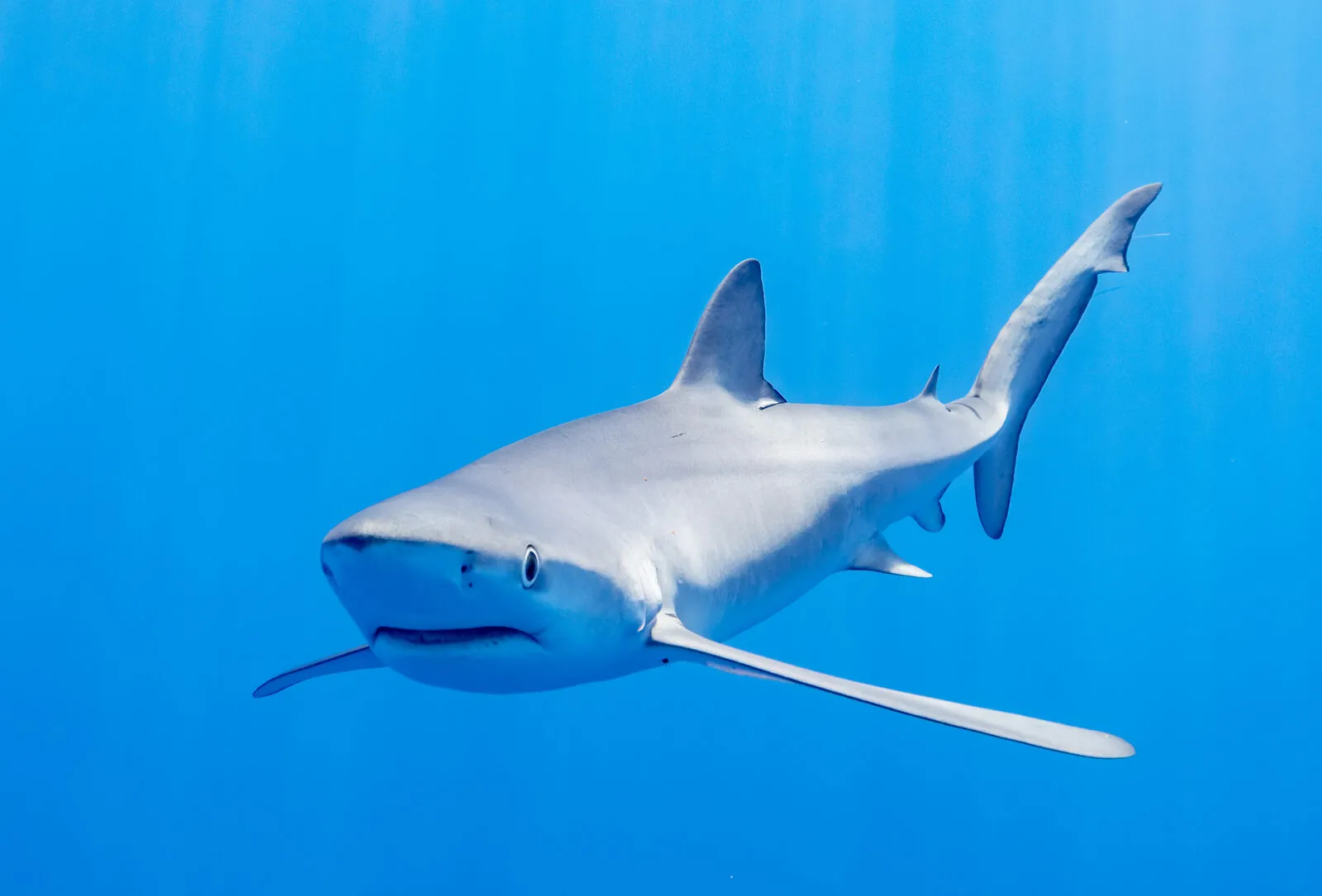
The blue shark (Prionace glauca) is the most landed shark in Peru: between 1996 and 2010 it made up 42 % of shark landings.10 It is a slender, oceanic, epipelagic shark, blue above and white below, recorded from the surface to at least 152 m, and it prefers relatively cold water, 7 to 16 °C.11 In Peru, 45 % of what was landed in that period came ashore at southern ports.10 Its global category on the IUCN Red List is Near Threatened.12
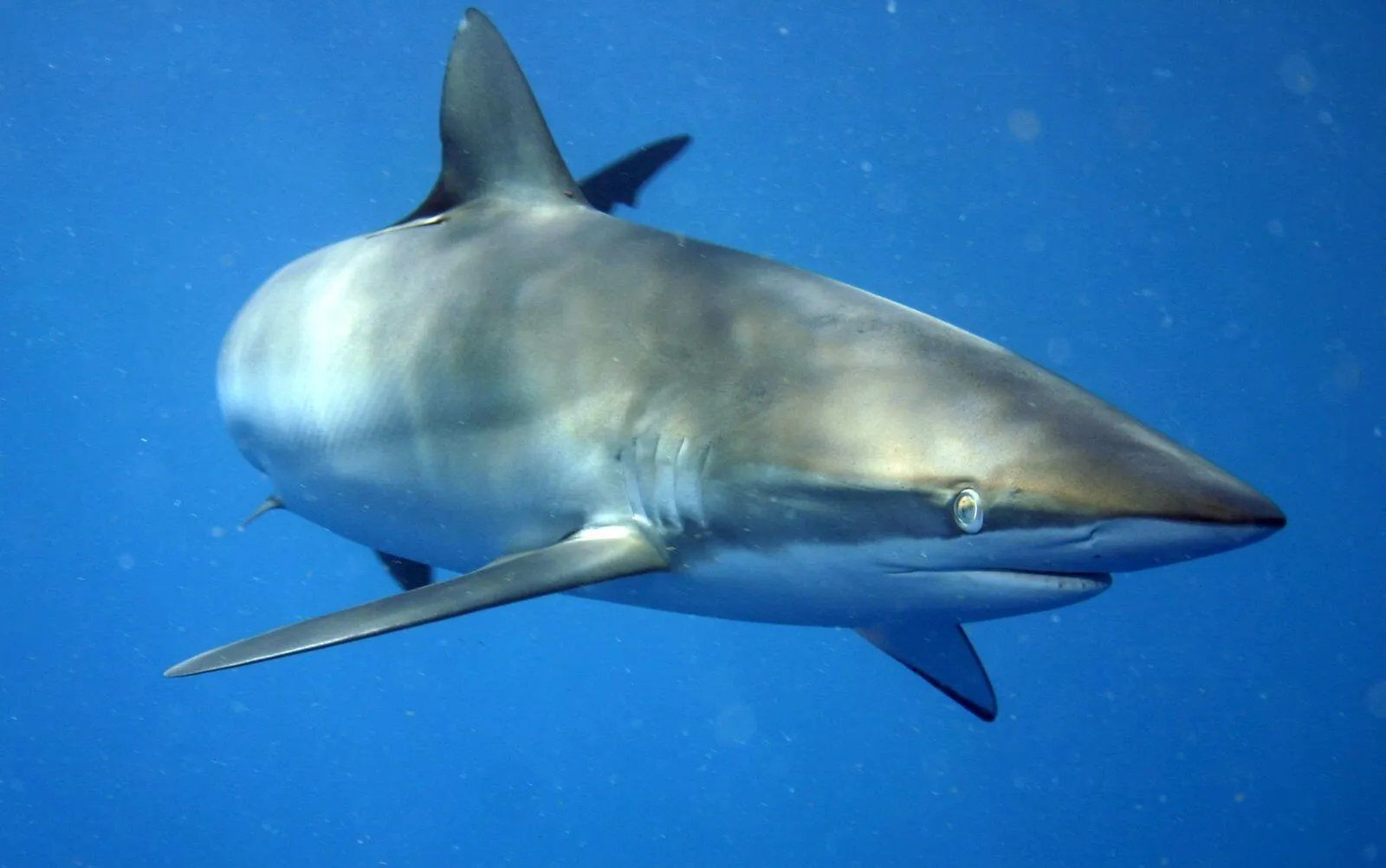
Carcharhinus longimanus can be recognised from afar by its long, broad pectoral fins, its tall, rounded first dorsal fin and the white tips of its fins; it lives in tropical and warm temperate waters worldwide and prefers water above 20 °C.11 It was once one of the three most abundant oceanic sharks, but its global category is now Critically Endangered.1113 Carcharhinus falciformis, the silky shark, is grey and slender, both oceanic and coastal, and has been recorded from the surface to at least 500 m in the open sea.11 Its global category is Vulnerable, and a genetic study of 628 specimens from 11 regions found significant population structure among all of them, which does not fit treating it as a single stock in each regional tuna fisheries organisation.1415

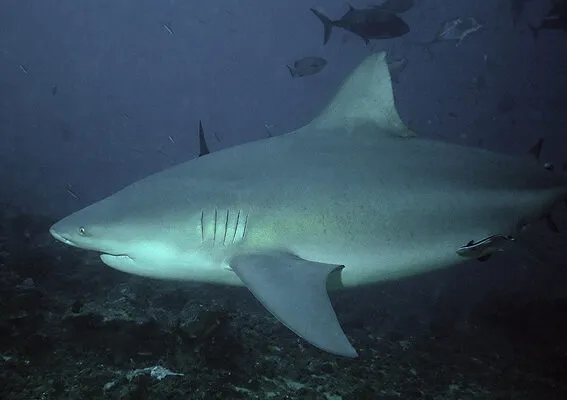
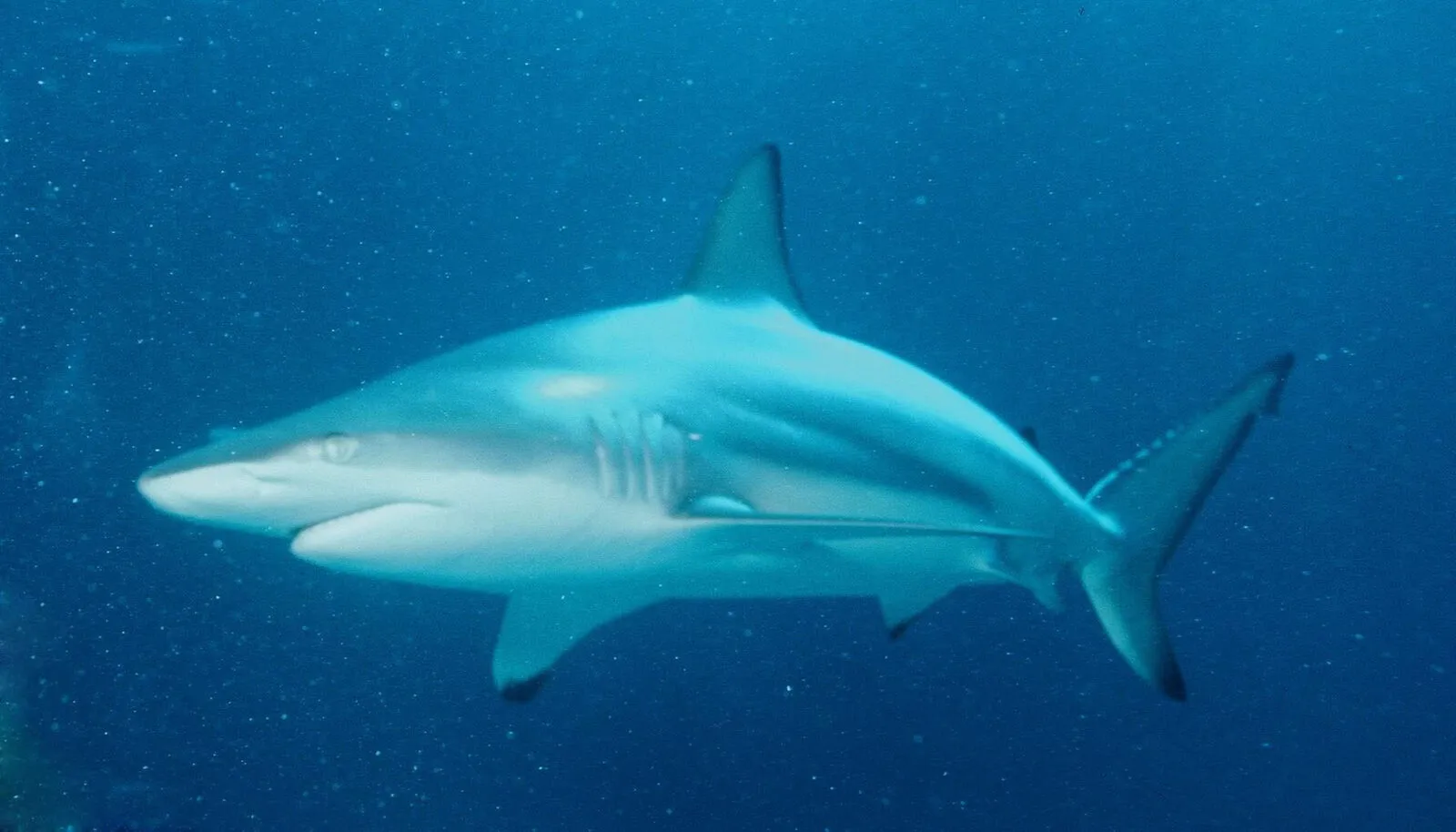
Nearer the shore, Carcharhinus leucas reaches 4 m and more than 300 kg, lives mostly in coastal waters and tolerates very low salinity, so it ascends rivers and lakes; in the Amazon it has been found some 4000 km from the coast.16 Carcharhinus limbatus is a stout, grey shark of coastal tropical and subtropical waters, about 255 cm long, told by the black tips of most of its fins; in the eastern Pacific its range reaches Peru.17 Both are listed as Vulnerable.1819 Negaprion brevirostris is a coastal shark of tropical shelves whose pups spend their first years in shallow, mangrove-fringed lagoons; the Peruvian checklist includes it for the north of the country, based only on a work from 2001.20217 Carcharhinus brachyurus reaches about 292 cm, lives from the surf zone to at least 100 m and in Peru it is not fished on purpose but caught incidentally.1122


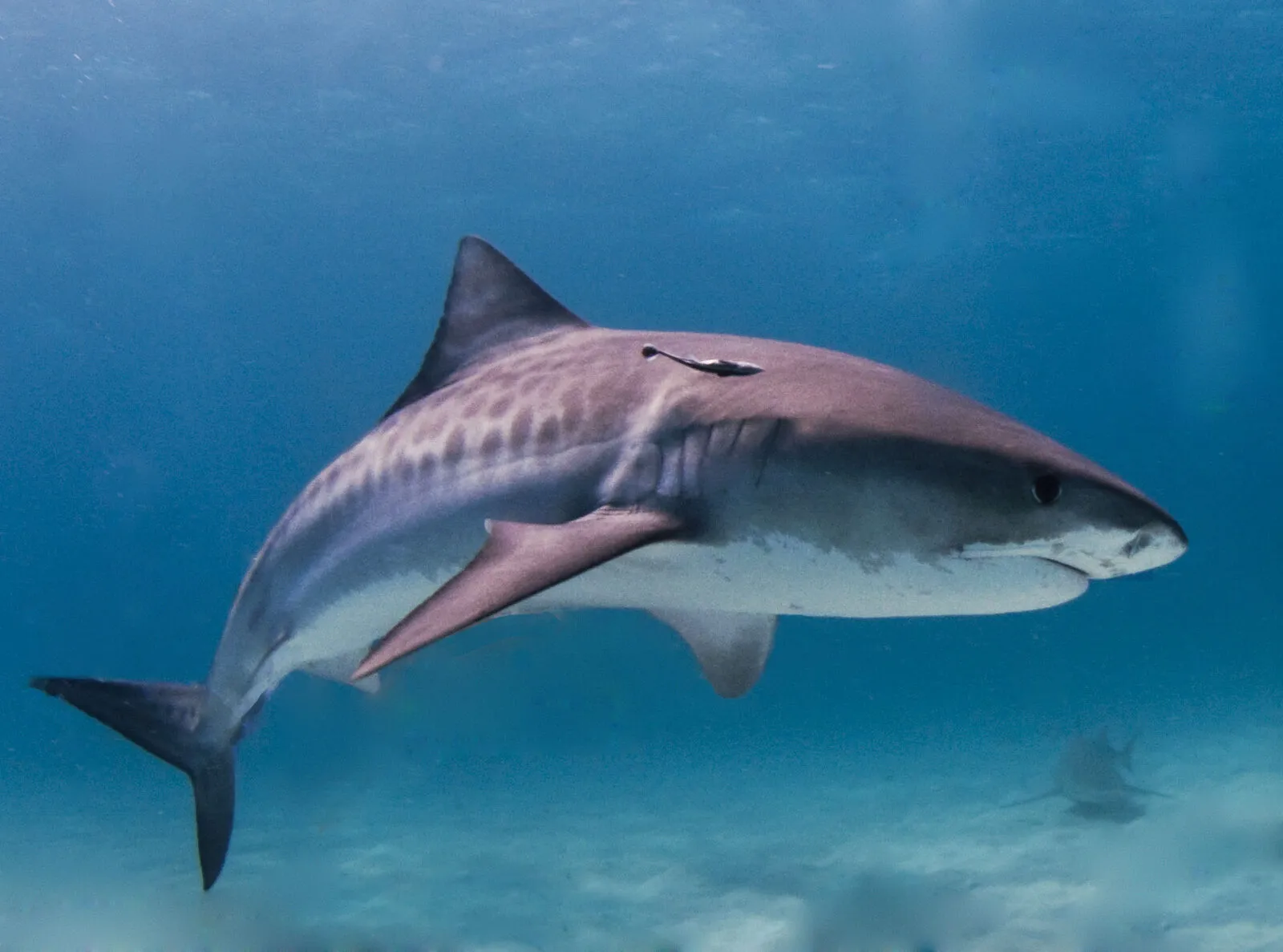
Carcharhinus altimus is a slender, grey shark of up to about 2.8 m that lives mostly in deep water along the edges of the continental shelves; its global category is Near Threatened.1723 Carcharhinus galapagensis is tied to oceanic islands and seamounts, and in the eastern Pacific it has been placed mostly shallower than 80 m; its global category is Least Concern.242526 Galeocerdo cuvier, the tiger shark, is a large predator with a broad diet, both coastal and open-sea; individuals of up to 464 cm have been measured in Hawaii, and its global category is Near Threatened.272829 Carcharhinus obscurus, about 370 cm long, matures very late, at about 19 years in males and 21 in females in the northwestern Atlantic, and it is not in the updated checklist of Peruvian chondrichthyans.11307
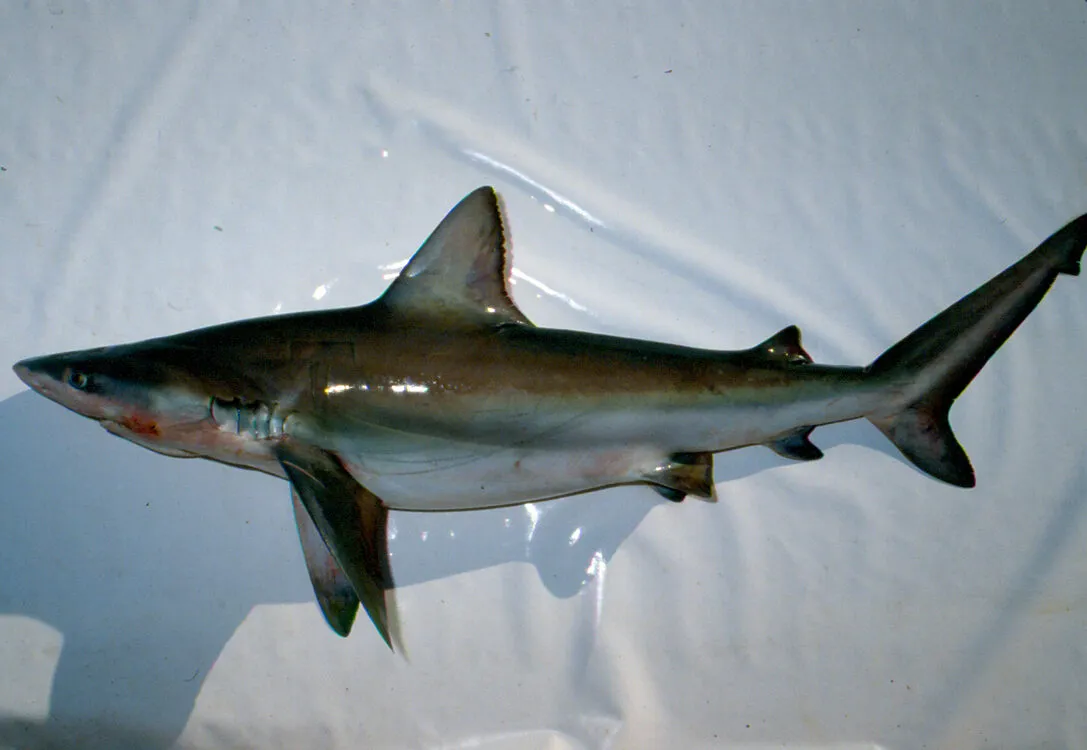


Rhizoprionodon longurio is the only member of its genus in the tropical eastern Pacific, has a particularly long snout and lives over the shelf from the intertidal zone to at least 27 m; its global category is Vulnerable.311132 Carcharhinus cerdale was recognised again as a distinct Pacific species in 2011, which is why much of the literature, the Peruvian included, still calls it Carcharhinus porosus; its global category is Critically Endangered.33734 Nasolamia velox is slender, with a long, conical snout, at least 150 cm long, and its range reaches Peru.11
The hammerheads
Hammerheads are the most striking group: of the six Sphyrna species on the Peruvian list, four appear here as Critically Endangered and one as Vulnerable.73536373839 Sphyrna zygaena was the third most landed shark in the country between 1996 and 2010, with 15 % of the total.10 It is the «tiburón martillo» of the rule that regulates its fishery, and its global category is Vulnerable.839
Off northern Peru, Sphyrna zygaena behaves as a top predator that eats mostly squid.40 Between December 2012 and June 2015, 485 stomachs were examined from sharks of 53 to 294 cm landed at seven ports, from Zorritos to Salaverry, and the calculated trophic position was 4.3.40 Cephalopods occurred in 89 % of stomachs on average, and the Patagonian squid Doryteuthis gahi (37 % of the index of relative importance) and the jumbo squid Dosidicus gigas (27 %) together made up more than 60 % of the diet.40 Neonates and small juveniles eat coastal prey and larger individuals eat oceanic prey, which suggests that the young live near the coast and the large ones move into oceanic water.40
Sphyrna lewini is probably the most abundant hammerhead in the world, coastal and semi-oceanic, and its global category is Critically Endangered because its worldwide population has probably fallen by more than 80 %.1141 Its southern limit in the eastern Pacific has been placed in northern Peru.42 At Manta, Ecuador, the stomachs of 116 sharks held mostly squids of the genus Histioteuthis (22.7 % of the index) and jumbo squid (21.9 %), which shows it as a hunter of open-ocean prey.42 In the Galapagos, hammerheads fitted with transmitters spent more time at the southeastern corner of Wolf Island, the same spot where censuses found the most tunas, jacks and other species.43
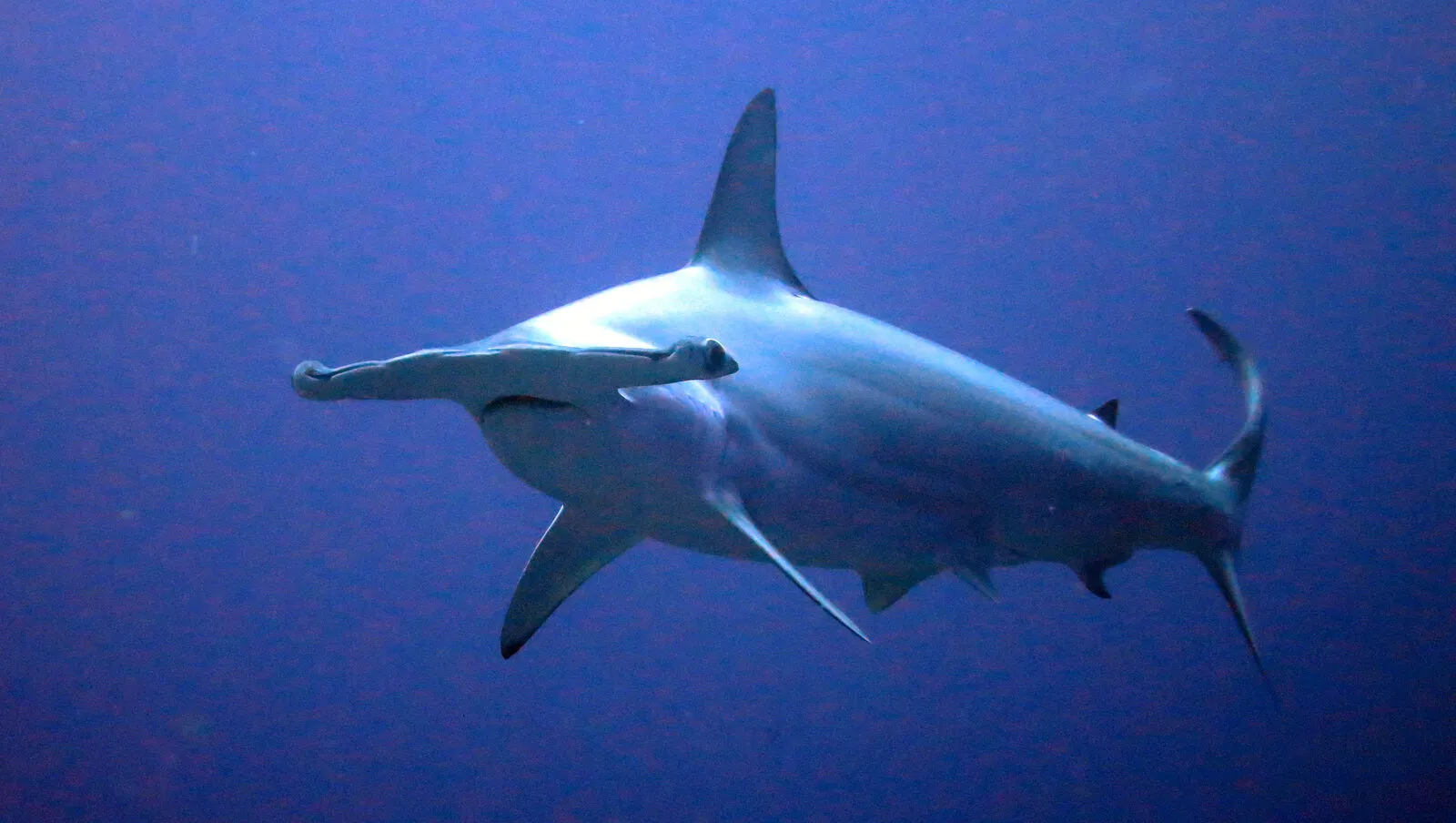

Sphyrna mokarran is the largest hammerhead, told by its tall, sickle-shaped dorsal fin and very wide head, and its range reaches northern Peru.4411 Sphyrna corona is one of the smallest hammerheads, lives on the shelf from southern Mexico to Peru and feeds mostly on crustaceans.1145 Sphyrna media, about 150 cm at most, is on the Peruvian list with a locality at Puerto Pizarro, Tumbes.117 Sphyrna zygaena, Sphyrna lewini and Sphyrna mokarran are on CITES Appendix II.10
Houndsharks: the Triakidae
Mustelus whitneyi is a bottom shark, plain grey and unspotted, of the Southeast Pacific shelf between Peru and southern Chile.11 It is one of the six most landed shark species in Peru, and between 1996 and 2010, 99 % of what reached the seven main ports came ashore at the northern ones: Talara, Paita and San José.10 Its global category is Critically Endangered.46
The problem is that in Peruvian markets the different Mustelus are sold together as tollos and official statistics treat the tollo as a single species.9 In 2019, DNA barcoding showed that, of 8 samples of this group taken in Piura and Tumbes, 6 were Mustelus whitneyi and 2 were Mustelus lunulatus, a species absent from the statistics.9 Mustelus lunulatus is now listed as Near Threatened.47 Mustelus mento, endemic to the Southeast Pacific between northern Peru and south-central Chile, has flattened, molar-like teeth and many white spots, and its global category is Critically Endangered.481149 Mustelus dorsalis, 64 cm at most, is a small, little-known shark of tropical bottoms, Vulnerable.1150 Mustelus henlei is bronzy and unspotted, with adults of 52 to 90 cm, and its global category is Least Concern.1151
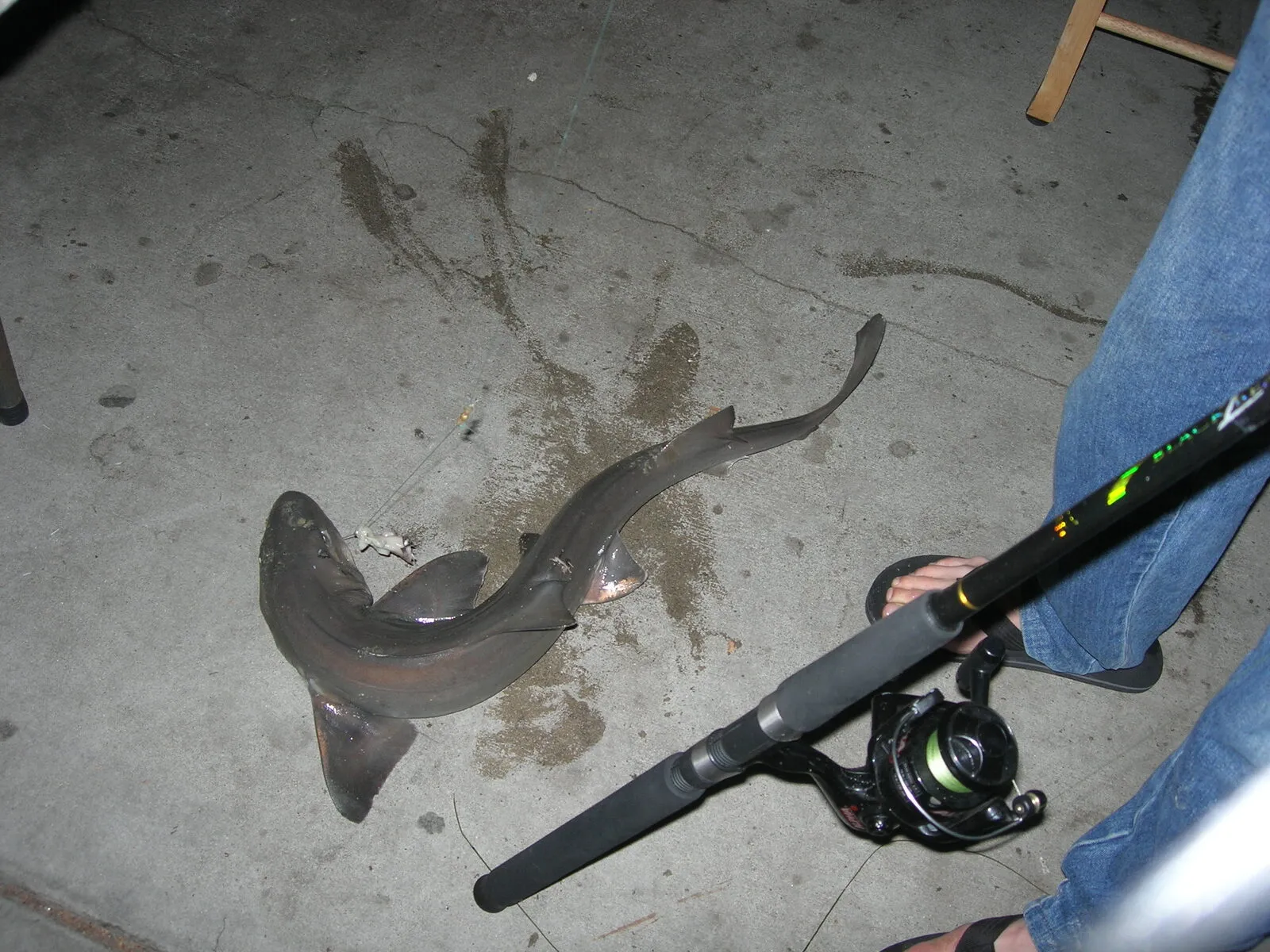

Galeorhinus galeus is slender and long-snouted, reaches 195 cm and lives in temperate waters of several oceans, including the coasts of Peru and Chile; its global category is Critically Endangered.1152 Triakis maculata is heavy-bodied and usually dotted with small black spots; it lives from Peru to northern Chile and also in the Galapagos, and its global category is Critically Endangered.1153 In Lambayeque it is caught with bottom gillnets in coastal waters, and in winter it is also taken in the nets aimed at Mustelus.54
Catsharks: rocky bottoms and deep water
Schroederichthys chilensis is a small species, endemic to Peru and Chile, of shallow rocky bottoms; its range runs from Ancón, in Peru, to Chiloé, in Chile.55 It lays eggs in tendril-bearing capsules that wind around kelp, and development inside the capsule lasts about 211 days.5657 Its global category is Least Concern.58 Schroederichthys bivius, by contrast, has been measured on the Argentine Patagonian shelf, up to 82 cm, and the source we use gives it for southern Brazil, Argentina and Chile, with no mention of Peru.59
Cephaloscyllium ventriosum is a reclusive catshark that rests in crevices by day and ambushes its prey at night, found only in the eastern Pacific, and it reaches more than 360 m deep.60 The Peruvian list includes it on the basis of a work from 2001, and its global category is Least Concern.761
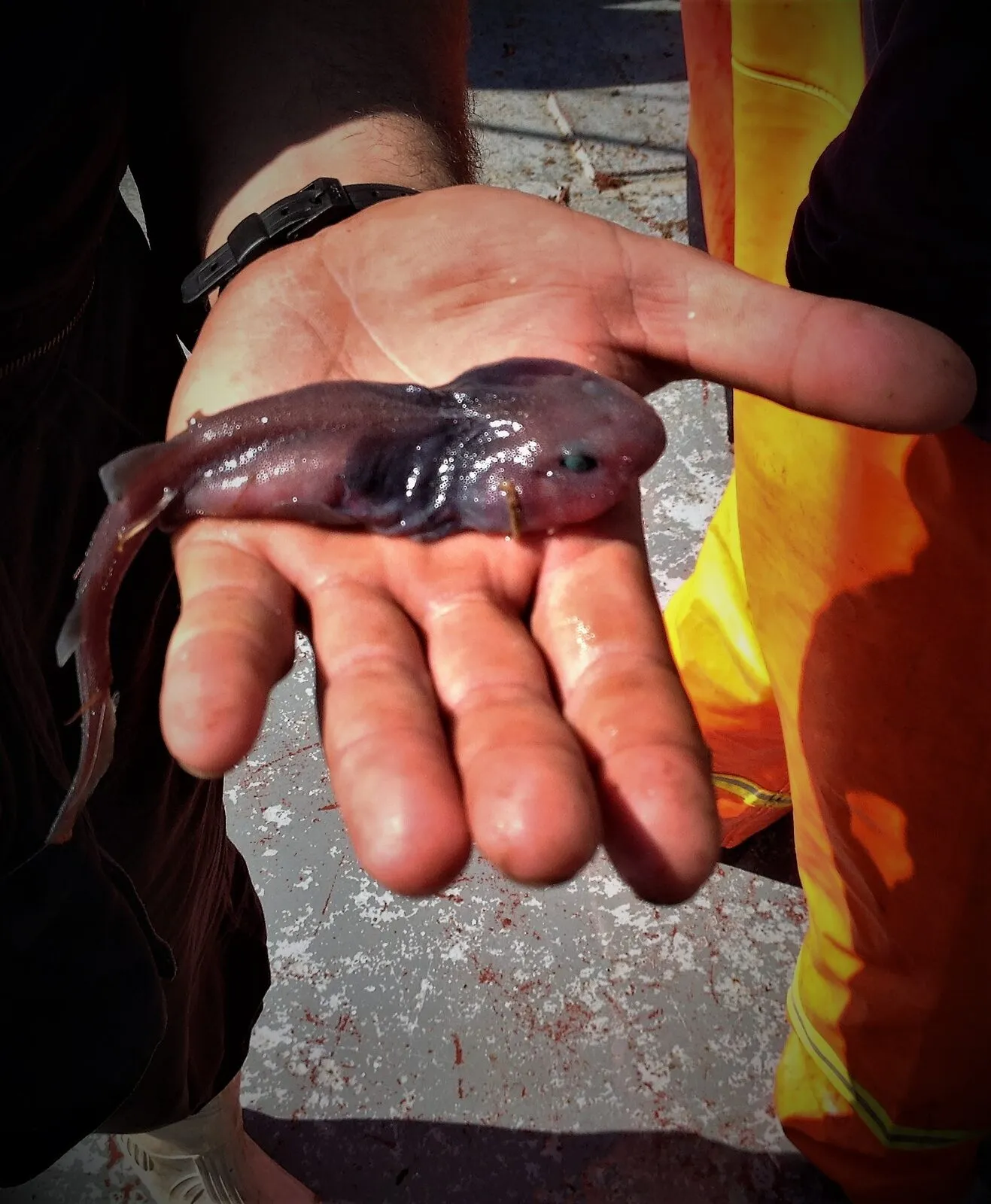
Cephalurus cephalus, tadpole-shaped, lives at 155 to 937 m from Baja California to northern Chile and is rare in catches.62 Bythaelurus canescens lives on the Southeast Pacific slope at 250 to 700 m, from southern Peru to the Strait of Magellan; in Chile it is discarded as bycatch in the squat lobster and nylon shrimp fisheries, and its global category is Vulnerable.6364 Apristurus nasutus is known from the Gulf of Panama to central Chile and is taken as bycatch in the deep-water longline fishery for Patagonian toothfish off Chile.65 Apristurus brunneus is common on the outer shelf from British Columbia to California and the literature places it perhaps as far as Peru, whereas the specimens of Apristurus kampae studied range from 42° N, in California, to 28° N, in the Gulf of California, and the Peruvian list includes it on the basis of earlier works.66677 Galeus piperatus is tiny, with females mature from about 30 cm, and was described in 1966 from the Gulf of California.68

Telling them apart
Among the hammerheads, the shape of the front edge of the head separates two species that are mixed up at the ports: Sphyrna zygaena has a broad arch with no central notch at any age, whereas Sphyrna lewini has a well-marked notch in the centre.6911 In addition, the free tip of the second dorsal fin of Sphyrna lewini reaches almost to the origin of the caudal fin.69
Among the houndsharks, teeth and spots help on paper: Mustelus whitneyi is plain grey with no white or dark dots and no bars, Mustelus mento carries many white spots and Triakis maculata is usually dotted with small black spots.111111 In practice it is harder: Mustelus sharks look very much alike and their characters partly overlap, so even specialists find them hard to tell apart.9 In houndsharks landed in 2018 and 2019, a key recognised Triakis maculata by its black spots, but juvenile fin measurements did not tell it apart from Mustelus whitneyi.70
Landing complicates the work: sharks tend to reach port headless and cut at different points along the trunk.70 Since 2016, every shark landed in Peru must keep its head and all its fins wholly or partly attached to the body.71
Nurseries, diet and movements
Off northern Peru, what Sphyrna zygaena eats suggests that the young live near the coast.40 Sphyrna zygaena is viviparous, with 29 to 37 pups per litter, born at 50 to 61 cm, and it matures at around 210 to 240 cm.69 In landings at Pacasmayo and Salaverry between March and September 2022, no individual exceeded 200 cm, 92 % were neonates of 50 to 70 cm or juveniles of 71 to 150 cm, and the authors estimated a natural mortality of 0.46 per year, higher than the values of 0.23 to 0.39 published earlier.72 Between 1991 and 2000, 97 % of the individuals landed at San José had not yet reached sexual maturity.10
Three northern nursery areas, Máncora, San José and Salaverry, were compared in juveniles of Sphyrna zygaena of 70 to 120 cm caught incidentally in 2019.73 Their trophic niches differed significantly, although the isotopic niches overlapped by more than 60 %, and the Salaverry juveniles appeared to feed in more oceanic water than those from San José.73
Among the requiem sharks, Carcharhinus longimanus is viviparous with a placenta, with litters of 1 to 15 young and a gestation of about a year, and the pups measure 60 to 65 cm at birth.11 It eats mainly open-sea bony fishes and cephalopods, and groups have been seen cruising with open mouths through schools of small tunas chasing sardines at the surface.11 Galeorhinus galeus, by contrast, moves in small groups that make long migrations: a mature female tagged in UK waters was recaptured 3900 km away.1174
Among the houndsharks, Mustelus whitneyi is a placental live-bearer, with litters of 6 to 18 embryos, births in September and a gestation of at least seven months, according to a study in northern Peru.75 Mustelus mento forms no placenta, has litters of 4 to 12 pups and an estimated gestation of about a year, according to a study of sharks landed at Antofagasta, in northern Chile.48 Monthly landings of Mustelus whitneyi in Peru showed a weak but significant relationship with the multivariate El Niño index.10
Fisheries in Peru and conservation status
A 61-year analysis of the Peruvian shark fishery says that, according to the government, no shark species in Peruvian waters is listed as threatened, so none has legal protection and their capture, transport and export are authorised.10 Ministerial Resolution 209-2001-PE sets minimum landing sizes: 60 cm for Mustelus whitneyi and Mustelus mento, with a tolerance of 20 % of smaller individuals, and 150 cm for the genus Carcharhinus, with a tolerance of 15 %.104822 For Carcharhinus altimus, that size lies below the sizes at maturity (226 cm for females and 216 cm for males), and the authors point out that such a rule leaves the fishery on adults open and unregulated.10
The blue shark has a minimum landing size of 160 cm, but it has not been fully enforced and many fishers are unaware of it.76 In the Ilo fishery, on average 71.1 % of the blue sharks measured in the shark season were below that size.76
The hammerhead has its own management rule.8 Since 2016 its fishery has been allowed from 11 March to 31 December and banned from 1 January to 10 March, and that year the catch limit for the artisanal fleet was 482 t.8 For 2026 the limit is 444 t, sharks must be landed with their fins attached and, since July 2026, those caught incidentally in gillnets during the closure may be landed, up to 10 % of the catch of each fishing trip.77 Its listing in CITES Appendix II, in force since September 2014, requires Peru to regulate and control its international trade.4010
For Carcharhinus longimanus, Ministerial Resolution 207-2020-PRODUCE, which applied the measures of the Inter-American Tropical Tuna Commission, forbade vessels registered with it to catch, retain, land or store individuals from the Convention Area.78 Catches of Carcharhinus longimanus in the eastern Pacific tuna purse-seine fishery fell to levels that match a population decline of 80 to 95 %.79 Galeorhinus galeus has been in Appendix II of the Convention on Migratory Species since 2020, and Carcharhinus falciformis is in CITES Appendix II and in Appendix II of that same convention.8015 The fins of Carcharhinus leucas are sold in Hong Kong under a trade name of their own, at an estimated share of no less than 1.8 % to 2.6 % of that market between October 1999 and March 2001.81 The large fins of hammerheads are highly sought after by the fin trade, which is considered a major driver of the worldwide decline of sharks.44
What is still unknown
Triakis acutipinna is known with certainty only from one specimen, a 102 cm female caught near Isla de la Plata, Ecuador, and its presence in Peru has not been verified.82 Galeus piperatus has been found in the northern Gulf of California, between 130 and 550 m.83 The authors of the Peruvian checklist also warn that misidentifications at ports are common and probably reflected in official reports.7
The FAO catalogue gave Mustelus mento a maximum of 130 cm and a size at maturity of 86 to 90 cm in females, but between 2021 and 2023 females of up to 159.3 cm were measured at Antofagasta and the size at which half of the females are mature turned out to be 53.6 cm.1148 For Mustelus whitneyi, FAO gave adults of 68 to 87 cm, but pregnant females of up to 118 cm have been measured in northern Peru.1175 Of the largest Carcharhinus longimanus measured, a 2024 review gives 350 cm and considers that the 395 cm figure was never confirmed.79
Landings of Sphyrna zygaena in northern Peru indicate a lack of adult specimens.72 And because tollos are counted as one species, we do not know how much of each Mustelus the country catches.9
The species in this article
- Sphyrna zygaena
- Sphyrna lewini
- Mustelus whitneyi
- Galeorhinus galeus
- Mustelus mento
- Triakis maculata
- Carcharhinus longimanus
- Mustelus dorsalis
- Rhizoprionodon longurio
- Carcharhinus cerdale
- Sphyrna corona
- Sphyrna media
- Sphyrna mokarran
- Carcharhinus brachyurus
- Carcharhinus falciformis
- Prionace glauca
- Mustelus lunulatus
- Schroederichthys chilensis
- Cephalurus cephalus
- Bythaelurus canescens
- Carcharhinus leucas
- Carcharhinus limbatus
- Negaprion brevirostris
- Mustelus henlei
- Galeocerdo cuvier
- Apristurus brunneus
- Carcharhinus altimus
- Carcharhinus galapagensis
- Cephaloscyllium ventriosum
- Nasolamia velox
- Apristurus kampae
- Carcharhinus obscurus
- Schroederichthys bivius
- Triakis acutipinna
- Apristurus nasutus
- Galeus piperatus
Sources (83)
- WoRMS Editorial Board (2026). Sphyrna zygaena (Linnaeus, 1758). World Register of Marine Species. marinespecies.org
- Froese, R. & Pauly, D. (2026). Mustelus whitneyi Chirichigno F., 1973. World Register of Marine Species. marinespecies.org
- WoRMS Editorial Board (2026). Carcharhinus longimanus (Poey, 1861). World Register of Marine Species. marinespecies.org
- WoRMS Editorial Board (2026). Apristurus brunneus (Gilbert, 1892). World Register of Marine Species. marinespecies.org
- WoRMS Editorial Board (2026). Galeocerdo cuvier (Péron & Lesueur, 1822). World Register of Marine Species. marinespecies.org
- WoRMS Editorial Board (2026). Schroederichthys bivius (Müller & Henle, 1838). World Register of Marine Species. marinespecies.org
- Cornejo, R. et al. (2015). An updated checklist of Chondrichthyes from the southeast Pacific off Peru. Check List. 1809. doi.org
- Ministerio de la Producción (2016). Resolución Ministerial N.° 008-2016-PRODUCE: Establecen temporada de pesca del recurso tiburón martillo a nivel nacional. El Peruano (15-01-2016), Normas Legales, p. 575501; copia en FAOLEX. faolex.fao.org
- Marín, A. et al. (2021). DNA barcoding reveals overlooked shark and bony fish species in landing reports of small-scale fisheries from northern Peru. Marine and Fishery Sciences. 307-314. doi.org
- Gonzalez-Pestana, A., Kouri J., C. & Velez-Zuazo, X. (2016). Shark fisheries in the Southeast Pacific: A 61-year analysis from Peru. F1000Research. 164. doi.org
- Compagno, L.J.V. (1984). FAO species catalogue Vol. 4. Sharks of the world. An annotated and illustrated catalogue of shark species known to date. Part 2. Carcharhiniformes. FAO Fisheries Synopsis No. 125, Vol. 4, Part 2. FAO, Rome. fao.org
- Rigby, C.L. et al. (2018). Prionace glauca. The IUCN Red List of Threatened Species 2019: e.T39381A2915850. doi.org
- Rigby, C.L. et al. (2018). Carcharhinus longimanus. The IUCN Red List of Threatened Species 2019: e.T39374A2911619. doi.org
- Rigby, C.L. et al. (2017). Carcharhinus falciformis. The IUCN Red List of Threatened Species 2021: e.T39370A205782570. doi.org
- Kraft, D.W. et al. (2025). Global stock structure of the Silky shark (Carcharhinus falciformis, Carcharhinidae) assessed with high-throughput DNA sequencing. PeerJ. e19493. doi.org
- Castellanos-Galindo, G.A., Robertson, D.R. & Bravo, V. (2026). First Confirmed Record of a Bull Shark in Lake Gatun, the Freshwater Body of the Panama Canal. Ecology and Evolution. e73114. doi.org
- Compagno, L.J.V. (1984). FAO species catalogue. Vol. 4. Sharks of the world. An annotated and illustrated catalogue of shark species known to date. Part 2. Carcharhiniformes. FAO Fisheries Synopsis No. 125, Vol. 4, Part 2. FAO, Rome. fao.org
- Rigby, C.L. et al. (2021). Carcharhinus leucas. The IUCN Red List of Threatened Species 2021: e.T39372A2910670. doi.org
- Rigby, C.L. et al. (2020). Carcharhinus limbatus. The IUCN Red List of Threatened Species 2021: e.T3851A2870736. doi.org
- Compagno, L.J.V. (1984). FAO species catalogue. Vol. 4. Sharks of the world. An annotated and illustrated catalogue of shark species known to date. Part 2. Carcharhiniformes. FAO Fisheries Synopsis No. 125, Vol. 4, Part 2. FAO, Rome. fao.org
- Tavares, R., Rodriguez, J.P. & Morales, M. (2016). Nursery area and size structure of the lemon shark population, Negaprion brevirostris (Poey, 1868), in Los Roques Archipelago National Park, Venezuela. Universitas Scientiarum. 33-52. doi.org
- Ministerio del Ambiente (MINAM) (2025). Dictamen de Extracción No Perjudicial (DENP) de aletas de tiburón mantequero (Carcharhinus brachyurus) en el Perú - 2025. Ministerio del Ambiente, Dirección General de Diversidad Biológica, Autoridad Científica CITES-Perú, Lima. cdn.www.gob.pe
- Rigby, C.L., Morgan, D.L. & Derrick, D. (2020). Carcharhinus altimus. The IUCN Red List of Threatened Species 2020: e.T161564A890724. doi.org
- Pazmiño, D.A. et al. (2018). Strong trans-Pacific break and local conservation units in the Galapagos shark (Carcharhinus galapagensis) revealed by genome-wide cytonuclear markers. Heredity. 407-421. doi.org
- Lara-Lizardi, F., Ketchum, J.T. & Hearn, A. (2026). Shark movements between islands in the Revillagigedo Archipelago and connectivity to other islands in the Eastern Tropical Pacific. PLOS One. e0341840. doi.org
- Kyne, P.M. et al. (2018). Carcharhinus galapagensis. The IUCN Red List of Threatened Species 2019: e.T41736A2954286. doi.org
- Dicken, M.L. et al. (2017). Diet and trophic ecology of the tiger shark (Galeocerdo cuvier) from South African waters. PLoS ONE. e0177897. doi.org
- Meyer, C.G. et al. (2014). Growth and Maximum Size of Tiger Sharks (Galeocerdo cuvier) in Hawaii. PLoS ONE. e84799. doi.org
- Ferreira, L.C. & Simpfendorfer, C. (2018). Galeocerdo cuvier. The IUCN Red List of Threatened Species 2019: e.T39378A2913541. doi.org
- Natanson, L.J., Casey, J.G. & Kohler, N.E. (1995). Age and growth estimates for the dusky shark, Carcharhinus obscurus, in the western North Atlantic Ocean. Fishery Bulletin 93(1), NOAA National Marine Fisheries Service. 116-126. spo.nmfs.noaa.gov
- Gayford, J.H. & Whitehead, D.A. (2023). The biology and ecology of the Pacific sharpnose shark Rhizoprionodon longurio. Ecology and Evolution 13. e10600. doi.org
- Pollom, R. et al. (2020). Rhizoprionodon longurio. The IUCN Red List of Threatened Species 2020: e.T161662A124524022. doi.org
- Navia, A.F. & Mejía-Falla, P.A. (2019). Checklist of marine elasmobranchs of Colombia. Universitas Scientiarum. 241-276. doi.org
- Pollom, R. et al. (2019). Carcharhinus cerdale. The IUCN Red List of Threatened Species 2020: e.T144137478A144137594. doi.org
- Gore, M. et al. (2024). Renewed occurrence of schooling scalloped hammerhead (Sphyrna lewini) and of great hammerhead (S. mokarran) sharks in the Cayman Islands. Frontiers in Marine Science. doi.org
- Rigby, C.L. et al. (2018). Sphyrna mokarran. The IUCN Red List of Threatened Species 2019: e.T39386A2920499. doi.org
- Pollom, R. et al. (2019). Sphyrna corona. The IUCN Red List of Threatened Species 2020: e.T44591A124434064. doi.org
- Pollom, R. et al. (2019). Sphyrna media. The IUCN Red List of Threatened Species 2020: e.T60201A3091753. doi.org
- Rigby, C.L. et al. (2018). Sphyrna zygaena. The IUCN Red List of Threatened Species 2019: e.T39388A2921825. doi.org
- Gonzalez-Pestana, A. et al. (2017). Trophic ecology of the smooth hammerhead shark (Sphyrna zygaena) off the coast of northern Peru. Fishery Bulletin. 451-459. doi.org
- Gore, M. et al. (2024). Renewed occurrence of schooling scalloped hammerhead (Sphyrna lewini) and of great hammerhead (S. mokarran) sharks in the Cayman Islands. Frontiers in Marine Science. doi.org
- Estupiñán-Montaño, C., Cedeño-Figueroa, L.G. & Galván-Magaña, F. (2009). Hábitos alimentarios del tiburón martillo Sphyrna lewini (Griffith & Smith, 1834) (Chondrichthyes) en el Pacífico ecuatoriano. Revista de Biología Marina y Oceanografía. 379-386. doi.org
- Hearn, A. et al. (2010). Hotspots within hotspots? Hammerhead shark movements around Wolf Island, Galapagos Marine Reserve. Marine Biology. 1899-1915. doi.org
- Hammerschlag, N. et al. (2011). Range extension of the Endangered great hammerhead shark Sphyrna mokarran in the Northwest Atlantic: preliminary data and significance for conservation. Endangered Species Research. 111-116. doi.org
- Estupiñán-Montaño, C. et al. (2026). First trophic ontogeny data for the scalloped bonnethead Sphyrna corona in the Colombian Pacific. Endangered Species Research. 1-16. doi.org
- Dulvy, N.K. et al. (2020). Mustelus whitneyi. The IUCN Red List of Threatened Species 2020: e.T63129A124461599. doi.org
- Rigby, C.L., Saldaña Ruiz, L. & Rohner, C.A. (2025). Mustelus lunulatus. The IUCN Red List of Threatened Species 2025: e.T161640A124519657. doi.org
- Tapia, K. et al. (2026). Reproductive Biology of the Speckled Smooth-Hound Shark Mustelus mento (Carcharhiniformes: Triakidae) from the Southeastern Pacific. Fishes 11(1). 28. doi.org
- Dulvy, N.K. et al. (2021). Mustelus mento. The IUCN Red List of Threatened Species 2021: e.T63128A203720849. doi.org
- Kyne, P.M. et al. (2020). Mustelus dorsalis. The IUCN Red List of Threatened Species 2020: e.T44580A124433729. doi.org
- Rigby, C.L. et al. (2024). Mustelus henlei. The IUCN Red List of Threatened Species 2024: e.T161648A124521269. doi.org
- Walker, T.I. et al. (2020). Galeorhinus galeus. The IUCN Red List of Threatened Species 2020: e.T39352A2907336. doi.org
- Dulvy, N.K. et al. (2019). Triakis maculata. The IUCN Red List of Threatened Species 2020: e.T63130A124461743. doi.org
- Torres, D. & Sarmiento, D. (2021). Interacción de cetáceos con la pesquería de enmalle artesanal en Lambayeque (06°S – 07°30’S). Boletín Instituto del Mar del Perú. 205-223. doi.org
- Flores, D. & Adams, G.D. (2014). Observations on the behavior of Schroederichthys chilensis (Carcharhiniformes, Scyliorhinidae). Revista Peruana de Biología 21(3). 275-276. doi.org
- Piaget, N. et al. (2005). ¿Es posible criar tiburones? El caso de la pintarroja común, Schroederichthys chilensis (Chondrichthyes, Scyliorhinidae). Gayana 69(1). 166-174. doi.org
- Hernández, S. et al. (2005). Desarrollo embrionario de la pintarroja común Schroederichthys chilensis (Guichenot, 1848) (Chondrichthyes: Scyliorhinidae). Gayana 69(1). 191-197. doi.org
- Dulvy, N.K. et al. (2019). Schroederichthys chilensis. The IUCN Red List of Threatened Species 2020: e.T44585A124433964. doi.org
- Sánchez, F., Marí, N.R. & Bernardele, J.C. (2009). Distribución, abundancia relativa y alimentación de pintarroja Schroederichthys bivius Müller & Henle, 1838 en el Océano Atlántico sudoccidental. Revista de Biología Marina y Oceanografía. 453-466. doi.org
- Gruber, D.F. et al. (2016). Biofluorescence in Catsharks (Scyliorhinidae): Fundamental Description and Relevance for Elasmobranch Visual Ecology. Scientific Reports. 24751. doi.org
- Finucci, B. & Rohner, C.A. (2024). Cephaloscyllium ventriosum. The IUCN Red List of Threatened Species 2025: e.T60227A124453628. doi.org
- Aguirre-Villaseñor, H. & Salas-Singh, C. (2012). New records of the lollipop catshark Cephalurus cephalus (Scyliorhinidae) from the Gulf of California, Mexico. Revista Mexicana de Biodiversidad 83(1). 298-300. doi.org
- Gatica, C. & Acuña, E. (2022). Biología reproductiva y estados de desarrollo embrionario de la gata café Bythaelurus canescens (Chondrichthyes: Scyliorhinidae) del centro-norte de Chile. Revista de Biología Marina y Oceanografía. 160-173. doi.org
- Concha, F. et al. (2019). Bythaelurus canescens. The IUCN Red List of Threatened Species 2020: e.T61400A124456465. doi.org
- Espínola-Novelo, J.F., Escribano, R. & Oliva, M.E. (2018). Metazoan parasite communities of two deep-sea elasmobranchs: the southern lanternshark, Etmopterus granulosus, and the largenose catshark, Apristurus nasutus, in the Southeastern Pacific Ocean. Parasite 25, 53. doi.org
- Cross, J.N. (1988). Aspects of the biology of two scyliorhinid sharks, Apristurus brunneus and Parmaturus xaniurus, from the upper continental slope off southern California. Fishery Bulletin 86(4), NOAA National Marine Fisheries Service. 691-704. spo.nmfs.noaa.gov
- Flammang, B.E., Ebert, D.A. & Cailliet, G.M. (2011). Intraspecific and Interspecific Spatial Distribution of Three Eastern North Pacific Catshark Species and Their Egg Cases (Chondrichthyes: Scyliorhinidae). Breviora 525. 1-18. doi.org
- Springer, S. & Wagner, M.H. (1966). Galeus piperatus, a new shark of the family Scyliorhinidae from the Gulf of California. Contributions in Science. 1-9. doi.org
- Compagno, L.J.V. (1984). FAO species catalogue. Vol. 4. Sharks of the world. An annotated and illustrated catalogue of shark species known to date. Part 2: Carcharhiniformes. FAO Fisheries Synopsis No. 125, Vol. 4, Part 2. FAO, Roma. fao.org
- Vitor-Caceres, M., Kanagusuku, K. & Aponte, H. (2022). Análisis morfológico de troncos y aletas de cinco especies comerciales de tiburones desembarcados en el litoral peruano. Revista de Biología Marina y Oceanografía. 145-159. doi.org
- Ministerio de la Producción (2016). Decreto Supremo N.° 021-2016-PRODUCE: Decreto Supremo que establece medidas de ordenamiento para la pesquería del recurso tiburón. El Peruano, Normas Legales (02-11-2016), pp. 603275-603277. elperuano.pe
- De La Cruz Barrueto, K.N. et al. (2024). Landings of Sphyrna zygaena (Linnaeus, 1758) in northern Peru indicate a lack of adult specimens. Latin American Journal of Aquatic Research. 233-241. doi.org
- Segura-Cobeña, E. et al. (2021). Stable isotope and fatty acid analyses reveal significant differences in trophic niches of smooth hammerhead Sphyrna zygaena (Carcharhiniformes) among three nursery areas in northern Humboldt Current System. PeerJ. e11283. doi.org
- Thorburn, J. et al. (2019). Ontogenetic Variation in Movements and Depth Use, and Evidence of Partial Migration in a Benthopelagic Elasmobranch. Frontiers in Ecology and Evolution. 353. doi.org
- Gonzalez-Pestana, A., Alfaro-Shigueto, J. & Mangel, J.C. (2019). Aspects of reproductive biology of the humpback smooth-hound shark (Mustelus whitneyi) off northern Peru. Marine and Freshwater Research. 1185-1188. doi.org
- Doherty, P.D. et al. (2014). Big catch, little sharks: Insight into Peruvian small-scale longline fisheries. Ecology and Evolution. 2375-2383. doi.org
- Ministerio de la Producción (2026). Resolución Ministerial N.° 00211-2026-PRODUCE: Autorizan desembarque de ejemplares del recurso tiburón martillo (Sphyrna zygaena) capturados incidentalmente durante el periodo de veda por embarcaciones pesqueras artesanales que operan con redes cortina. El Peruano (26-07-2026). busquedas.elperuano.pe
- Ministerio de la Producción (2020). Resolución Ministerial N.° 207-2020-PRODUCE: Establecen medidas de conservación a ser aplicadas en la pesquería del atún en observancia a las Resoluciones de la Comisión Interamericana del Atún Tropical-CIAT, y dictan otras disposiciones. El Peruano, Normas Legales (14-07-2020); copia en FAOLEX. faolex.fao.org
- National Marine Fisheries Service (2024). Endangered Species Act Recovery Status Review for the Oceanic Whitetip Shark (Carcharhinus longimanus). NOAA Fisheries, última actualización julio de 2024. fisheries.noaa.gov
- Convention on the Conservation of Migratory Species of Wild Animals (2026). Galeorhinus galeus. CMS, species page. cms.int
- Devloo-Delva, F., Feutry, P. & Shea, S.K.H. (2026). Genomic Tracking of Market-Derived Bull Shark Fins Back to Source Population of Origin. Molecular Ecology. e70546. doi.org
- Cevallos-Garcias, A. et al. (2022). Investigating the status of Ecuador’s lost shark, the Sharpfin Houndshark Triakis acutipinna. Revista de Biología Marina y Oceanografía 57 (especial). 289-294. doi.org
- Mathews, C.P. (1975). Some observations on the ecology of Galeus piperatus Springer and Wagner, a little known shark endemic to the Northern Gulf of California. Journal of Fish Biology. 77-82. doi.org