
Blog · wildlife of Peru
Marine mammals of Peru: whales, dolphins, sea lions and an otter
The sea off Peru brings together whales that travel from Antarctic waters to breed, dolphins that feed on anchoveta, deep-water species known almost only from strandings, and sea lions and an otter that stay close to the coast.
Published

Who the marine mammals of Peru are
The master plan of the Mar Tropical de Grau National Reserve notes that 32 cetacean species have been reported in Peruvian waters and that 13 of them are recorded in the Cabo Blanco – El Ñuro sector.1 To the whales and dolphins are added two eared seals that breed in the country, the sea lion and the fur seal, and an otter of rocky shores.23 The marine otter weighs about 4.5 kg on average and measures about 100 cm, so it is regarded as the smallest marine mammal in the world.3
Much of what is known about the least-seen species, such as the beaked whales and the sperm whale, comes from animals killed in nets or by whalers, stranded on beaches or counted from research vessels, not from everyday observation.45 Of Gray's beaked whale, for example, the Pacific coast of South America knows only one record from Peru, a female stranded at Paracas.6
Sea lions, fur seals and the otter: the animals of the shoreline
The South American sea lion (Otaria byronia), known in Peru as the «lobo chusco», is the more numerous of the two eared seals that breed on the coast: the March 2026 IMARPE census of protected natural areas counted at least 72651 animals, against 7770 fur seals counted in 2019 in another census.72 The central zone, from 11° to 14° S, held at least 44731, against 17567 in the northern zone and 10353 in the southern one.7 These are minimum figures, because counts are made early in the morning and late in the afternoon, when most animals rest ashore, and animals that have gone out to feed are left out.7 Its breeding season falls in the austral summer, between December and March.8
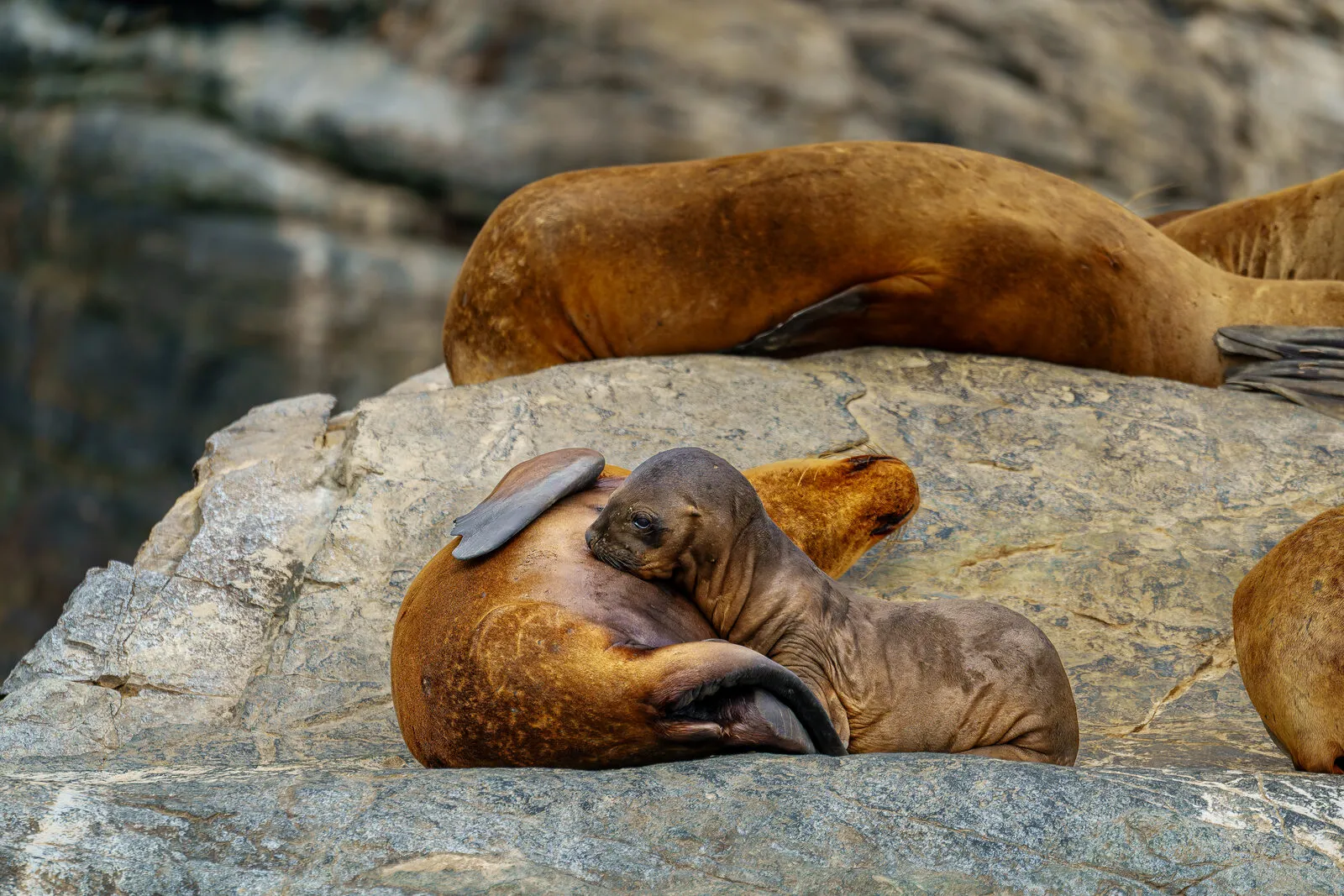

The Peruvian anchoveta (Engraulis ringens) accounted on average for 75 % of fish occurrences in scats collected on San Gallán Island outside the El Niño year, and every crustacean found was Pleuroncodes monodon.8 Between January and April 2023, surveillance in marine protected areas found 5224 sea lions dead or dying on beaches, about 5 % of the country's population, and the authors attribute that die-off to highly pathogenic avian influenza A(H5N1).9 On arid islands of the coast the common vampire bat also feeds on its blood: between 2003 and 2005 bats were seen at night approaching lone sea lions and biting them on the neck.10
The South American fur seal (Arctocephalus australis), called «lobo marino fino» in an official document of the Paracas reserve, is the other eared seal that breeds in the country, and the animals of Peru and northern Chile belong to a subspecies that has no name yet.112 Its colonies run from Mazorca Island (11° 20′ S) to Ilo (17° 42′ S), with a small isolated colony on Isla Foca, and the southern coast, between 15° and 18° S, held more than 90 % of the animals counted.2 Ninety per cent of births happen within about 40 days towards the end of November, which is why IMARPE runs its surveys in November and December.2 The 1997-1998 El Niño cut the Peruvian population by 66 % in two years, and the surveys from 2016 to 2019 fell from 9727 to 7770 animals.2
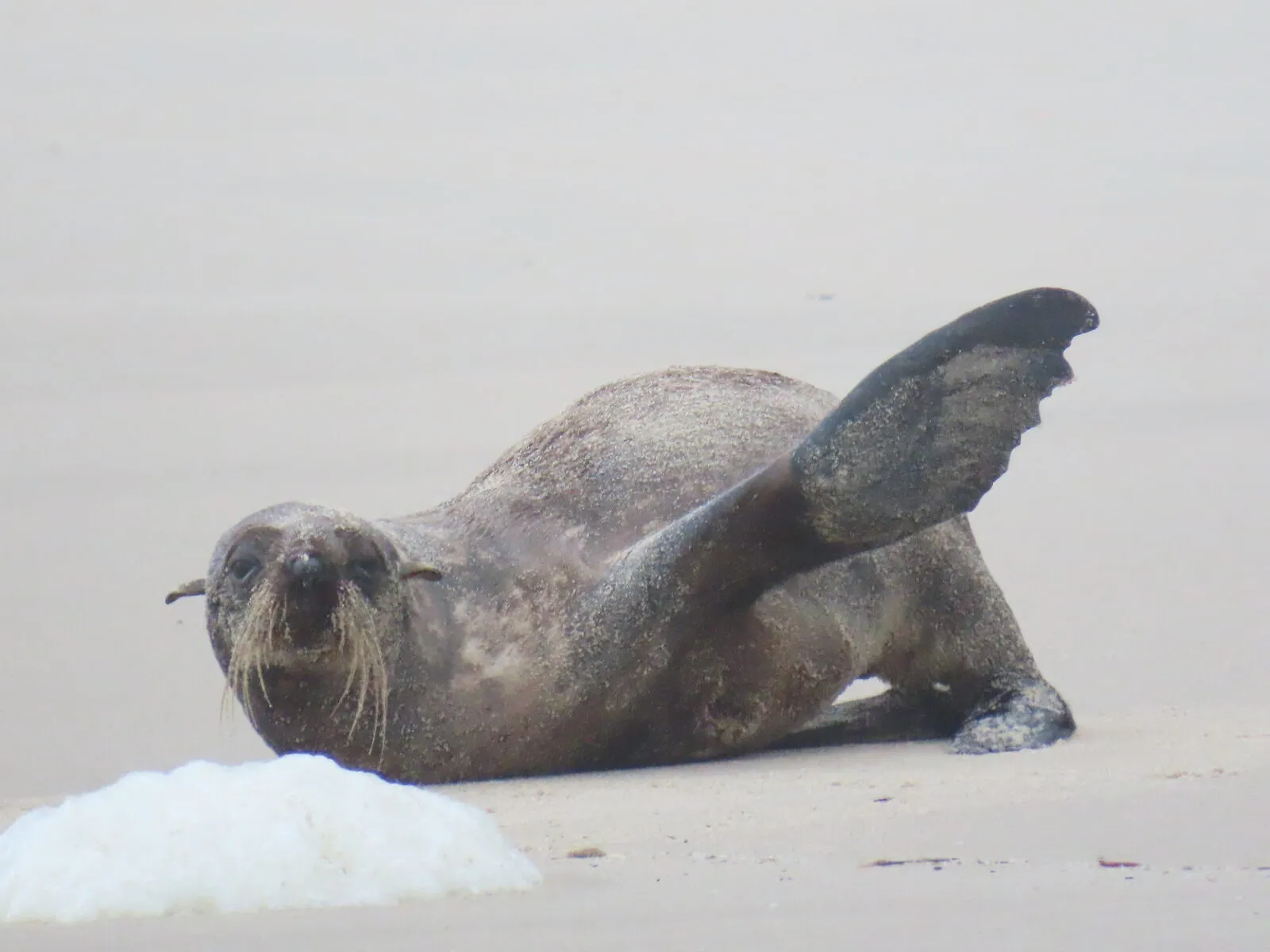

The fur seal is recognised by a moderately long, pointed muzzle, long ears that are easy to see and creamy whiskers in adults.12 The adult male sea lion is larger than any other animal in the colony and carries a thick mane, and its pups are dark.7
The Galápagos fur seal (Arctocephalus galapagoensis) is endemic to that archipelago, although in El Niño years stray animals turn up on the mainland coast.13 On Isla Foca, off Paita, there is a small colony of about 30 animals that the reserve's master plan assigns, with reservations, to this species.1
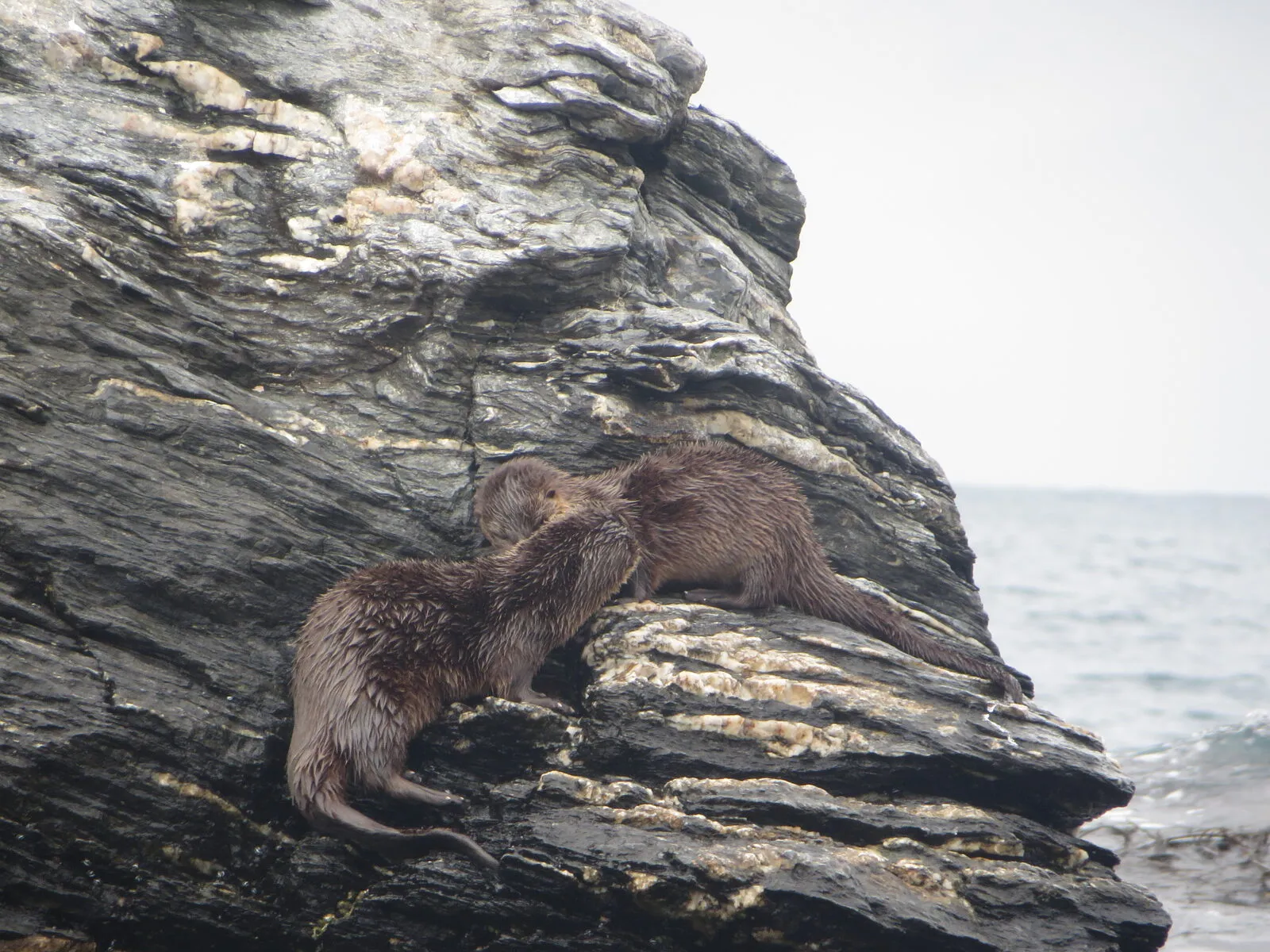
The marine otter (Lutra felina, Lontra felina in the Peruvian literature) occupies more than 5000 km of South American Pacific coast, from Chimbote (9° S) to Chiloé Island (43° S).143 It is thought to have once reached farther north, and in recent decades its limit would have retreated by about 400 km.15 Its home range is limited to 1 to 4 km of coast, and its diet weighs more towards fish in Peru and towards crustaceans in Chile.163

The great whales: the ones that migrate
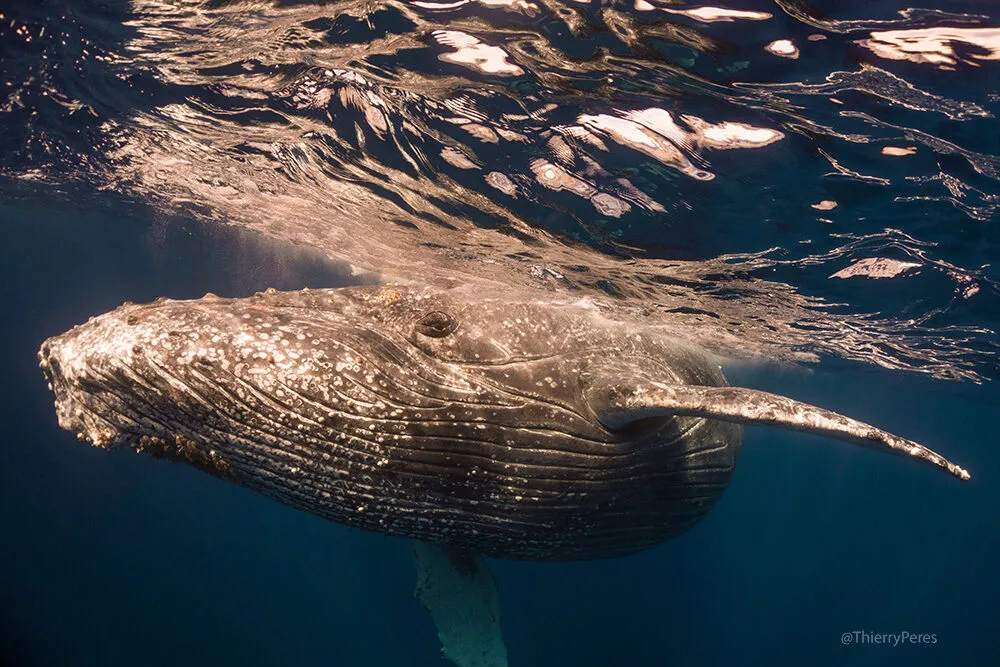
The humpback whale (Megaptera novaeangliae), called «ballena jorobada» or «yubarta» in Peru, travels some 8000 km from its Antarctic and Magellanic feeding grounds to tropical coastal waters, where it breeds in the austral winter and spring.117 Northern Peru's coast marks the southern end of that breeding area.18 Between Los Órganos and Cabo Blanco, from 2010 to 2013, 98 % of sightings were made over the continental shelf, between the shore and 200 m depth.17 Between July and September 2009, 43 trips out of Los Órganos recorded 124 whales in 60 groups of 1 to 8 animals, and 8 newborn calves confirmed that they breed and nurse there.18 The reserve's master plan has it present from June to November in Cabo Blanco – El Ñuro and Arrecifes de Punta Sal.1
Adults reach about 18 m, and the tail flukes about 5.5 m across.19 The colour pattern on the underside of the tail, its shape and its scars differ from whale to whale, so they work like a fingerprint for recognising individuals in photographs.19 On breeding grounds such as the one off northern Peru it usually goes without food and spends the energy it has stored, which is not unlimited.20
The fin whale (Balaenoptera physalus), called «rorcual común» in the master plan, is the second-largest whale, after the blue whale, and the plan counts it among the cetaceans seen in the Cabo Blanco – El Ñuro sector.211 Its most distinctive feature is the asymmetric colour of the head: the lower jaw is dark on the left side and white on the right.21 A review of records from 1980 to 2012 found an equatorial gap between about 20° N and 20° S, and in the whaling era there were few catch records off Ecuador and off Peru, near 15° S, which did not sustain a fishery for this species.22
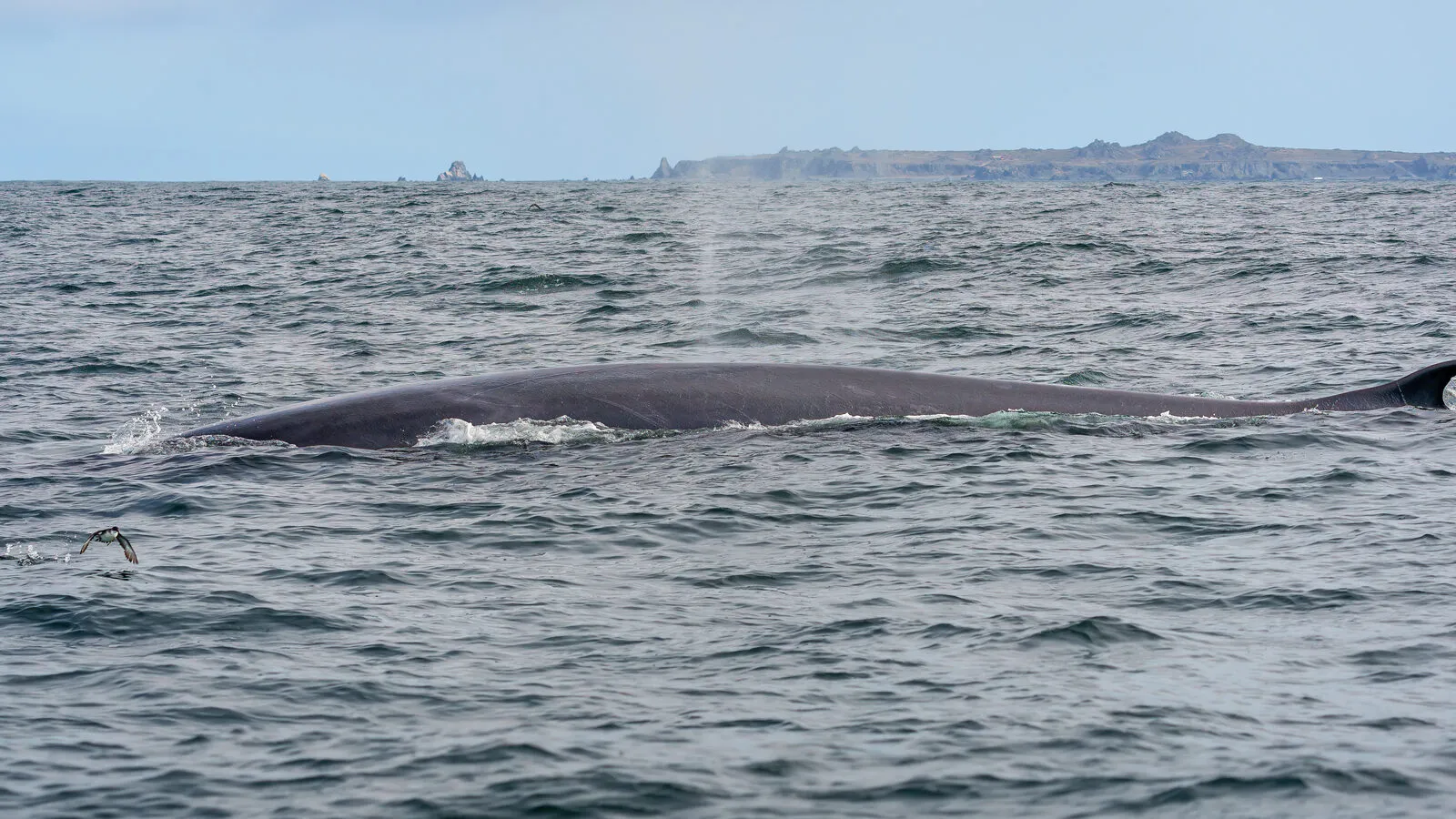

The blue whale (Balaenoptera musculus) is the largest animal ever to have lived and feeds almost entirely on krill.23 The master plan includes it, under the name «ballena azul», among the cetaceans sighted in Cabo Blanco – El Ñuro.1 Whales tagged in the Galápagos in 2021, 2022 and 2023 appeared to travel south along the edge of the continental shelf, with a feeding hotspot where it converges with the Nazca Ridge.24
Bryde's whale was long treated as a single species with two provisional subspecies, a small coastal one and a larger oceanic one.25 A 2025 genomic study proposes that they are separate species and that Balaenoptera brydei should be reinstated, and the master plan names the «rorcual tropical» and the «ballena de Bryde» separately, both sighted in Cabo Blanco – El Ñuro.261 The authors of a 2018 review warn that the proposal cannot be adopted until its type specimen is described.25
The sei whale (Balaenoptera borealis) appears under the name «ballena sei» in the MINCETUR good-practice manual among the larger cetaceans.27 It is an oceanic species that, unlike other rorquals, does not regularly reach polar or tropical regions.28 The Antarctic minke whale (Balaenoptera bonaerensis) lives tied to sea ice and is the only baleen whale that consistently inhabits ice-covered waters, and the literature consulted documents no specific sightings in Peru.2927
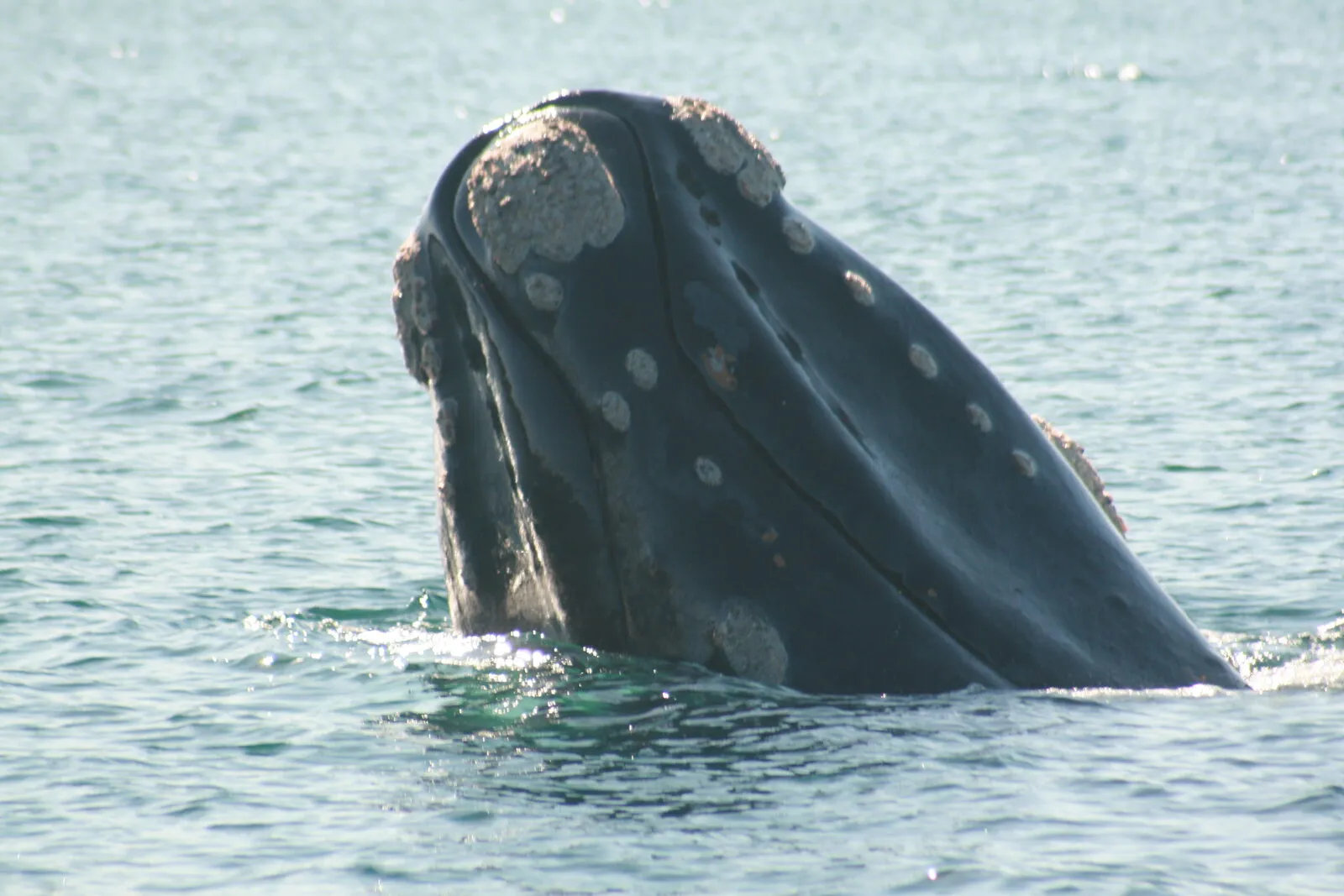
The southern right whale (Eubalaena australis) had six confirmed sightings in Peru between 1987 and 2007, between 12° 24′ S and 17° 38′ S; five were made from shore, and it arrives mostly from July to December.30 Observers recognised it by the massive body, the lack of a dorsal fin, the callosities, the black colour and the V-shaped blow.30 Its figures show how sources can differ without contradicting each other: the IUCN classifies it globally as Least Concern, but between 1789 and 1976 about 9000 individuals of the southeast Pacific population were killed, and it is now thought to hold fewer than 50 mature individuals.3132 According to NOAA, several breeding populations have recovered, but the Chile-Peru population remains small and shows no signs of recovery.33

Sperm whales and beaked whales: the deep-sea species
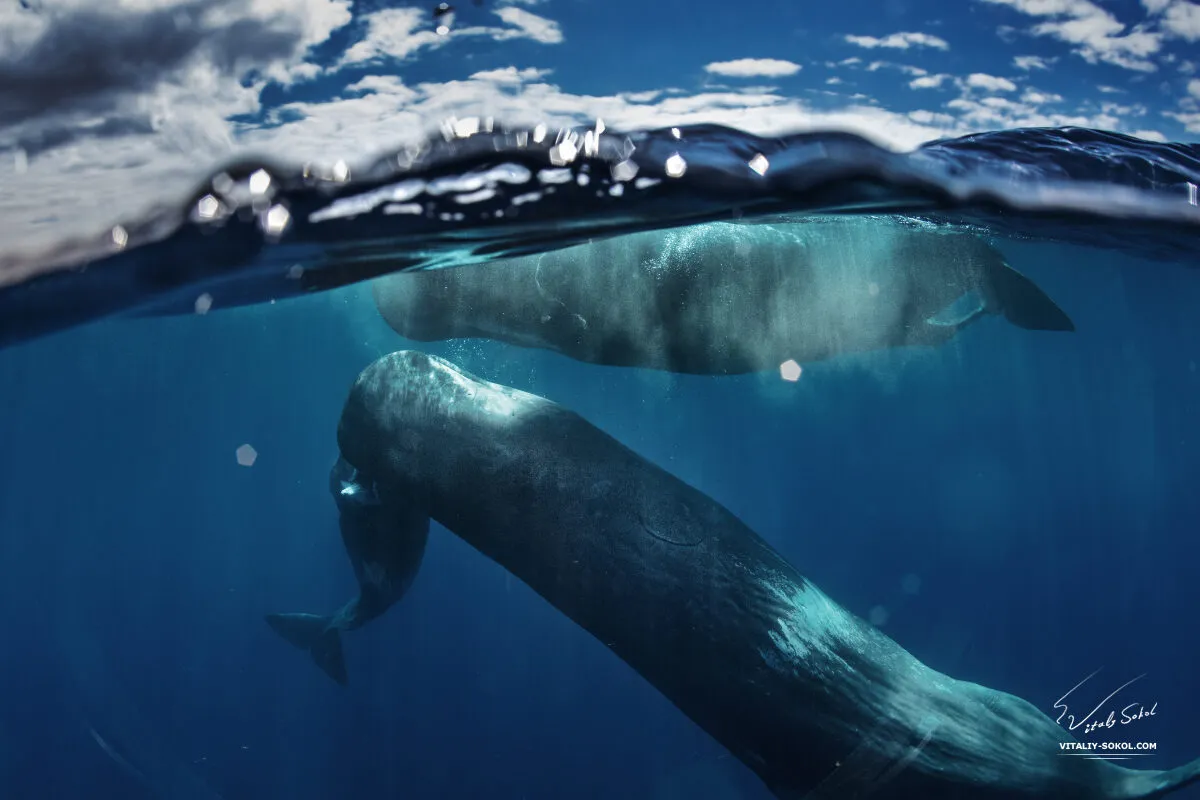
The sperm whale (Physeter macrocephalus) is the only living cetacean whose single blowhole is offset to the left side of the head.34 It hunts on dives that often reach about 600 m and last up to 45 minutes.34 It was the large cetacean most heavily hunted in Peruvian waters: 49858 animals between 1951 and 1981.5 IMARPE's cruises from 1995 to 2002 logged 38 sightings between 3° and 18° S, all but 2 in oceanic waters beyond the shelf, clustered in the north, from 7° S to the Ecuadorian border, and in the south, from 16° S to the Chilean border.5 Its relative abundance tended to rise when the sea was warmer than normal, although El Niño years blurred that link.5

The Peruvian beaked whale (Mesoplodon peruvianus) is known thanks to fishing: the original description rested on animals caught or stranded on the Peruvian coast, and in 2018 10 further specimens, all from Peru, were documented, raising the world catalogue by 46 %.354 It was described in 1991 from 10 specimens from the south-central coast, between about 11° and 15° S, and it is the smallest of its genus, with a maximum recorded length of 372 cm.35 In Peru it is caught with some regularity in drift gillnets set for sharks and rays, and it is the only mesoplodont frequently captured in small-scale coastal fisheries.364
Gray's beaked whale (Mesoplodon grayi) hardly appears on this coast: on the Pacific coast of South America only one record is known from Peru, a female stranded at Paracas, and the review confirms four records for Chile.6 Between 2009 and 2021 only 2 of the 1093 cetacean strandings recorded in Chile were beaked whales.6
Cuvier's beaked whale (Ziphius cavirostris) has very few records in Peru: IMARPE attended an animal stranded at Cañete in January 2021, whose stomach held two large beaks, probably from jumbo squid (Dosidicus gigas).37 In southern California, 8 satellite-tagged individuals reached dives of up to 2992 m, and one lasted 137.5 minutes.38
The reserve's master plan says that dwarf sperm whales (Kogia spp.), present off Ecuador, are probably also in northern Peru, but were not detected in the sightings of that study.1 The dwarf sperm whale (Kogia sima) reaches at most about 2.7 m, and a female stranded at Iquique in 2011 is the northernmost record of the species in Chilean waters.3940
Dolphins, killer whales and the coastal porpoise
The bottlenose dolphin (Tursiops truncatus) is named «bufeo» in Law 26585 of 1996, which declares it a legally protected species.41 In the southeast Pacific there are two forms: the offshore one reaches at least Chilean Patagonia, whereas the coastal form appears confined between Colombia and south-central Peru.42 On the central coast the groups seen in 2021 were on average 391 m from shore, over depths of 2.8 to 12.3 m.43
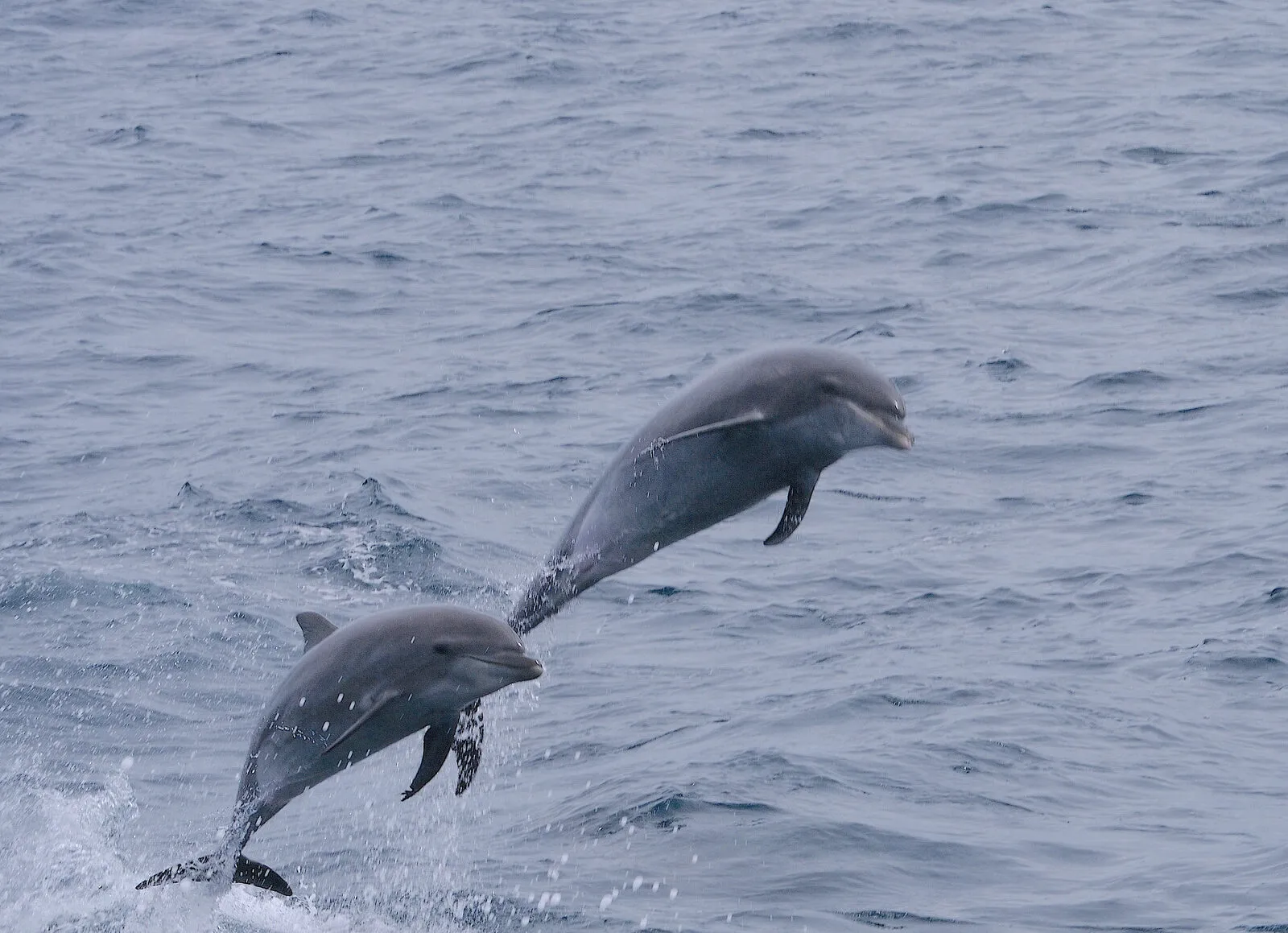

The common dolphin (Delphinus delphis) forms enormous groups: on IMARPE's cruises from 2001 to 2019, 213 groups with 12239 individuals were recorded.44 Off Los Órganos groups of 500 to 1500 individuals have been seen.45 The dusky dolphin, which the Peruvian rule calls «delfín oscuro» or «chancho marino», eats mostly anchoveta on the central coast: it was in 97.8 % of stomachs and made up 92.5 % of prey by number.4647 Its known northern limit was near Salaverry, at about 6° S, until a group of 10 to 20 adults was photographed off Los Órganos in October 2017, an event the authors consider occasional.48
Burmeister's porpoise (Phocoena spinipinnis) is the only porpoise in Peruvian waters and one of the small cetaceans most often caught incidentally in the artisanal fisheries.49 It is hard to see at sea except when the surface is calm, because its dorsal fin is low and set far back.50 Anchovy occurred in 88 % of the stomachs of caught porpoises.50 In the Salaverry artisanal fleet, 66 % of 32 fishers interviewed said they had caught porpoises the previous year, equivalent to about 420 a year across the port's whole gillnet fleet.51
The killer whale (Orcinus orca), known in Peru as «orca», had for a long time scarce and mostly anecdotal records in Peruvian waters.52 A 2019 study gathered 29 reports from 2003 to 2018, involving at least 110 animals, and concluded that the species is more frequent than had been documented.53 The sources differ on where: of the 13 records from IMARPE's cruises only 3 were over the shelf, and most in water warmer than 20 °C, whereas the 29 later reports were concentrated over the shelf or near its edge.5253 In January 2003 a lone male caught 4 fur seal pups on the beach at Punta San Juan.52 Of 897 humpbacks photo-identified off northern Peru from 2009 to 2017, 19.6 %, that is 172, had rake marks left by killer whale teeth on their flukes.53
For other oceanic species, Peru has isolated records.5455 The pygmy killer whale (Feresa attenuata) is known in the country from a mummified specimen found in 1984 on a rubbish dump at Pucusana, the first Peruvian record.54 The presence of the short-finned pilot whale (Globicephala macrorhynchus) was confirmed in the mid-1980s, and the capture of it for its meat was continuing according to an IMARPE study.5556 For the long-finned pilot whale (Globicephala melas), by contrast, in Chile 203 of 324 individuals seen were logged only as Globicephala sp., which prevents saying whether the two species are distributed differently.57 The false killer whale (Pseudorca crassidens) has Paita, Peru, as the type locality of Orca destructor, and the MINCETUR manual includes it among the minor cetaceans.5827
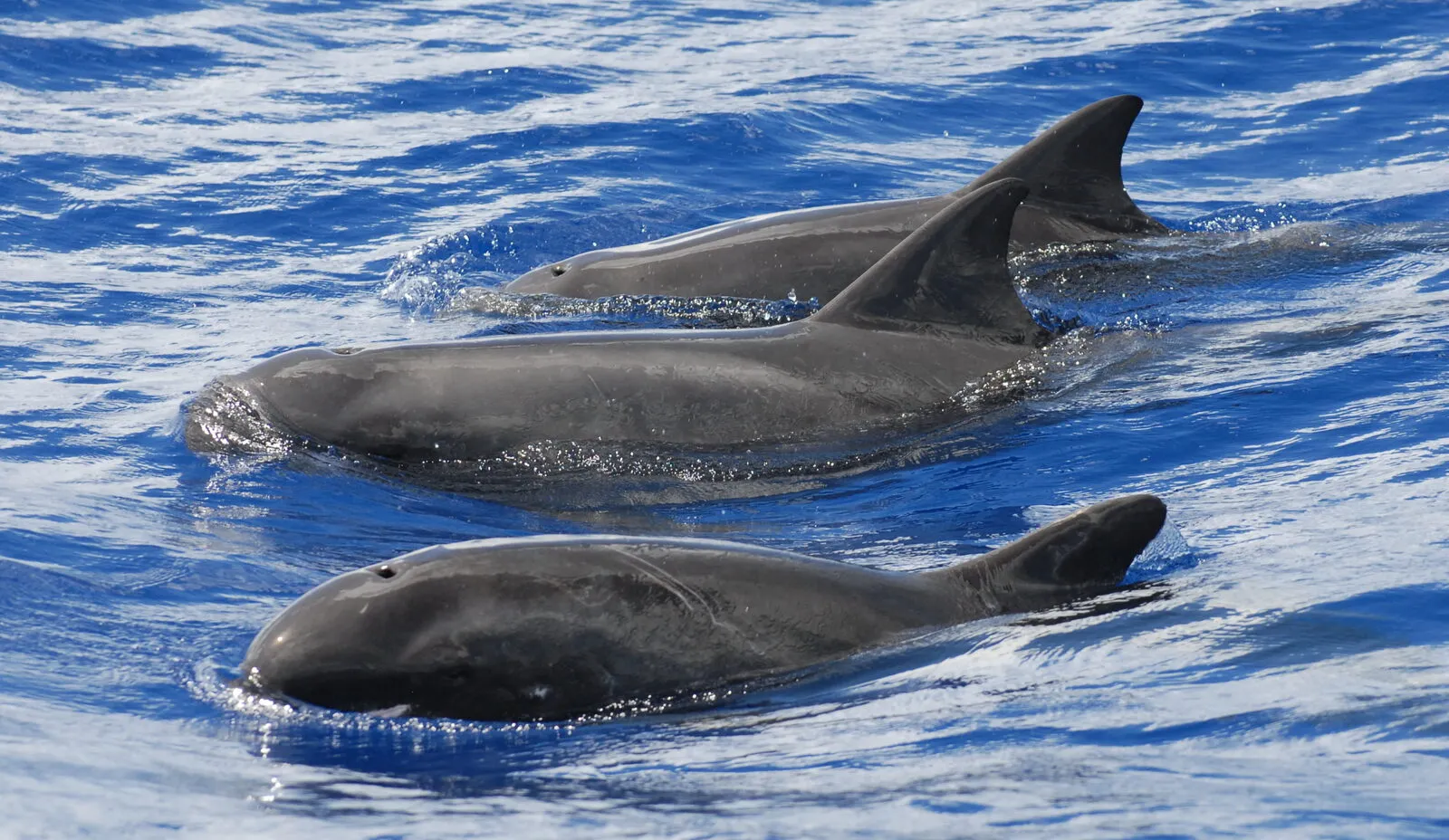

In the north, the coast is the southern edge of the pantropical spotted dolphin's (Stenella attenuata) range in the Eastern Tropical Pacific, and between 2021 and 2023 34 groups were recorded, 29 of them in 2023, a year of a strong El Niño event.59 The MINCETUR manual also names the striped dolphin (Stenella coeruleoalba) and the spinner dolphin (Stenella longirostris) among the smaller cetaceans.2727 By contrast, the master plan does not include the rough-toothed dolphin (Steno bredanensis) in its list of 13 species for Cabo Blanco – El Ñuro, and the Peruvian literature on it is scarce.1
How to tell them apart at sea
Some species are known by a single mark: the sperm whale by its left-side blowhole, the killer whale by its black back, white belly and a white patch near each eye, and the right whale by its lack of a dorsal fin.346030 The southern right whale dolphin (Lissodelphis peronii) also lacks a dorsal fin and has a black back and a white underside, features that set it apart from other dolphins at sea.61 Its northernmost records in the Pacific are tied to a cold current, the Humboldt Current.61
Others are easily confused: at sea the two pilot whales are almost impossible to tell apart, and the authors who reviewed the Peruvian records asked for the old sightings of pilot whales to be revisited for that reason.55 The Antarctic minke whale is hard to separate from the dwarf form of the common minke whale, with which it shares part of the Southern Hemisphere.62 Bryde's whale and its small relative were told apart mainly by adult size, and the 2018 authors warn that the labels «coastal» and «oceanic» can lead to wrong assignments.2625
When, where and on what they live
Seasons of presence and breeding differ from one species to another on the Peruvian coast.130 The humpback is present from June to November and the right whale arrives mostly from July to December, whereas sea lions breed from December to March and fur seals around November.13082 Dusky dolphin births cluster in late winter, in August, September and October, with a gestation of 12.9 months.63 Bycatches and sightings of the Peruvian beaked whale were concentrated in late spring and early summer.4
The common thread of the diet is the anchoveta of the Humboldt Current: it is eaten by the sea lion, the fur seal, the dusky dolphin and Burmeister's porpoise.8644750 A shallow oxygen minimum zone, at 30 to 50 m depth, limits the anchovy from below, and common and dusky dolphins chose cold, productive areas with that shallow zone in every season, separated by latitude.44 The deep divers eat squid: the Cuvier's beaked whale found at Cañete had jumbo squid beaks, and Risso's dolphin eats mainly squid and does so mostly at night.3765
El Niño alters all of this: it cut the Peruvian fur seal population by 66 % in 1997-1998, and in the sea lion the censuses fell from 144087 animals in 1997 to 27998 in 1998.266 During the 1982-83 El Niño, whalers found sperm whale concentrations 600 km further south than usual.5
Conservation status and threats
The IUCN classifies the sea lion, the fur seal, the humpback, the bottlenose dolphin, the dusky dolphin, Risso's dolphin, the southern right whale, the Peruvian beaked whale and Cuvier's beaked whale as Least Concern.676869707172317374 The global category is Vulnerable for the fin whale and the sperm whale, Near Threatened for Burmeister's porpoise, the false killer whale and the Antarctic minke whale, and Data Deficient for the killer whale.757677787980 Peru's 2014 list is harsher than the global one for two of them, since it classifies the sea lion as Vulnerable and the fur seal as Endangered, and it also lists the marine otter as Endangered.81
Among the threats, incidental capture is the one with the most figures in the sources consulted.5182 At Salaverry, observers aboard 66 artisanal trips between 2005 and 2007 recorded 253 small cetaceans caught, of which 33, or 13 %, were bottlenose dolphins, and the authors estimated about 259 a year for the gillnet fleet.82 Between 1995 and 2012, 10 humpback strandings linked to fishing gear were documented, 9 in drift nets and 1 in a longline.83 Between September 2022 and December 2023, sets with an acoustic alarm had 52.9 % fewer whale entanglements than sets without one, with no loss of catch.84
Hunting left a long mark.18 The whaling fleets of the Southeast Pacific killed hundreds of humpbacks between 1951 and 1987, and since hunting ended in Peruvian waters in 1987 the Southeast Pacific population has grown by about 5 % a year.18 Between 1890 and 1980 commercial whaling removed more than 900000 fin whales, and it is estimated to have killed about 300000 sei whales.2285 A 2002 estimate put the world population of sperm whales at about 360000, and in 1999 some 32 % of the pre-whaling population remained.86
There are also threats of other kinds.9 The sea lion suffered in 2023 a die-off attributed to avian influenza, and in the eastern tropical Pacific millions of spinner and spotted dolphins have died since the 1960s as bycatch in tuna purse-seine nets, with no clear sign of recovery.987 The marine otter also bears pollution from mining, fishing and sewage, displacement by dogs, cats and rats, targeted hunting and dynamite fishing.15
What the rules say about approaching them
In Peru, Ministerial Resolution 451-2019-PRODUCE sets minimum approach distances: 50 m for smaller cetaceans and 150 m when they are feeding or socialising, and 100 m for those longer than 5 m and 300 m in those cases.4646 The same regulation forbids heading for or approaching mothers with calves and requires any collision or entangled animal to be reported to IMARPE and the maritime authority.46 Law 26585 of 1996 also bans catching, processing and selling dolphins and other small cetaceans.41
Two studies from northern Peru measure how whales react to boats.8820 From a cliff in northern Peru, 180 groups were tracked over 167 hours, and, by classical tests, the only significant change after meeting boats was in the linearity of the path of groups with a calf.88 In the same area, whales swam faster the more boats surrounded them.20
What we still do not know
For several species Peru has more questions than data.1 There is no information on the common dolphin's reproduction in the Humboldt Current System, although a seasonal cycle cannot be ruled out.44 Where the south-east Pacific right whales feed remains uncertain: the west of the Antarctic Peninsula has been proposed, but there are no photo-identification or genetic data to support it.89 For the rough-toothed dolphin, the MINCETUR manual names it but does not say where it is seen or whether its list refers to species recorded in Peru.27
The species in this article
- Otaria byronia
- Megaptera novaeangliae
- Tursiops truncatus
- Orcinus orca
- Arctocephalus australis
- Physeter macrocephalus
- Arctocephalus galapagoensis
- Phocoena spinipinnis
- Lagenorhynchus obscurus
- Delphinus delphis
- Grampus griseus
- Balaenoptera physalus
- Balaenoptera edeni
- Balaenoptera musculus
- Mesoplodon peruvianus
- Ziphius cavirostris
- Lutra felina
- Balaenoptera bonaerensis
- Pseudorca crassidens
- Feresa attenuata
- Balaenoptera borealis
- Eubalaena australis
- Globicephala macrorhynchus
- Globicephala melas
- Kogia breviceps
- Kogia sima
- Lissodelphis peronii
- Mesoplodon grayi
- Peponocephala electra
- Stenella attenuata
- Stenella coeruleoalba
- Stenella longirostris
- Steno bredanensis
Sources (89)
- SERNANP (2026). Plan Maestro de la Reserva Nacional Mar Tropical de Grau 2026–2031. SERNANP. cdn.www.gob.pe
- Aguilar-Arakaki, R. (2021). Población del lobo fino Arctocephalus australis en la costa peruana en el periodo 2016- 2019.. Boletín Instituto del Mar del Perú. doi.org
- Hostos Olivera, L.L. (2021). Ecomorfología de la alimentación de la nutria marina Lontra felina (Molina, 1782) (Carnivora: Mustelidae). Tesis de licenciatura, Universidad Peruana Cayetano Heredia, Lima. repositorio.upch.edu.pe
- Reyes, J.C.; Van Waerebeek, K. (2018). The Lesser Beaked Whale Mesoplodon peruvianus Reyes, Mead & Van Waerebeek 1991 Revisited, with Biological Observations on New Specimens from Peru. Journal of Marine Biology & Oceanography 7(4). doi.org
- García-Godos, I. (None). A note on the occurrence of sperm whales (Physeter macrocephalus) off Peru, 1995-2002. Journal of Cetacean Research and Management 8(1), 2006. doi.org
- Canto Hernández, J. et al. (2022). Review of Gray's beaked whale (Mesoplodon grayi) in the South East Pacific. Therya. doi.org
- Instituto del Mar del Perú (2026). Censo nacional de lobo chusco (Otaria byronia) 2026 al interior de áreas naturales protegidas. Informe, IMARPE, Dirección General de Investigaciones de Recursos Pelágicos (16-04-2026). cdn.www.gob.pe
- Soto, K.H.; Trites, A.W.; Arias-Schreiber, M. (2006). Changes in diet and maternal attendance of South American sea lions indicate changes in the marine environment and prey abundance. Marine Ecology Progress Series. doi.org
- Gamarra-Toledo, V. et al. (2023). Mass Mortality of Sea Lions Caused by Highly Pathogenic Avian Influenza A(H5N1) Virus. Emerging Infectious Diseases. doi.org
- Catenazzi, A.; Donnelly, M.A. (2008). Sea lion Otaria flavescens as host of the common vampire bat Desmodus rotundus. Marine Ecology Progress Series. doi.org
- Servicio Nacional de Áreas Naturales Protegidas por el Estado (2025). Plan Maestro de la Reserva Nacional de Paracas 2025-2030. SERNANP, RPE N.° 000173-2025-SERNANP/PE. cdn.www.gob.pe
- Jefferson, T.A.; Leatherwood, S.; Webber, M.A. (1993). FAO species identification guide. Marine mammals of the world. FAO y PNUMA, Roma (ISBN 92-5-103292-0). fao.org
- Félix, F. et al. (2007). New records and first births of the Galapagos fur seal, Arctocephalus galapagoensis (Heller, 1904), from the mainland coast of Ecuador. Revista de Biología Marina y Oceanografía. doi.org
- WoRMS Editorial Board (2026). Lutra felina (Molina, 1782). World Register of Marine Species. marinespecies.org
- Alfaro-Shigueto, J.; Valqui, J.; Mangel, J.C. (2011). Nuevo registro de la nutria marina Lontra felina (Molina, 1782) al norte de su distribución actual. Ecología Aplicada. doi.org
- Pizarro-Neyra, J. (2023). The Marine Otter Lontra felina (Molina, 1782) (Mammalia: Carnivora: Mustelidae) along the marine protected areas in Peru. Journal of Threatened Taxa. doi.org
- Guidino, C. et al. (2014). Patterns of Spatial and Temporal Distribution of Humpback Whales at the Southern Limit of the Southeast Pacific Breeding Area. PLoS ONE. doi.org
- Pacheco, A.S.; Silva, S.; Alcorta, B. (2009). Winter distribution and group composition of humpback whales (Megaptera novaeangliae) off northern Peru. Latin American Journal of Aquatic Mammals. doi.org
- NOAA Fisheries (2026). Humpback Whale. NOAA Fisheries, Species Directory. fisheries.noaa.gov
- Villagra, D. et al. (2021). Energetic Effects of Whale-Watching Boats on Humpback Whales on a Breeding Ground. Frontiers in Marine Science. doi.org
- NOAA Fisheries (2026). Fin Whale. NOAA Fisheries species profile. fisheries.noaa.gov
- Edwards, E.F. et al. (2015). Global distribution of fin whales Balaenoptera physalus in the post-whaling era (1980–2012). Mammal Review. doi.org
- NOAA Fisheries (2026). Blue Whale. NOAA Fisheries species profile. fisheries.noaa.gov
- Guzman, H.M.; Estévez, R.M.; Kaiser, S. (2024). Insights into Blue Whale (Balaenoptera musculus L.) Population Movements in the Galapagos Archipelago and Southeast Pacific. Animals. doi.org
- Constantine, R. et al. (2018). Future Directions in Research on Bryde's Whales. Frontiers in Marine Science. doi.org
- Lin, Y.-T. et al. (2025). Chromosome-Level Genome Assembly of Eden's Whale Clarifies the Taxonomy and Speciation of Bryde's Whale Complex. Molecular Biology and Evolution. doi.org
- MINCETUR (2026). Manual de buenas prácticas de gestión de servicio turístico para la actividad de observación de fauna marina (3.ª ed.). Ministerio de Comercio Exterior y Turismo, Perú. cdn.www.gob.pe
- Haro, D. et al. (2026). Opportunistic Feeding and Parasite Assemblages in Sei Whales (Balaenoptera borealis) From Southern Chile Revealed by DNA Metabarcoding. Ecology and Evolution. doi.org
- Herr, H. et al. (2019). Aerial surveys for Antarctic minke whales (Balaenoptera bonaerensis) reveal sea ice dependent distribution patterns. Ecology and Evolution. doi.org
- Van Waerebeek, K.; Santillán, L.; Suazo, E. (2009). On the Native Status of the Southern Right Whale Eubalaena australis in Peru. Boletín del Museo Nacional de Historia Natural, Chile 58. doi.org
- Cooke, J.G.; Zerbini, A.N. (2017). Eubalaena australis: Cooke, J.G. & Zerbini, A.N.. The IUCN Red List of Threatened Species 2018: e.T8153A50354147. doi.org
- García-Cegarra, A.M.; Malebran, M.; Van Waerebeek, K. (2021). Antofagasta Region in northern Chile, a potential nursing ground for the Southern right whale Eubalaena australis. Latin American Journal of Aquatic Mammals 16(1). doi.org
- NOAA Fisheries (2026). Southern Right Whale. NOAA Fisheries, Species Directory. fisheries.noaa.gov
- NOAA Fisheries (2026). Sperm Whale. NOAA Fisheries, Species Directory. fisheries.noaa.gov
- Reyes, J.C.; Mead, J.G.; Van Waerebeek, K. (1991). A NEW SPECIES OF BEAKED WHALE MESOPLODON PERUVIANUS SP. N. (CETACEA: ZIPHIIDAE) FROM PERU. Marine Mammal Science 7(1). doi.org
- Sanino, G.P.; Yáñez, J.; Van Waerebeek, K. (2007). A first confirmed specimen record in Chile, and sightings attributed to the lesser beaked whale, Mesoplodon peruvianus Reyes, Mead and van Waerebeek, 1991. Boletín Museo Nacional de Historia Natural 56. doi.org
- Instituto del Mar del Perú (IMARPE) (2021). Cañete: varamiento de Zifio de Cuvier fue atendido por el Imarpe. Nota informativa, gob.pe. gob.pe
- Schorr, G.S. et al. (2014). First Long-Term Behavioral Records from Cuvier’s Beaked Whales (Ziphius cavirostris) Reveal Record-Breaking Dives. PLoS ONE. doi.org
- Covelo, P.; López, A. (2021). First record of dwarf sperm whale (Kogia sima) in the north of Spain. Galemys, Spanish Journal of Mammalogy. doi.org
- Canto, J. et al. (2015). Nuevo Registro de Kogia Sima (Cetacea: Kogiidae) con la Descripción del Aparato Hiolingual y una Revisión de los Registros en las Aguas de Chile. Boletín del Museo Nacional de Historia Natural, Chile. doi.org
- Congreso de la República del Perú (1996). Ley N.° 26585: declaran a delfines y otros mamíferos marinos como especies legalmente protegidas. El Peruano, Normas Legales (09-04-1996), N.° 5757; copia en FAOLEX. faolex.fao.org
- Félix, F. et al. (2018). Variation in Dorsal Fin Morphology in Common Bottlenose Dolphin Tursiops truncatus (Cetacea: Delphinidae) Populations from the Southeast Pacific Ocean. Pacific Science 72(3). doi.org
- Cortez-Casamayor, S. et al. (2024). Characterizing common bottlenose dolphin (Tursiops truncatus) ecology aspects in the central coast of Peru: Distribution, group dynamics, skin lesions and behavior patterns. Revista de Biología Marina y Oceanografía 59(2). doi.org
- Llapapasca, M.A. et al. (2022). The oxygen minimum zone relative depth is a key driver of dolphin habitats in the northern Humboldt Current System. Frontiers in Marine Science. doi.org
- Martínez, L. et al. (2021). First records of the pantropical spotted dolphin Stenella attenuata, within groups of common dolphins Delphinus delphis in northern Peru. Revista de Biología Marina y Oceanografía. doi.org
- Ministerio de la Producción (2019). Resolución Ministerial N.° 451-2019-PRODUCE: establecen las distancias mínimas de acercamiento a los cetáceos marinos. Ministerio de la Producción, Plataforma del Estado Peruano (21-10-2019). cdn.www.gob.pe
- McKinnon, J. (1994). Feeding habits of the dusky dolphin, Lagenorhynchus obscurus, in the coastal waters of central Peru. Fishery Bulletin 92(3), NOAA National Marine Fisheries Service. spo.nmfs.noaa.gov
- Suárez, A.P. et al. (2019). Northernmost record of dusky dolphin Lagenorhynchus obscurus in coastal waters off northern Peru (4°S). Revista de Biología Marina y Oceanografía. doi.org
- Vega, D. et al. (2024). Macroscopic and histologic characteristics of sexual maturation in the Burmeister's porpoise Phocoena spinipinnis from Peru. Latin American Journal of Aquatic Mammals. doi.org
- Clay, T.A. et al. (2018). Distribution and Habitat Use of a Cryptic Small Cetacean, the Burmeister's Porpoise, Monitored From a Small-Scale Fishery Platform. Frontiers in Marine Science. doi.org
- Ortiz-Alvarez, C. et al. (2025). Concurrent bycatch and population assessments of Burmeister's porpoises in northern Peru reveal unsustainable levels of mortality. ICES Journal of Marine Science. doi.org
- García-Godos, I. (2004). Killer whale (Orcinus orca) occurrence off Peru, 1995-2003. Latin American Journal of Aquatic Mammals. doi.org
- Testino, J.P. et al. (2019). Killer Whale (Orcinus orca) Occurrence and Interactions with Marine Mammals Off Peru. Pacific Science. doi.org
- Van Waerebeek, K.; Reyes, J.C. (1988). First record of the Pygmy killer whale, Feresa attenuata Gray, 1875 from Peru, with a summary of distribution in the eastern Pacific. Zeitschrift für Säugetierkunde 53. doi.org
- Van Waerebeek, K.; Reyes, J.; Luscombe, B.A. (1988). Revisión de la distribución de pequeños cetáceos frente al Perú. Boletín del Instituto del Mar del Perú, volumen extraordinario (COLACMAR 1987), tomo I. repositorio.imarpe.gob.pe
- Chauca, J. et al. (2021). Varamiento de mega vertebrados marinos en la costa norte de Perú (2017-2018). Boletín del Instituto del Mar del Perú. doi.org
- Sanino, G.P.; Yáñez, J. (2001). Estudio de un ejemplar de Globicephala melas varado en III Región y revisión de los registros del género para Chile. Boletín del Museo Nacional de Historia Natural. doi.org
- Stacey, P.J.; Leatherwood, S.; Baird, R.W. (1994). Pseudorca crassidens. Mammalian Species 456: 1-6. doi.org
- Cortez-Casamayor, S. et al. (2024). Occurrence of pantropical spotted dolphin (Stenella attenuata) in northern Peru: an El Niño effect?. Mammalia. doi.org
- NOAA Fisheries (2026). Killer Whale. NOAA Fisheries, Species Directory. fisheries.noaa.gov
- Arrial, L.G.R. et al. (2024). New record of southern right whale dolphin, Lissodelphis peronii (Lacépède, 1804), in coastal waters of Brazil. Research Square (preprint). doi.org
- Ten, S.; Konishi, K.; Raga, J.A.; Pastene, L.A.; Aznar, F.J. (2022). Epibiotic fauna of the Antarctic minke whale as a reliable indicator of seasonal movements. Scientific Reports. doi.org
- Van Waerebeek, K.; Read, A.J. (1994). Reproduction of Dusky Dolphins, Lagenorhynchus obscurus, from Coastal Peru. Journal of Mammalogy. doi.org
- Fire, S.E. et al. (2016). Peruvian fur seals (Arctocephalus australis ssp.) and South American sea lions (Otaria byronia) in Peru are exposed to the harmful algal toxins domoic acid and okadaic acid. Marine Mammal Science. doi.org
- NOAA Fisheries (2026). Risso's Dolphin. NOAA Fisheries species directory. fisheries.noaa.gov
- Instituto del Mar del Perú, Oficina de Investigaciones en Depredadores Superiores (2020). Indicadores de la población de lobos marinos chuscos en Perú. Hoja de indicadores, IMARPE (datos al 08-05-2020; fechada 27-06-2020). cdn.www.gob.pe
- Cárdenas-Alayza, S.; Crespo, E.; Oliveira, L. (2015). Otaria byronia: Cárdenas-Alayza, S., Crespo, E. & Oliveira, L.. The IUCN Red List of Threatened Species 2016: e.T41665A61948292. doi.org
- Cárdenas-Alayza, S.; Oliveira, L.; Crespo, E. (2016). Arctocephalus australis: Cárdenas-Alayza, S., Oliveira, L. & Crespo, E.. The IUCN Red List of Threatened Species 2016: e.T2055A45223529. doi.org
- Cooke, J.G. (2018). Megaptera novaeangliae: Cooke, J.G.. The IUCN Red List of Threatened Species 2018: e.T13006A50362794. doi.org
- Wells, R.S.; Natoli, A.; Braulik, G. (2018). Tursiops truncatus: Wells, R.S., Natoli, A. & Braulik, G.. The IUCN Red List of Threatened Species 2019: e.T22563A156932432. doi.org
- Alafaro-Shiguieto, J. et al. (2018). Lagenorhynchus obscurus: Alafaro-Shiguieto, J., Crespo, E., Elwen, S., Lundquist, D. & Mangel, J.. The IUCN Red List of Threatened Species 2019: e.T11146A175604493. doi.org
- Kiszka, J.; Braulik, G. (2018). Grampus griseus: Kiszka, J. & Braulik, G.. The IUCN Red List of Threatened Species 2018: e.T9461A50356660. doi.org
- Pitman, R.L.; Taylor, B.L. (2020). Mesoplodon peruvianus: Pitman, R.L. & Taylor, B.L.. The IUCN Red List of Threatened Species 2020: e.T13251A50367335. doi.org
- Baird, R.W.; Brownell Jr., R.L.; Taylor, B.L. (2020). Ziphius cavirostris: Baird, R.W., Brownell Jr., R.L. & Taylor, B.L.. The IUCN Red List of Threatened Species 2020: e.T23211A50379111. doi.org
- Cooke, J.G. (2018). Balaenoptera physalus: Cooke, J.G.. The IUCN Red List of Threatened Species 2018: e.T2478A50349982. doi.org
- Whitehead, H. et al. (2025). Physeter macrocephalus: Whitehead, H., Barlow, J., Dawson, S.M., Eguiguren, A., Miller, B. & Shabangu, F.. The IUCN Red List of Threatened Species 2025: e.T41755A50382216. doi.org
- Félix, F. et al. (2018). Phocoena spinipinnis: Félix, F., Alfaro, J., Reyes, J., Mangel, J., Dellabianca, N., Heinrich, S. & Crespo, E.. The IUCN Red List of Threatened Species 2018: e.T17029A50370481. doi.org
- Baird, R.W. (2018). Pseudorca crassidens: Baird, R.W.. The IUCN Red List of Threatened Species 2018: e.T18596A50371251. doi.org
- Cooke, J.G.; Zerbini, A.N.; Taylor, B.L. (2018). Balaenoptera bonaerensis: Cooke, J.G., Zerbini, A.N. & Taylor, B.L.. The IUCN Red List of Threatened Species 2018: e.T2480A50350661. doi.org
- Reeves, R.; Pitman, R.L.; Ford, J.K.B. (2017). Orcinus orca: Reeves, R., Pitman, R.L. & Ford, J.K.B.. The IUCN Red List of Threatened Species 2017: e.T15421A50368125. doi.org
- Ministerio de Agricultura y Riego (2014). Decreto Supremo N.° 004-2014-MINAGRI: actualización de la lista de clasificación y categorización de las especies amenazadas de fauna silvestre legalmente protegidas. El Peruano (08-04-2014); ficha en SINIA, Ministerio del Ambiente. sinia.minam.gob.pe
- Mangel, J.C. et al. (2010). Small cetacean captures in Peruvian artisanal fisheries: High despite protective legislation. Biological Conservation 143(1). doi.org
- Costanza, A.B. et al. (2021). Participatory Risk Assessment of Humpback Whale (Megaptera novaeangliae) and Leatherback Turtle (Dermochelys coriacea) Bycatch in Northern Peru. Frontiers in Marine Science. doi.org
- Guidino, C. et al. (2025). Assessing the Effectiveness of Whale Pingers in Mitigating Large Whale Entanglements in Gillnet Fisheries in Northern Peru. Aquatic Conservation: Marine and Freshwater Ecosystems. doi.org
- NOAA Fisheries (2026). Sei Whale. NOAA Fisheries species profile. fisheries.noaa.gov
- Whitehead, H. (2002). Estimates of the current global population size and historical trajectory for sperm whales. Marine Ecology Progress Series. doi.org
- Leslie, M.S.; Morin, P.A. (2016). Using Genome-Wide SNPs to Detect Structure in High-Diversity and Low-Divergence Populations of Severely Impacted Eastern Tropical Pacific Spinner (Stenella longirostris) and Pantropical Spotted Dolphins (S. attenuata). Frontiers in Marine Science. doi.org
- García-Cegarra, A.M. et al. (2018). Statistical dependence for detecting whale-watching effects on humpback whales. The Journal of Wildlife Management. doi.org
- Aguayo-Lobo, A. et al. (2008). La ballena franca del sur, Eubalaena australis (Desmoulins, 1822) en aguas chilenas: análisis de sus registros desde 1976 a 2008. Revista de Biología Marina y Oceanografía 43(3). doi.org