
Blog · wildlife of Peru · subgroup
Rays, mantas, guitarfishes and torpedoes of Peru
Thirty-two rays from four different orders are recorded in the sea of Peru, from mantas several metres across to round rays barely twenty centimetres wide.
Published

What rays are and which ones live in Peru
Rays are cartilaginous fishes with a flattened body and the gill slits on the underside of the head.1 The updated checklist of chondrichthyans of the Peruvian sea gathers 115 species, 43 of them batoids.2 Its authors caution that misidentifications at ports are common and that species-richness comparisons between countries need to be validated with voucher specimens.2
Mantas and devil rays, eagle rays and whiptail stingrays belong to the order Myliobatiformes.34 Guitarfishes and sawfishes are grouped in Rhinopristiformes, electric rays in Torpediniformes and the bottom-living skates that lay egg capsules in Rajiformes.5678 Sawfishes look like sharks, but they are rays.9
Among the rays of Peru there are tropical species that arrive from the north and temperate ones that arrive from the south: the giant electric ray (Narcine entemedor) ranges from the Gulf of California to northern Peru,10 while the Chilean eagle ray (Myliobatis chilensis) lives in the temperate waters of the Humboldt Current, between Chile and Peru.11 The electric ray Discopyge tschudii is found, on the Pacific side, from Peru to southern Chile.12
Mantas and devil rays (Mobulidae)
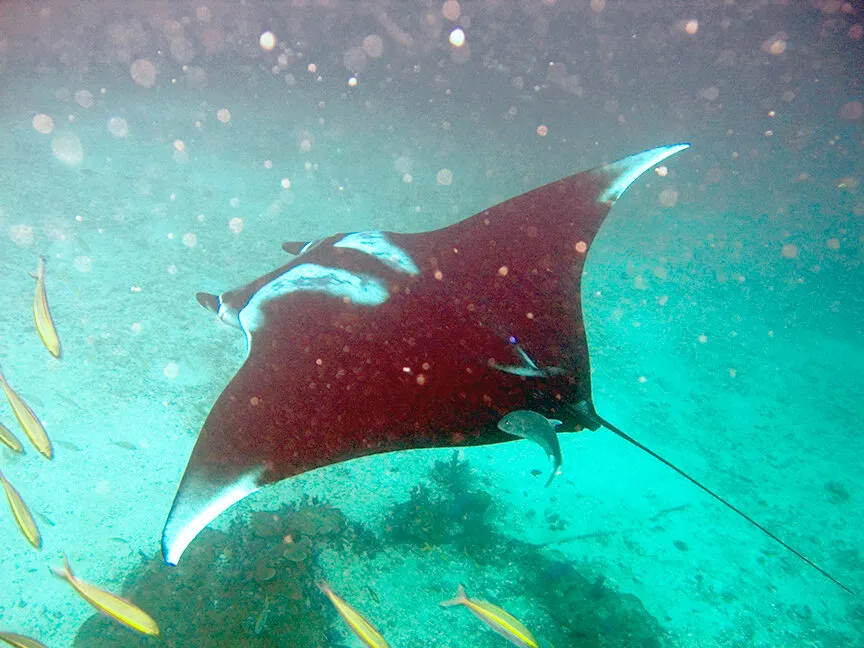
Five rays of the family Mobulidae are recorded in Peru: Mobula birostris, Mobula mobular, Mobula munkiana, Mobula tarapacana and Mobula thurstoni.13 The giant manta, Mobula birostris, is the largest: according to the data compiled in a 2019 paper, its disc reaches at least 670 cm across.14 The group living off Ecuador and northern Peru is probably the largest known population in the world.15
Of the five satellite tags fitted off Tumbes in 2018, three sent data: two mantas stayed on or near the continental shelf, moving between the coast of Tumbes and that of Ecuador, and the third headed into the open ocean and reached the Galápagos, some 1300 km away.16 A female with a 621 cm disc tangled in a net near Acapulco, Tumbes, in September 2017 carried a 137 cm female fetus, and the authors suggest that the north coast of Peru could be a breeding area.14
Devil rays of the genus Mobula have the mouth on the underside of the head, unlike the mantas, whose mouth is subterminal.17 Mobula thurstoni reaches about 220 cm across and, in the Gulf of California, eats almost nothing but one small crustacean, the euphausiid Nyctiphanes simplex.1817 Mobula tarapacana is an oceanic animal: individuals fitted with satellite transmitters in the central North Atlantic dived to almost 2000 m.19 Between 2013 and 2023, Mobula mobular dominated Peruvian landings of mobulid rays, with 3152 tons, 71.79 % of the total.13
Mobula munkiana is the smallest of the genus: a disc width of up to 112 cm has been given.2021 Its range runs from the Baja California peninsula to Peru, the Galápagos included, and it forms aggregations of thousands of individuals.2120 In Costa Rica, groups of 2 to 10 juveniles feed in the surf zone, at less than 50 cm depth.21

Eagle rays, cownose rays and whiptail stingrays
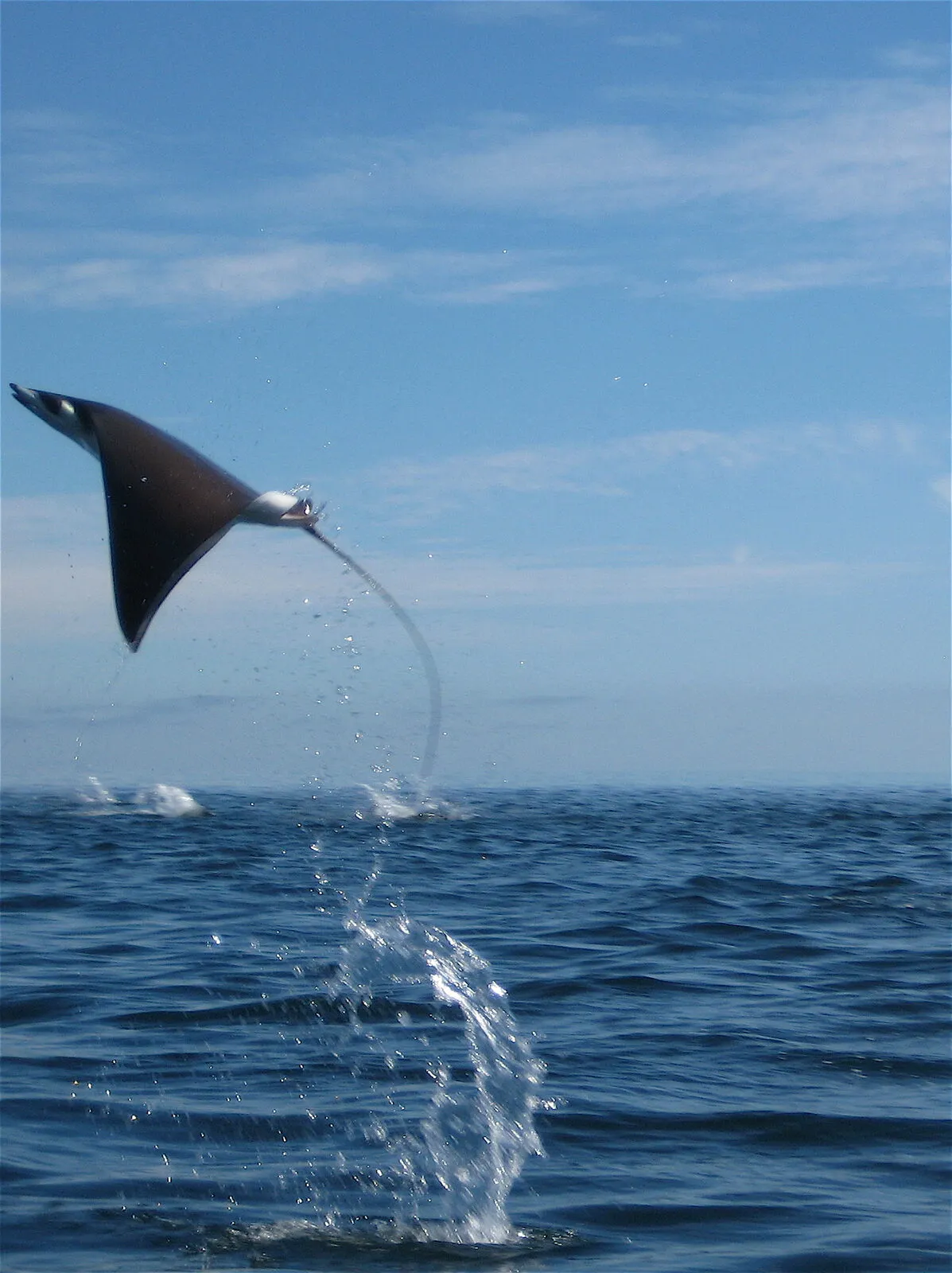
The white-spotted eagle ray, Aetobatus laticeps, is called «raya bruja» in Peru.22 Its back is bluish black covered in white spots and its belly is almost entirely white.23 For a long time these rays of the American Pacific were included in Aetobatus narinari, a species considered to be found worldwide.24 Later work restricted Aetobatus narinari to the continental western Atlantic,25 and a 2026 analysis concluded that the spotted eagle rays of the continental coast of the eastern tropical Pacific are a single species, Aetobatus laticeps.26
The Chilean eagle ray, Myliobatis chilensis, is pelagic but drops to the seabed to feed.11 In the landings at Salaverry, La Libertad, the largest female measured about 222 cm in disc width and, from 155 cm upward, only females appeared.11 At Chancay, one crustacean, Pleuroncodes monodon, made up 89 % of prey weight in 24 stomachs.27 The Pacific cownose ray, Rhinoptera steindachneri, reaches a maximum of 104 cm across and has a single pup per cycle.2829
Among the whiptail stingrays, Hypanus dipterurus is known in Peru as «batea», a commercial name in wide use.30 Between 1997 and 2015 it made up 5.9 % of batoid landings.31 Hypanus longus, the «raya látigo», was recorded at Punta Sal, Tumbes, and by day it rests half-buried in the sand, always near rocky reefs.32 The pelagic stingray, Pteroplatytrygon violacea, is oceanic, reaches 80 cm in disc width and is the only member of its family known to use both pelagic and near-bottom habitats.33

Round rays and butterfly rays
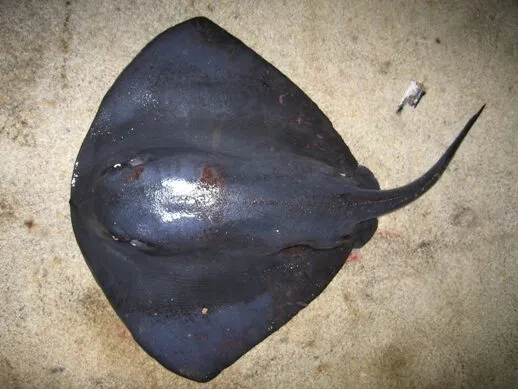
Six species of round rays of the genus Urotrygon have been recorded in Peru.2 Urotrygon chilensis is small, up to 51.6 cm in total length in the Gulf of California, and is caught incidentally in trawls and bottom gillnets.3435 Urotrygon aspidura is smaller still: the largest female measured in a Colombian study had a disc width of 26.5 cm.36
Two other Peruvian species are known barely beyond their original description: Hildebrand described Urotrygon caudispinosus in 1946 from two specimens, one from Independencia Bay and one from Sechura Bay.37 He described Urotrygon serrula from a single male of 187 mm taken with a seine in Lobos de Tierra Bay,37 collected on 17 May 1941.38
The Tumbes round stingray, Urobatis tumbesensis, is listed as Vulnerable.39 At Los Órganos, Piura, it was recorded between 1 and 6 m deep, in caves and crevices of mixed ground.40 Among the butterfly rays, the Peruvian checklist includes Gymnura afuerae and Gymnura marmorata,2 although for the latter there is no confirmed record in the literature consulted, only two seafood samples identified as Gymnura sp.41 Gymnura crebripunctata is given by FishBase as far as Peru, but it is not in the Peruvian checklist of chondrichthyans.422
Guitarfishes and sawfishes
In 2016 the genus Pseudobatos was created for the American guitarfishes that had until then been placed in Rhinobatos.43 The Pacific guitarfish, Pseudobatos planiceps, was believed to occur from Mexico to Chile, but a 2026 review concludes that it lives only in southern Ecuador, the Galápagos, Peru and northern Chile.44 In northern Peru there is a coastal fishery aimed at it: between December 2012 and June 2014, 796 guitarfish were recorded in 183 sets, and they appeared in 86.3 % of them.45
Pseudobatos prahli is one of the least known guitarfishes: when it was assessed for the Red List, in 2007, only three specimens were known.46 In Peru a 71 cm male was recorded in the year 2000.47 Pseudobatos leucorhynchus appears in the Peruvian checklist with a record from Tumbes.2 A study of fish from Nayarit, Mexico, describes Pseudobatos glaucostigma from the Gulf of California to Ecuador and mentions no Peruvian records, although the Peruvian checklist includes it.482 The guitarfish Zapteryx xyster was seen at Los Órganos at 1 to 6 m depth, resting buried in the sand.40

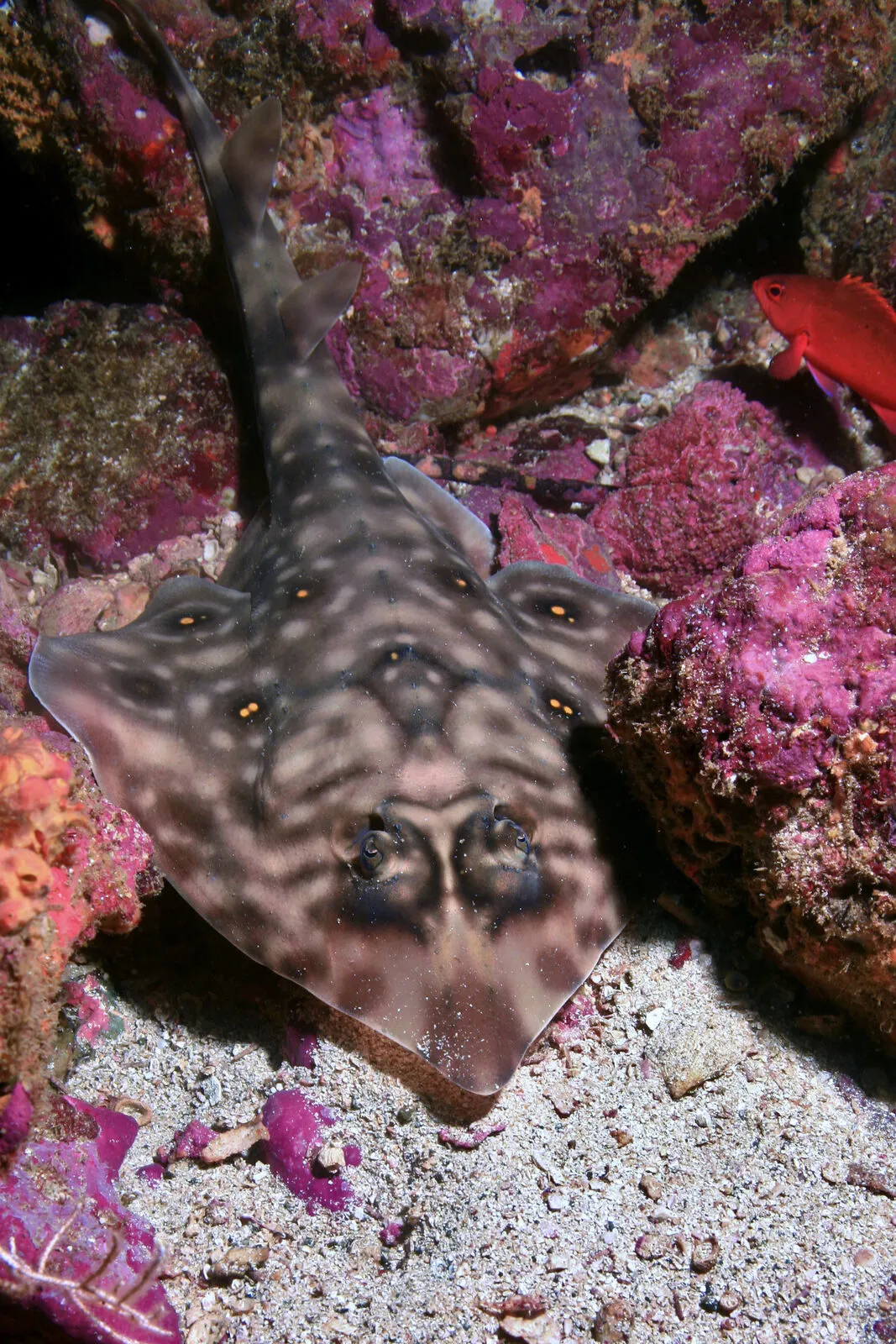

Sawfishes are among the most threatened rays: in 2014 and 2015 two large individuals of Pristis pristis, a species thought to be gone from Peru, were caught in gillnets off Tumbes: one of about 350 cm, a gravid female caught on 22 January 2014, and another of about 600 cm.49 Fishers from Cancas said these fish had been abundant on the north coast and that overfishing, driven by the value of the teeth, had almost eliminated them.49 The rostral teeth of Central and South American sawfishes are the preferred material for the spurs used in cockfighting in Peru, and a pair was valued at 80 to 220 US dollars.50
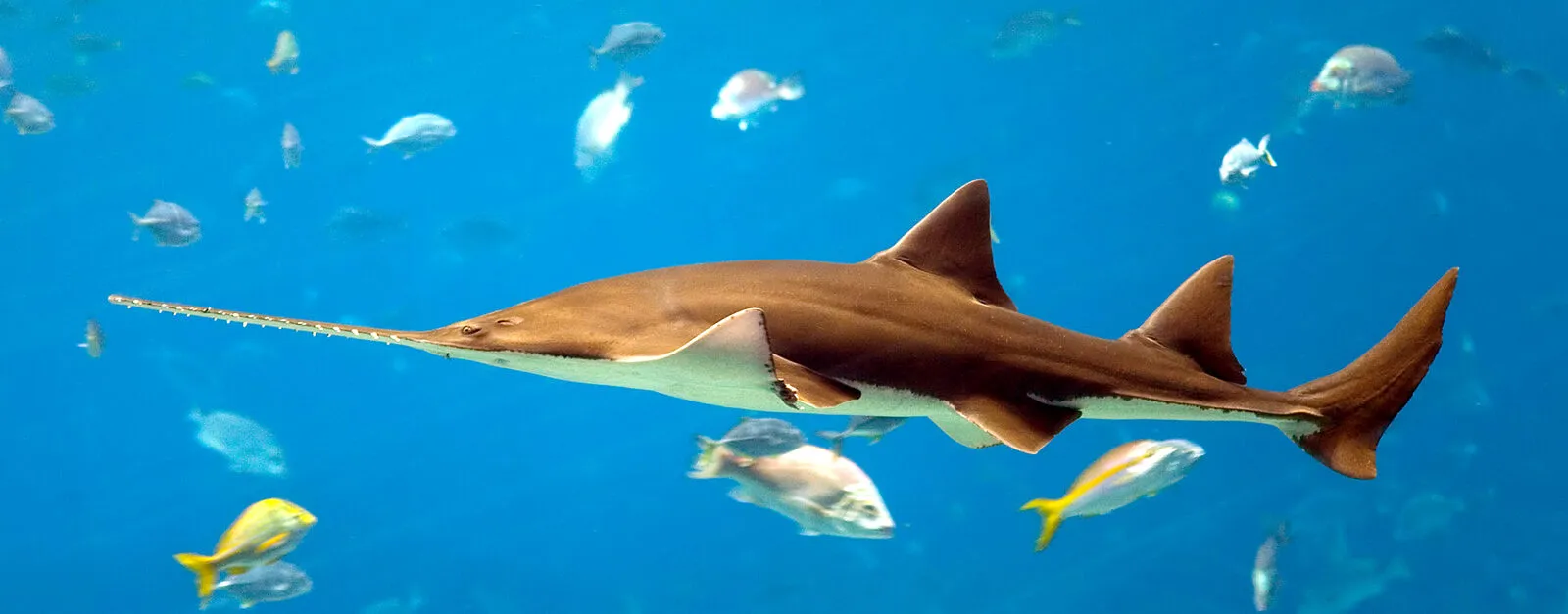

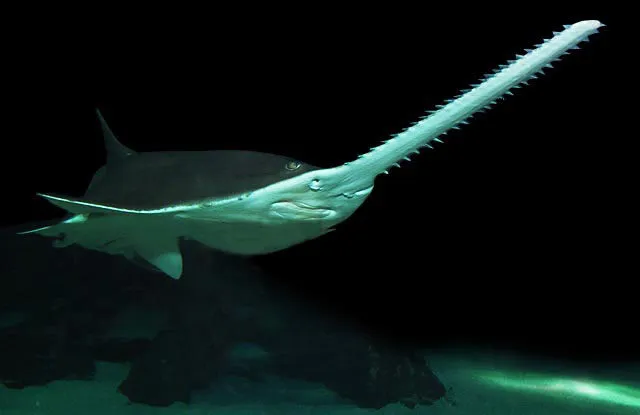
The smalltooth sawfish, Pristis pectinata, is an Atlantic species: it is now considered absent from the Pacific, and its Peruvian record, at the mouth of the Tumbes River, probably belonged to another sawfish.249 Old records from the Pacific coast of Central America are probably misidentifications of other sawfishes.51

Electric rays and skates
The giant electric ray, Narcine entemedor, lives on shallow sandy bottoms and stays buried by day; it enters shallow bays after dark to eat mostly polychaete worms.10 In the southern Gulf of California females reached 84 cm in total length and males 58 cm.52 Tetronarce tremens, from Costa Rica to Chile, reaches 90 cm and its electric organs deliver a shock of about 45 volts, which it uses to stun prey and ward off attackers.53 The northernmost record is a male taken in a bottom gillnet near San Agustinillo, in Oaxaca, Mexico.54
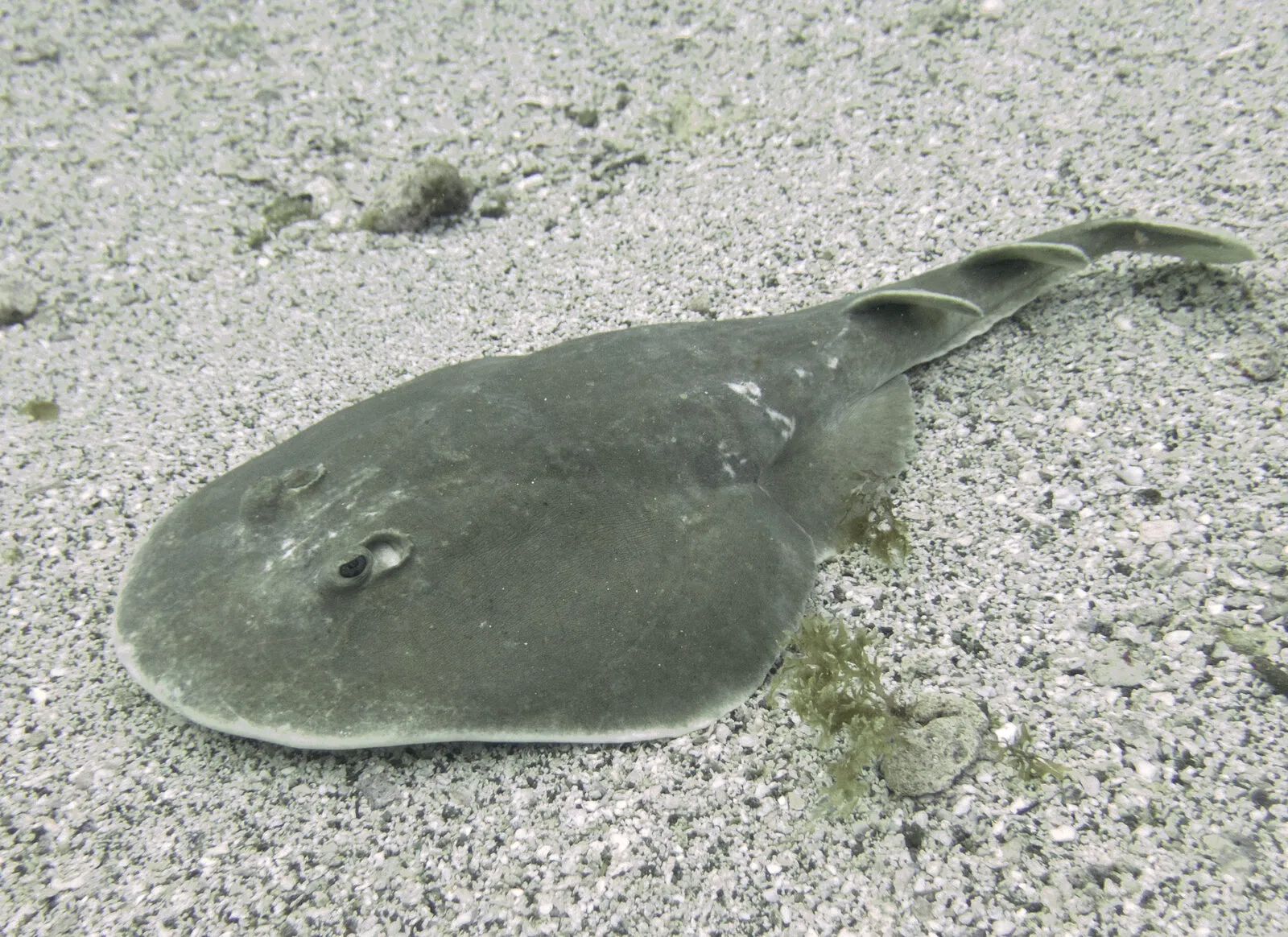

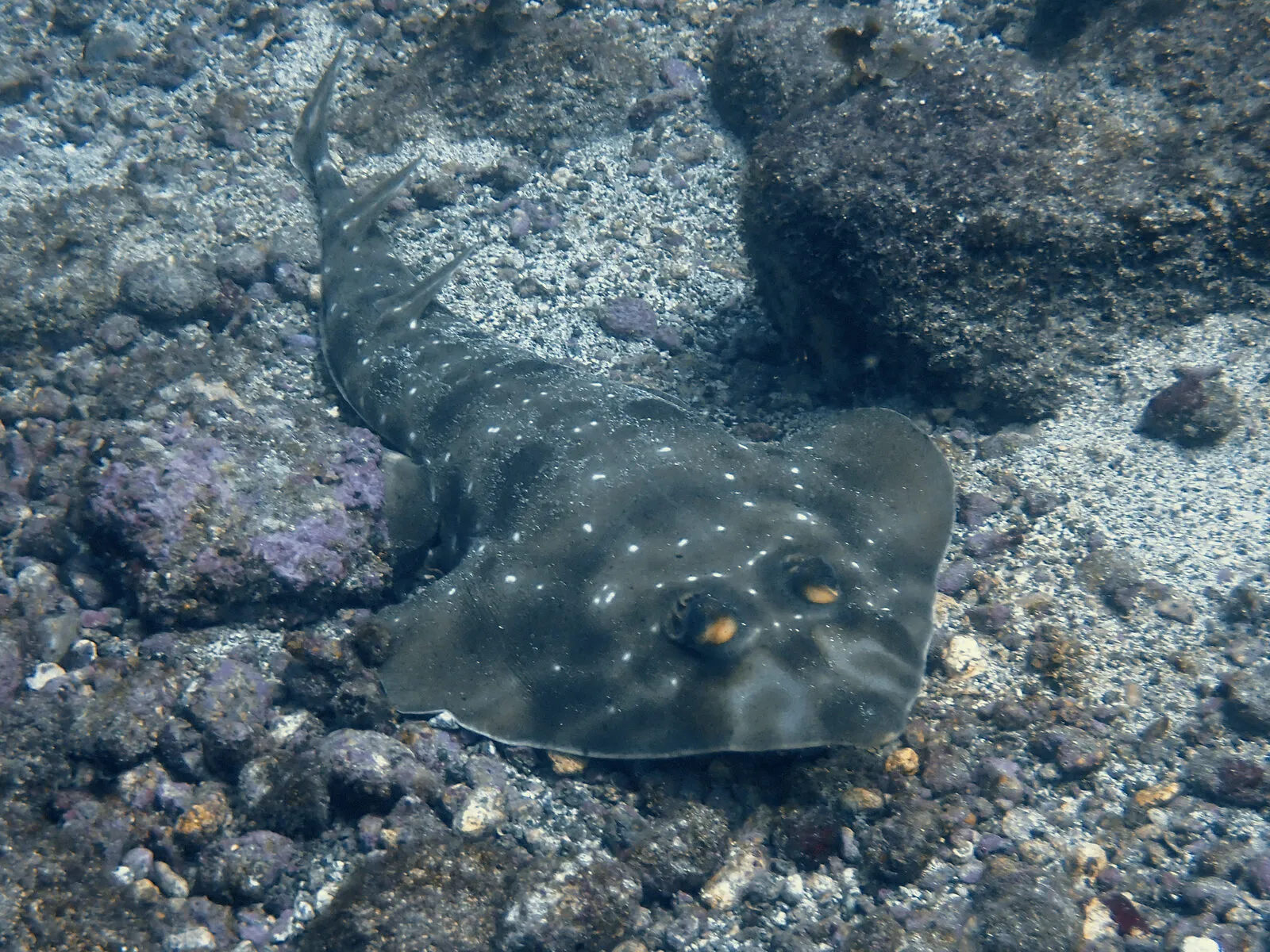
Almost everything gathered here about Discopyge tschudii comes from studies made in Argentina: there the males are larger than the females, which is unusual among cartilaginous fishes, and it feeds mainly on polychaete worms.1255 Its inclusion in the Peruvian checklist rests on an earlier taxonomic reference, not on new sampling.2
Skates lay eggs in capsules: Sympterygia brevicaudata, called «raya espinosa» in a study of specimens bought at Peruvian ports,1 fastens its capsules to algae and other objects with long tendrils.56 Rostroraja velezi was studied at Los Órganos: of 74 stomachs collected at the pier, 59 held food, and decapod crustaceans made up 54.1 % of the index of relative importance and bony fishes 31.5 %.57 Rajella nigerrima is a deep-water skate, recorded between 590 and 1000 m.58 It is worth noting that «raya bruja» designates both Aetobatus laticeps and Rostroraja velezi in the sources.2259
Telling them apart, and where and when they are recorded
Telling one ray from another by eye is difficult, and more so at a port: devil rays have the mouth on the underside; the giant manta carries a spine at the base of the tail, whereas Mobula thurstoni lacks one.1714 Aboard the boats of northern Peru it is hard to tell Mobula thurstoni from Mobula munkiana.60 For years IMARPE statistics attributed the landings to Mobula thurstoni, and misidentifications still bias the catch data.13
Other features are finer: Hypanus longus is told from Hypanus brevis because the distance between the eyes fits about 6 times into the disc width, against about 5.2 times in the other,32 and in Oaxaca, Mexico, processing at landing makes the features that separate it from Hypanus dipterurus disappear.61 Among the butterfly rays, the length of the nasal curtain and the lack of a tail spine in Gymnura crebripunctata set it apart from Gymnura marmorata.62 At Salaverry, Myliobatis chilensis and Myliobatis peruvianus were told apart by the dental plate,11 and in a genetic study a fillet sold as guitarfish in a supermarket in Trujillo turned out to be Myliobatis chilensis.41
Peruvian records come mostly from the far north: at Los Órganos, 20 snorkelling trips in 2016, 2017 and 2019 were made only in the mornings, because from midday strong wind lowers visibility.40 The mantas' satellite tags were fitted off Tumbes in May and July 2018,16 and the three recent encounters with sawfishes in Peru took place between late January and early March.49 Sechura Bay, in Piura, is a key area for the Pacific guitarfish.45 The management plan of the Mar Tropical de Grau National Reserve cites Aetobatus laticeps in the Arrecifes de Punta Sal and Cabo Blanco – El Ñuro sectors.22 According to high-seas longline data, the presence of Pteroplatytrygon violacea in the tropical eastern Pacific was most likely between December and May.63
What they eat and how they reproduce
Devil rays and mantas filter plankton, but with nuances: stable isotopes in mantas sampled in Ecuador assign on average 73 % of their diet to mesopelagic prey and only 27 % to surface zooplankton.64 Bottom rays eat bottom prey: Pseudobatos leucorhynchus feeds mostly on shrimps, which are 52 % of the index of relative importance of its diet,65 and Rhinoptera steindachneri specialises in one bivalve, Tellina subtrigona, which made up 99.5 % of its diet in the upper Gulf of California.66 The smalltooth sawfish feeds mainly on fish and uses its saw to detect and immobilise them.9
Many have few young: the giant manta has a single pup per birth, rarely two, after a pregnancy of about a year, and its maximum population growth rate, 0.116 per year, is one of the lowest among 106 sharks and rays compared.67 Pristis pristis has litters of 7.3 pups on average and an intrinsic rate of increase of only 0.12 per year.50 Hypanus dipterurus has little capacity to recover: in Mexico the population studied could grow only 5 to 6 % a year without fishing, and about 1 % under low fishing mortality.68 Others reproduce faster: Urotrygon chilensis has, in the Gulf of California, an estimated gestation of 6 months and two reproductive periods a year,34 and Pteroplatytrygon violacea can have up to two litters of 4 to 13 pups a year, with a gestation of 2 to 3 months.33
The egg-layers have their own stories: in captivity, 32 of 72 capsules of Sympterygia brevicaudata hatched after about 7 months, and the young measured 5.2 cm.69 Pseudobatos prahli gestates for about 12 months and gives birth around March, according to landings at Santa Elena, Ecuador.47 Narcine entemedor reproduces all year round and its embryos can pause their development.70
Conservation status and threats
On the IUCN Red List, the two sawfishes and two devil rays are in the gravest category: Mobula thurstoni and Mobula tarapacana are listed as Critically Endangered,7172 as are Pristis pristis and Pristis pectinata.7374 Aetobatus laticeps, Hypanus dipterurus, Hypanus longus, Myliobatis chilensis, Narcine entemedor, Pseudobatos planiceps, Pseudobatos prahli, Pseudobatos leucorhynchus, Urobatis tumbesensis, Zapteryx xyster and Mobula munkiana are Vulnerable.7576777879808182394083 Sympterygia brevicaudata, Urotrygon chilensis, Urotrygon aspidura, Rhinoptera steindachneri, Gymnura crebripunctata and Gymnura marmorata are Near Threatened.848586878889 Discopyge tschudii, Tetronarce tremens, Rajella nigerrima and Pteroplatytrygon violacea are of Least Concern.90919293
Peruvian law has protected mantas since January 2016: Ministerial Resolution 441-2015-PRODUCE bans taking them with any gear, and also landing, transporting, processing and selling them.94 In September 2024 a new resolution extended that protection to Mobula tarapacana, Mobula mobular, Mobula thurstoni and Mobula munkiana.95 The rule was due to take effect in January 2025,13 but fishing communities have voiced concern about their livelihoods and enforcement is uncertain.13 In 2017, by contrast, sawfishes were not protected by Peruvian law, so catching and selling them was not illegal.49 Since February 2023, the guitarfish family (Rhinobatidae) has been in CITES Appendix II.96
Fishing is the threat the sources document most: between 2000 and 2023, 7444.9 tons of mobulid rays were reported in the small-scale fishery, and gillnets caught 87.23 % of the landings of Mobula mobular between 2013 and 2023.13 Of the 156 Mobula mobular specimens measured between 2017 and 2019, 92.3 % were juveniles.13 Landings of Hypanus dipterurus fell by an average of 11.5 % a year between 1997 and 2006, and the species has no management measures of its own in Peru.31 For large coastal rays, the management plan of Mar Tropical de Grau points to catches with bottom gillnets, spearguns and handlines, and incidental catches by purse seiners and trawlers operating illegally, with significantly reduced populations.22 Sawfishes are also affected by the loss of mangroves, which serve them as nurseries.49
What is still unknown
For several species there are almost no Peruvian data: Urotrygon serrula was described from a single male and the sources consulted add nothing more, and for Urotrygon caudispinosus the original description is still the main source.37 For Gymnura afuerae the literature consulted has no description of how to recognise it in the water, and a 2024 genetic study calls for a revision of the whole genus.97 What Sympterygia brevicaudata eats at sea has not been described.69
Peruvian research on batoids is scarce: between 1978 and 2022 only 25 studies on Peruvian rays were published.31 The official statistics on mobulid rays do not separate Mobula tarapacana.13 Every specimen of Hypanus dipterurus from northern and central Peru shared a single COI haplotype, which could point to a bottleneck.30 And a 2026 paper argues that, with a much smaller range than was believed, the Pacific guitarfish may be at higher risk than its current category indicates.44
The species in this article
- Aetobatus laticeps
- Mobula birostris
- Urobatis tumbesensis
- Mobula thurstoni
- Hypanus dipterurus
- Pseudobatos planiceps
- Pristis pectinata
- Hypanus longus
- Sympterygia brevicaudata
- Mobula mobular
- Mobula tarapacana
- Pristis pristis
- Urotrygon chilensis
- Pseudobatos prahli
- Zapteryx xyster
- Urotrygon caudispinosus
- Myliobatis chilensis
- Narcine entemedor
- Discopyge tschudii
- Mobula munkiana
- Pseudobatos leucorhynchus
- Urotrygon serrula
- Gymnura crebripunctata
- Gymnura marmorata
- Rhinoptera steindachneri
- Urotrygon aspidura
- Tetronarce tremens
- Rostroraja velezi
- Gymnura afuerae
- Pteroplatytrygon violacea
- Pseudobatos glaucostigma
- Rajella nigerrima
Sources (97)
- Sánchez-Rea, A. & Kanagusuku, K. (2022). Caracterización morfológica preliminar de las estructuras dérmicas de tres especies de batoideos (Chondrichthyes: Batoidea) en el litoral peruano. Revista de Biología Marina y Oceanografía 57 (especial). doi.org
- Cornejo, R. et al. (2015). An updated checklist of Chondrichthyes from the southeast Pacific off Peru. Check List 11(6). doi.org
- WoRMS Editorial Board (2026). Mobula birostris (Walbaum, 1792). World Register of Marine Species. marinespecies.org
- WoRMS Editorial Board (2026). Hypanus dipterurus (Jordan & Gilbert, 1880). World Register of Marine Species. marinespecies.org
- WoRMS Editorial Board (2026). Pseudobatos planiceps (Garman, 1880). World Register of Marine Species. marinespecies.org
- WoRMS Editorial Board (2026). Pristis pectinata Latham, 1794. World Register of Marine Species. marinespecies.org
- WoRMS Editorial Board (2026). Tetronarce tremens (de Buen, 1959). World Register of Marine Species. marinespecies.org
- WoRMS Editorial Board (2026). Rostroraja velezi (Chirichigno F., 1973). World Register of Marine Species. marinespecies.org
- NOAA Fisheries Southeast Region (2023). Smalltooth Sawfish and Smalltooth Sawfish Critical Habitat Consultation Framework. National Marine Fisheries Service, Southeast Regional Office, St. Petersburg (Florida). fisheries.noaa.gov
- Froese, R. & Pauly, D. (2026). Narcine entemedor, Giant electric ray. FishBase. fishbase.se
- Valderrama-Herrera, M. et al. (2026). Reproductive biology of the Chilean eagle ray, Myliobatis chilensis (Myliobatiformes: Myliobatidae), disembarked in the port of Salaverry, Peru. Scientia Marina 90(1): e119. doi.org
- Estalles, M. et al. (2011). Distribution and reproductive biology of the Electric ray Discopyge tschudii Heckel, 1846 in San Matías Gulf, Northern Patagonia, Argentina. Neotropical Ichthyology 9(4). doi.org
- Rojas-Perea, S. et al. (2024). Fisheries, trade, and conservation of manta and devil rays in Peru. Environmental Biology of Fishes. doi.org
- Cabanillas-Torpoco, M. et al. (2019). First description of a giant manta ray fetus Mobula birostris (Walbaum 1792) from Tumbes, Peru (Southeast Pacific). Zootaxa. doi.org
- Harty, K. et al. (2022). Demographics and dynamics of the world’s largest known population of oceanic manta rays Mobula birostris in coastal Ecuador. Marine Ecology Progress Series. doi.org
- Andrzejaczek, S. et al. (2021). Reverse diel vertical movements of oceanic manta rays off the northern coast of Peru and implications for conservation. Ecological Solutions and Evidence. doi.org
- Notarbartolo-di-Sciara, G. (1988). Natural history of the rays of the genus Mobula in the Gulf of California. Fishery Bulletin 86(1), NOAA National Marine Fisheries Service. spo.nmfs.noaa.gov
- Froese, R. & Pauly, D. (2026). Mobula thurstoni, Bentfin devil ray. FishBase. fishbase.se
- Thorrold, S.R. et al. (2014). Extreme diving behaviour in devil rays links surface waters and the deep ocean. Nature Communications. doi.org
- Palacios, M.D. et al. (2021). Description of first nursery area for a pygmy devil ray species (Mobula munkiana) in the Gulf of California, Mexico. Scientific Reports 11: 132. doi.org
- Porsiel, N. et al. (2021). The devil is coming: Feeding behavior of juvenile Munk’s devil rays (Mobula munkiana) in very shallow waters of Punta Descartes, Costa Rica. Revista de Biología Tropical 69(S2). doi.org
- Servicio Nacional de Áreas Naturales Protegidas por el Estado (2026). Plan Maestro de la Reserva Nacional Mar Tropical de Grau 2026–2031. Anexo de la Resolución de Presidencia Ejecutiva N.° 000052-2026-SERNANP/PE. cdn.www.gob.pe
- Froese, R. & Pauly, D. (2026). Aetobatus laticeps, Pacific eagle ray. FishBase. fishbase.se
- Richards, V.P. et al. (2009). Species Delineation and Evolutionary History of the Globally Distributed Spotted Eagle Ray (Aetobatus narinari). Journal of Heredity. doi.org
- Sales, J.B.L. et al. (2019). Phylogeography of eagle rays of the genus Aetobatus: Aetobatus narinari is restricted to the continental western Atlantic Ocean. Hydrobiologia. doi.org
- Vinueza Guarderas, M. et al. (2026). Phylogeography and population genetics of the white spotted eagle ray, Aetobatus laticeps Gill, 1865, in the Eastern Tropical Pacific. PLOS One. doi.org
- Yapur-Pancorvo, A.L. & Pinilla García, F. (2025). Aportes sobre la composición dietaria y los desafíos de conservación de la raya águila chilena (Myliobatis chilensis) en el puerto de Chancay, Lima. South Sustainability 6(2): e127. doi.org
- Carrillo-Colín, L.D. et al. (2021). Bayesian estimation of the age and growth of the golden cownose ray (Rhinoptera steindachneri) in the southern Gulf of California in Mexico. Fishery Bulletin 119 (1). doi.org
- Burgos-Vázquez, M.I. et al. (2018). Reproductive strategy of the Pacific cownose ray Rhinoptera steindachneri in the southern Gulf of California. Marine and Freshwater Research 70 (1). doi.org
- Marín, A. et al. (2026). Hypanus brevis: a newly resurrected Eastern South Pacific stingray lineage revealed by integrative taxonomy. bioRxiv (preprint). doi.org
- González-Pestana, A. et al. (2023). Batoid fishery in Peru (1950-2015): Magnitude, management and data needs. Revista de Biología Marina y Oceanografía. doi.org
- Hooker, Y. (2011). Nuevos registros de peces costeros tropicales para el Perú. Revista Peruana de Biología. doi.org
- Poisson, F. et al. (2024). Preliminary Insights on the Habitat Use and Vertical Movements of the Pelagic Stingray (Pteroplatytrygon violacea) in the Western Mediterranean Sea. Fishes 9. doi.org
- Alvarez-Fuentes, C.J. et al. (2023). Reproductive Ecology of the Chilean Round Ray (Urotrygon chilensis, Günther, 1872) in the Southern Gulf of California. Fishes. doi.org
- Oñate-González, E.C. et al. (2017). Trophic ecology of the blotched stingray, Urotrygon chilensis (Elasmobranchii: Myliobatiformes: Urotrygonidae), in three areas of the Mexican Pacific. Acta Ichthyologica et Piscatoria. doi.org
- Torres-Palacios, K. et al. (2019). Age and growth parameters of the Panamic stingray (Urotrygon aspidura). Fishery Bulletin. doi.org
- Hildebrand, S.F. (1946). A descriptive catalog of the shore fishes of Peru. Bulletin of the United States National Museum. doi.org
- Orrell, T. (2026). NMNH Extant Specimen Records (USNM, US). GBIF occurrence dataset. doi.org
- Kyne, P.M. et al. (2020). Urobatis tumbesensis (IUCN Red List assessment). The IUCN Red List of Threatened Species 2020: e.T63135A124462289. doi.org
- González-Pestana, A. et al. (2023). Ensamble de batoideos costeros en el norte del Perú: Conocimiento preliminar. Revista de Biología Marina y Oceanografía 57 (Especial, 2022 volume). doi.org
- Marín, A. et al. (2018). A glimpse into the genetic diversity of the Peruvian seafood sector: Unveiling species substitution, mislabeling and trade of threatened species. PLOS ONE. doi.org
- Froese, R. & Pauly, D. (2026). Gymnura crebripunctata, Longsnout butterfly ray. FishBase. fishbase.se
- Last, P.R. et al. (2016). A new species of guitarfish, Rhinobatos borneensis sp. nov. with a redefinition of the family-level classification in the order Rhinopristiformes (Chondrichthyes: Batoidea). Zootaxa 4117(4). doi.org
- Almendras, D. et al. (2026). Revised Geographic Distribution of the Pacific Guitarfish Pseudobatos planiceps Based on Occurrence Records and Species Distribution Modelling. Aquatic Conservation: Marine and Freshwater Ecosystems 36. doi.org
- Jimenez, A. et al. (2024). Characterization of a Peruvian coastal fishery targeting the Pacific guitarfish Pseudobatos planiceps. Journal of Fish Biology 105. doi.org
- Moore, A.B.M. (2017). Are guitarfishes the next sawfishes? Extinction risk and an urgent call for conservation action. Endangered Species Research 34. doi.org
- Prieto-Veloz, M.C. et al. (2022). Reproductive biology of the Gorgona guitarfish Pseudobatos prahli in the central-eastern Pacific Ocean. Revista de Biología Marina y Oceanografía 57 (especial). doi.org
- De la Rosa-Meza, K. et al. (2013). Feeding habits of the speckled guitarfish Rhinobatos glaucostigma (Elasmobranchii, Batoidea) in the southeastern Gulf of California. Ciencias Marinas. doi.org
- Mendoza, A. et al. (2017). The Largetooth Sawfish, Pristis pristis (Linnaeus, 1758), is not extirpated from Peru: new records from Tumbes. Check List. doi.org
- Dulvy, N.K. et al. (2016). Ghosts of the coast: global extinction risk and conservation of sawfishes. Aquatic Conservation: Marine and Freshwater Ecosystems. doi.org
- National Marine Fisheries Service (2018). Smalltooth Sawfish (Pristis pectinata) 5-Year Review: Summary and Evaluation of United States Distinct Population Segment of Smalltooth Sawfish. National Marine Fisheries Service, Southeast Regional Office, St. Petersburg (Florida). repository.library.noaa.gov
- Mora-Zamacona, P. et al. (2021). Growth Modeling of the Giant Electric Ray Narcine entemedor in the Southern Gulf of California: Analyzing the Uncertainty of Three Data Sets. Animals 12(1). doi.org
- Froese, R. & Pauly, D. (2026). Tetronarce tremens, Chilean torpedo. FishBase. fishbase.se
- Ruiz-Escobar, F. et al. (2023). Northernmost record of the Chilean torpedo Tetronarce tremens from tropical coastal waters of the Mexican Pacific. Journal of the Marine Biological Association of the United Kingdom 103. doi.org
- Spath, M.C. et al. (2012). Feeding habits of the apron ray, Discopyge tschudii (Elasmobranchii: Narcinidae), from off Uruguay and northern Argentina. Journal of the Marine Biological Association of the United Kingdom 93(2). doi.org
- Seguel, M.E. et al. (2022). Predation and epibiosis on egg capsules of the Shorttail fanskate, Sympterygia brevicaudata. Revista de Biología Marina y Oceanografía. doi.org
- Molina-Salgado, P. et al. (2021). Diet of the rasptail skate, Rostroraja velezi (Rajiformes: Rajidae), off Piura, Peru. Ciencias Marinas 47(2). doi.org
- Froese, R. & Pauly, D. (2026). Rajella nigerrima, Blackish skate. FishBase. fishbase.se
- Roque-Sanchez, M. & Donayre-Salazar, S. (2025). Ampliación de rango geográfico de la raya bruja Rostroraja velezi (Chirichigno, 1973) (Rajiformes: Rajidae) en el litoral centro del Perú. Boletín del Instituto del Mar del Perú 40(2). doi.org
- Alfaro-Cordova, E. et al. (2017). Captures of manta and devil rays by small-scale gillnet fisheries in northern Peru. Fisheries Research. doi.org
- Anislado-Tolentino, V. et al. (2023). Aspectos Biológico Pesqueros de la Raya Arenera, Hypanus Longus (Myliobatiformes: Dasyatidae), Capturada en la Costa de Oaxaca, México. Ciencia Pesquera. doi.org
- Smith, W. et al. (2009). Morphometric convergence and molecular divergence: the taxonomic status and evolutionary history ofGymnura crebripunctataandGymnura marmoratain the eastern Pacific Ocean. Journal of Fish Biology. doi.org
- Wang, J. et al. (2023). Environmental Characteristics Associated with the Presence of the Pelagic Stingray (Pteroplatytrygon violacea) in the Pacific High Sea. Fishes 8. doi.org
- Burgess, K.B. et al. (2016). Manta birostris, predator of the deep? Insight into the diet of the giant manta ray through stable isotope analysis. Royal Society Open Science. doi.org
- Payán, L.F. et al. (2011). Biologia de la raya guitarra Rhinobatos leucorhynchus (Günther, 1867) (Rajiformes: Rhinobatidae) en el Pacifico colombiano. Latin American Journal of Aquatic Research 39(2). doi.org
- Simental-Anguiano, M.D.R. et al. (2022). Importance of Shellfish in the Diet of Two Ray Species (Rhinoptera steindachneri and Hypanus dipterurus) in the Upper Gulf of California. Journal of Shellfish Research 41 (2). doi.org
- Dulvy, N.K. et al. (2014). Diagnosing the dangerous demography of manta rays using life history theory. PeerJ. doi.org
- Smith, W.D. et al. (2008). Demography and elasticity of the diamond stingray, Dasyatis dipterura: parameter uncertainty and resilience to fishing pressure. Marine and Freshwater Research. doi.org
- Méndez-Abarca, F. et al. (2024). Morfología de los estados embrionarios tardíos y cápsula ovígera de Sympterygia brevicaudata (Rajiformes: Arhynchobatidae) en el norte de Chile. Revista de Biología Marina y Oceanografía. doi.org
- Pérez-Palafox, X.A. et al. (2022). Length at Maturity, Sex Ratio, and Proportions of Maturity of the Giant Electric Ray, Narcine entemedor, in Its Septentrional Distribution. Animals 12(1). doi.org
- Jabado, R.W. et al. (2025). Mobula thurstoni (IUCN Red List assessment). The IUCN Red List of Threatened Species 2025: e.T60200A279078290. doi.org
- Jabado, R.W. et al. (2025). Mobula tarapacana (IUCN Red List assessment). The IUCN Red List of Threatened Species 2025: e.T60199A279077133. doi.org
- Kyne, P.M. et al. (2013). Pristis pristis (IUCN Red List assessment). The IUCN Red List of Threatened Species 2013: e.T18584848A18620395. doi.org
- Carlson, J. et al. (2022). Pristis pectinata (IUCN Red List assessment). The IUCN Red List of Threatened Species 2022: e.T18175A249881355. doi.org
- Pollom, R. et al. (2019). Aetobatus laticeps (IUCN Red List assessment). The IUCN Red List of Threatened Species 2021: e.T104021731A104021771. doi.org
- Pollom, R. et al. (2020). Hypanus dipterurus (IUCN Red List assessment). The IUCN Red List of Threatened Species 2020: e.T60152A80677563. doi.org
- Pollom, R. et al. (2020). Hypanus longus (IUCN Red List assessment). The IUCN Red List of Threatened Species 2020: e.T60157A124445324. doi.org
- Dulvy, N.K. et al. (2019). Myliobatis chilensis (IUCN Red List assessment). The IUCN Red List of Threatened Species 2020: e.T60123A124441181. doi.org
- Pollom, R. et al. (2019). Narcine entemedor (IUCN Red List assessment). IUCN Red List of Threatened Species. doi.org
- Kyne, P.M. et al. (2020). Pseudobatos planiceps (IUCN Red List assessment). The IUCN Red List of Threatened Species 2020: e.T44584A124433864. doi.org
- Kyne, P.M. et al. (2020). Pseudobatos prahli (IUCN Red List assessment). The IUCN Red List of Threatened Species 2020: e.T63158A124463727. doi.org
- Pollom, R. et al. (2019). Pseudobatos leucorhynchus (IUCN Red List assessment). The IUCN Red List of Threatened Species 2020: e.T60168A124446908. doi.org
- Marshall, A. et al. (2018). Mobula munkiana (IUCN Red List assessment). The IUCN Red List of Threatened Species. doi.org
- Dulvy, N.K. et al. (2019). Sympterygia brevicaudata (IUCN Red List assessment). The IUCN Red List of Threatened Species 2020: e.T44596A124434224. doi.org
- Kyne, P.M. et al. (2020). Urotrygon chilensis (IUCN Red List assessment). The IUCN Red List of Threatened Species 2020: e.T44647A124436667. doi.org
- Kyne, P.M. et al. (2020). Urotrygon aspidura (IUCN Red List assessment). The IUCN Red List of Threatened Species 2020: e.T161689A124528276. doi.org
- Pollom, R. et al. (2020). Rhinoptera steindachneri (IUCN Red List assessment). The IUCN Red List of Threatened Species 2020: e.T60130A124442442. doi.org
- Pollom, R. et al. (2019). Gymnura crebripunctata (IUCN Red List assessment). The IUCN Red List of Threatened Species 2020: e.T14134431A124549206. doi.org
- Pollom, R. et al. (2019). Gymnura marmorata (IUCN Red List assessment). The IUCN Red List of Threatened Species 2020: e.T14134429A124548901. doi.org
- Dulvy, N.K. et al. (2019). Discopyge tschudii (IUCN Red List assessment). The IUCN Red List of Threatened Species 2020: e.T44993A2999889. doi.org
- Dulvy, N.K. et al. (2021). Tetronarce tremens (IUCN Red List assessment). The IUCN Red List of Threatened Species 2021: e.T201621105A201621664. doi.org
- Ebert, D.A. et al. (2019). Rajella nigerrima (IUCN Red List assessment). The IUCN Red List of Threatened Species 2020: e.T44655A124437551. doi.org
- Kyne, P.M. et al. (2018). Pteroplatytrygon violacea (IUCN Red List assessment). The IUCN Red List of Threatened Species 2019: e.T161731A896169. doi.org
- Ministerio de la Producción (2016). Resolución Ministerial N.° 441-2015-PRODUCE: prohíben extracción de la especie Mantarraya gigante con cualquier arte o aparejo de pesca y/o cualquier otro instrumento, en aguas marinas de la jurisdicción peruana. El Peruano, Normas Legales (01-01-2016). busquedas.elperuano.pe
- Ministerio de la Producción (2024). Resolución Ministerial N.° 000362-2024-PRODUCE: incorporan nuevas especies dentro de los alcances de la Resolución Ministerial N.° 441-2015-PRODUCE. El Peruano, Normas Legales (08-09-2024). busquedas.elperuano.pe
- UNEP-WCMC (2026). Pseudobatos planiceps (Garman, 1880). Species+ (CITES listings). speciesplus.net
- Ehemann, N.R. et al. (2024). Barcode Reveals Hidden Diversity and Cryptic Speciation among Butterfly Rays Distributed in the Americas. Taxonomy 4. doi.org