
Blog · wildlife of Peru
The sea turtles and the sea snake of Peru
Five sea turtles and one open-sea snake frequent the waters of Peru.
Published

Six reptiles, two ways of living at sea
The National Plan for the Conservation of Sea Turtles in Peru, which covers 2019-2029, deals with five turtle species present in Peruvian waters.1 They are the olive ridley (Lepidochelys olivacea), the hawksbill (Eretmochelys imbricata), the green turtle (Chelonia mydas), the loggerhead (Caretta caretta) and the leatherback (Dermochelys coriacea).123
A sea snake, Hydrophis platurus, joins them, and it is the only sea snake in the tropical waters of the west coast of the Americas.4 The leatherback, for its part, is the only living species in its family, Dermochelyidae.1
Of the five turtles, the olive ridley has the most nesting records in Peru, and nests of the green turtle have also been recorded in the north.1 The hawksbill does not nest in the country.5 For the loggerhead, no nesting beaches are known in the eastern Pacific.6 There are no records of leatherback nests on Peruvian beaches.1 The snake, by contrast, needs no beach at all: it is viviparous and gives birth to live young at the sea surface.7
Who is who
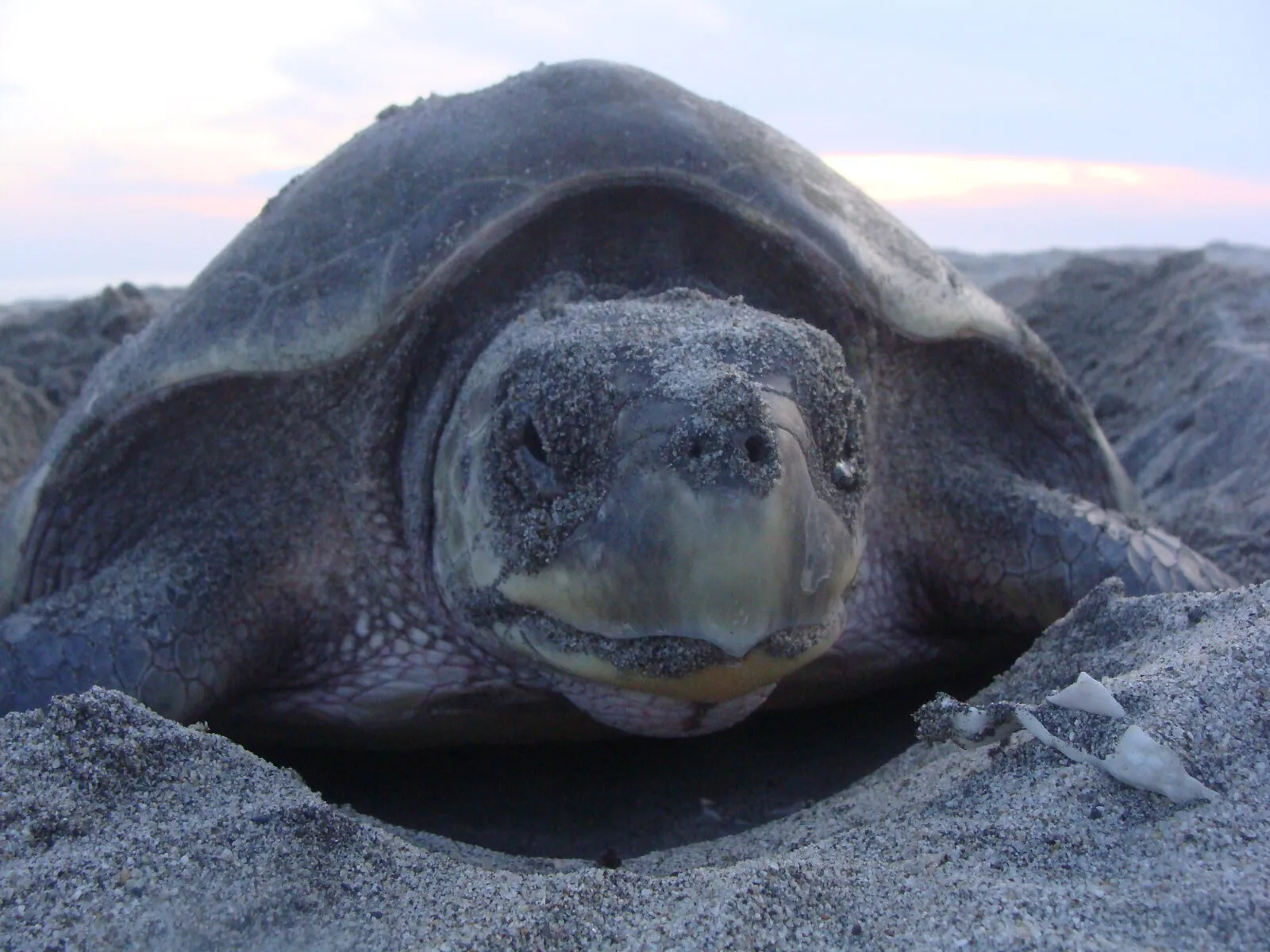
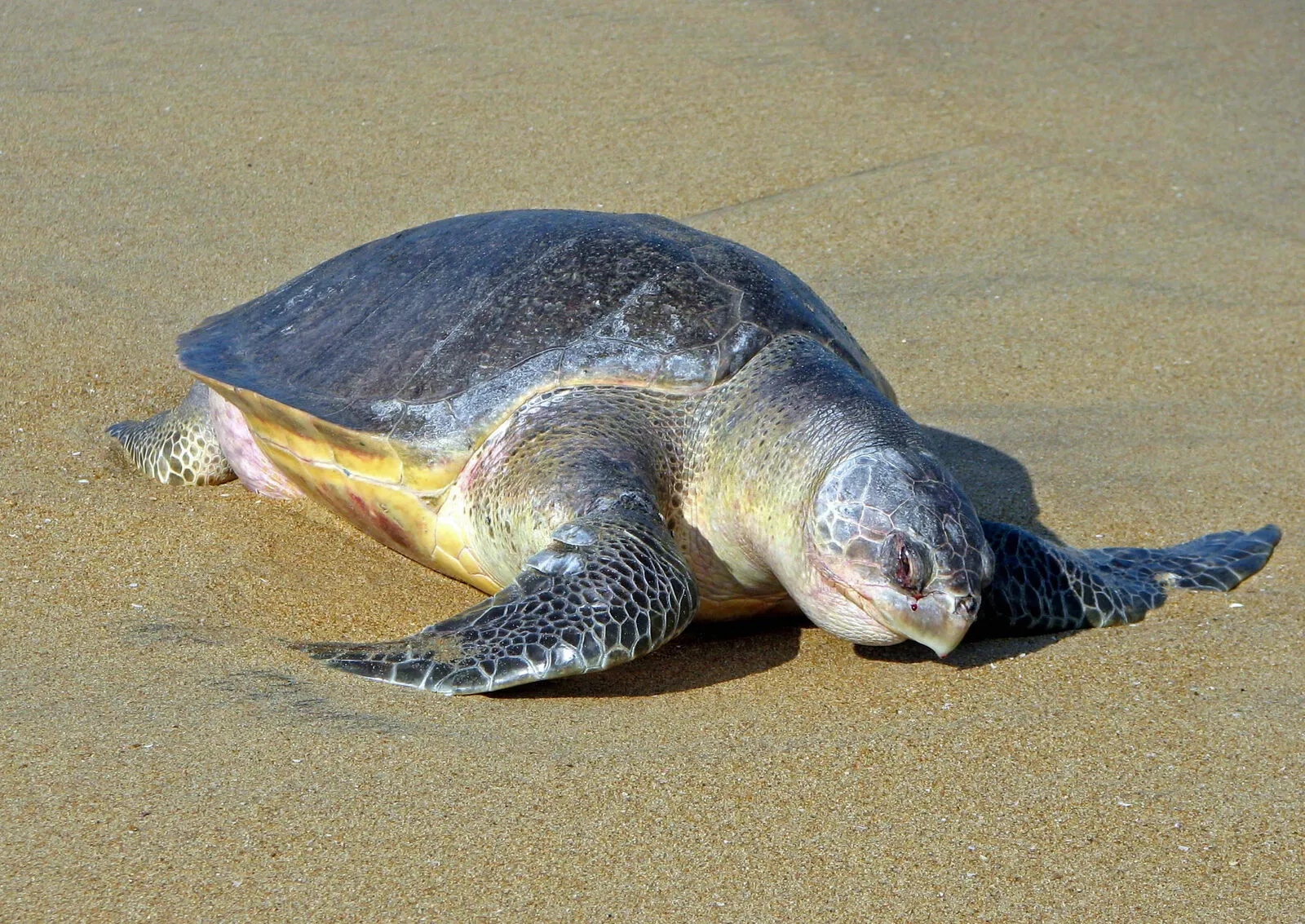
The olive ridley, also called pico de loro in Peru, is the sea turtle with the most nesting records in the country.1 The ones that reach Peruvian waters belong to the eastern Pacific population.1 It is one of the smallest sea turtles: adults weigh about 45 kg.8

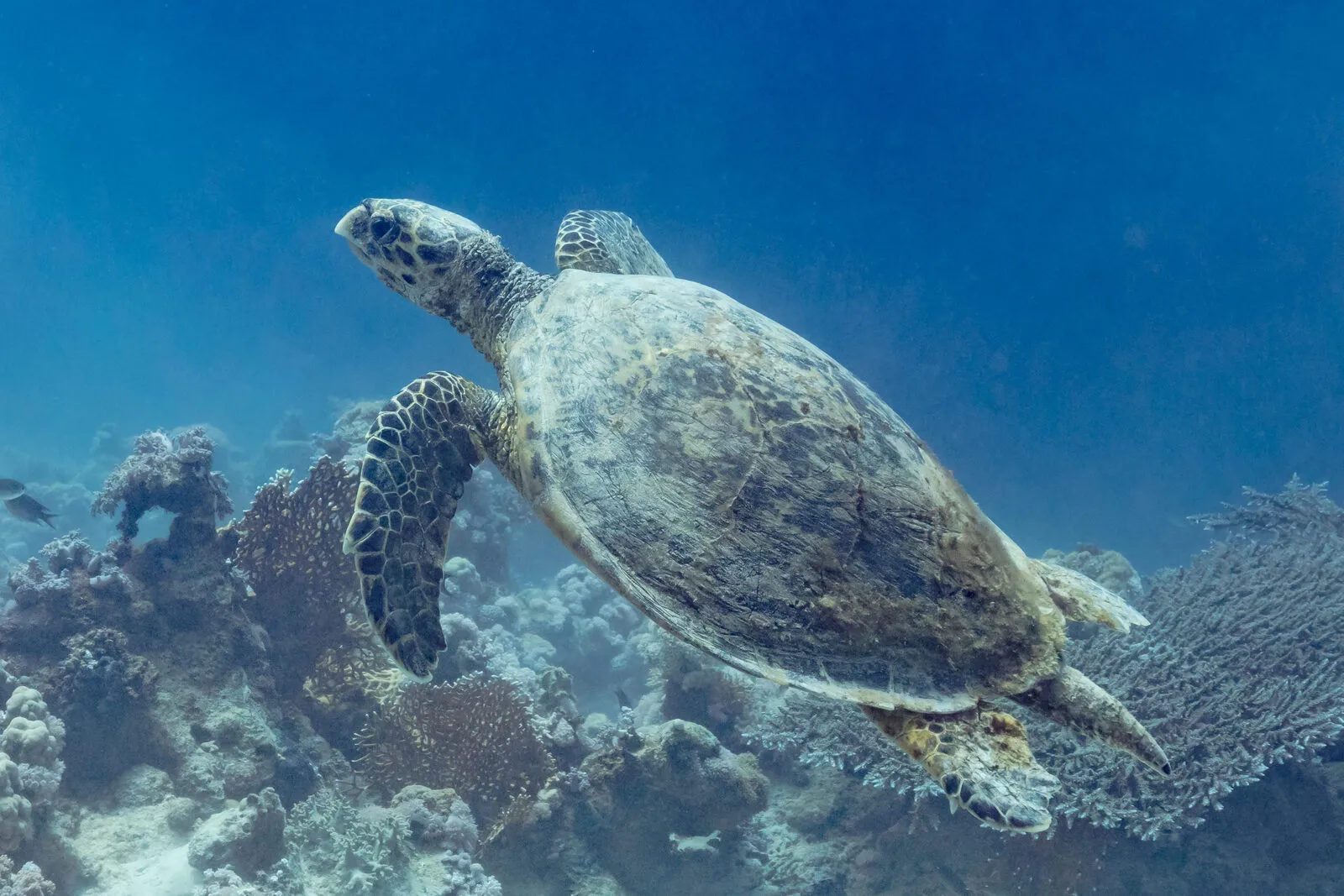
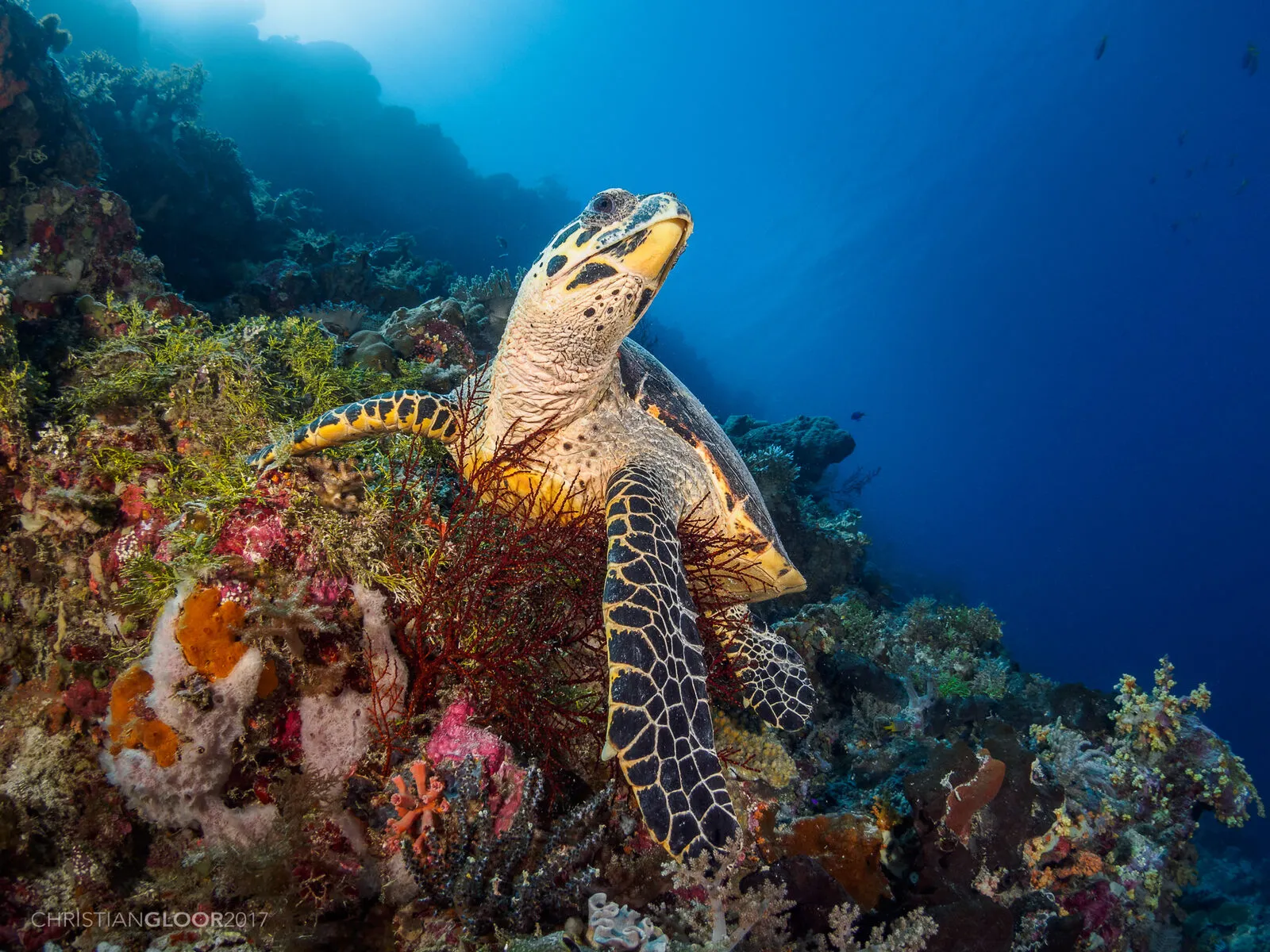
According to the national plan, the hawksbill is the most tropical of the sea turtles recorded in the country, and most of its Peruvian records come from Tumbes and Piura.1 It feeds mainly on sponges and corals.3 Almost all the ones that reach Peru are juveniles.5

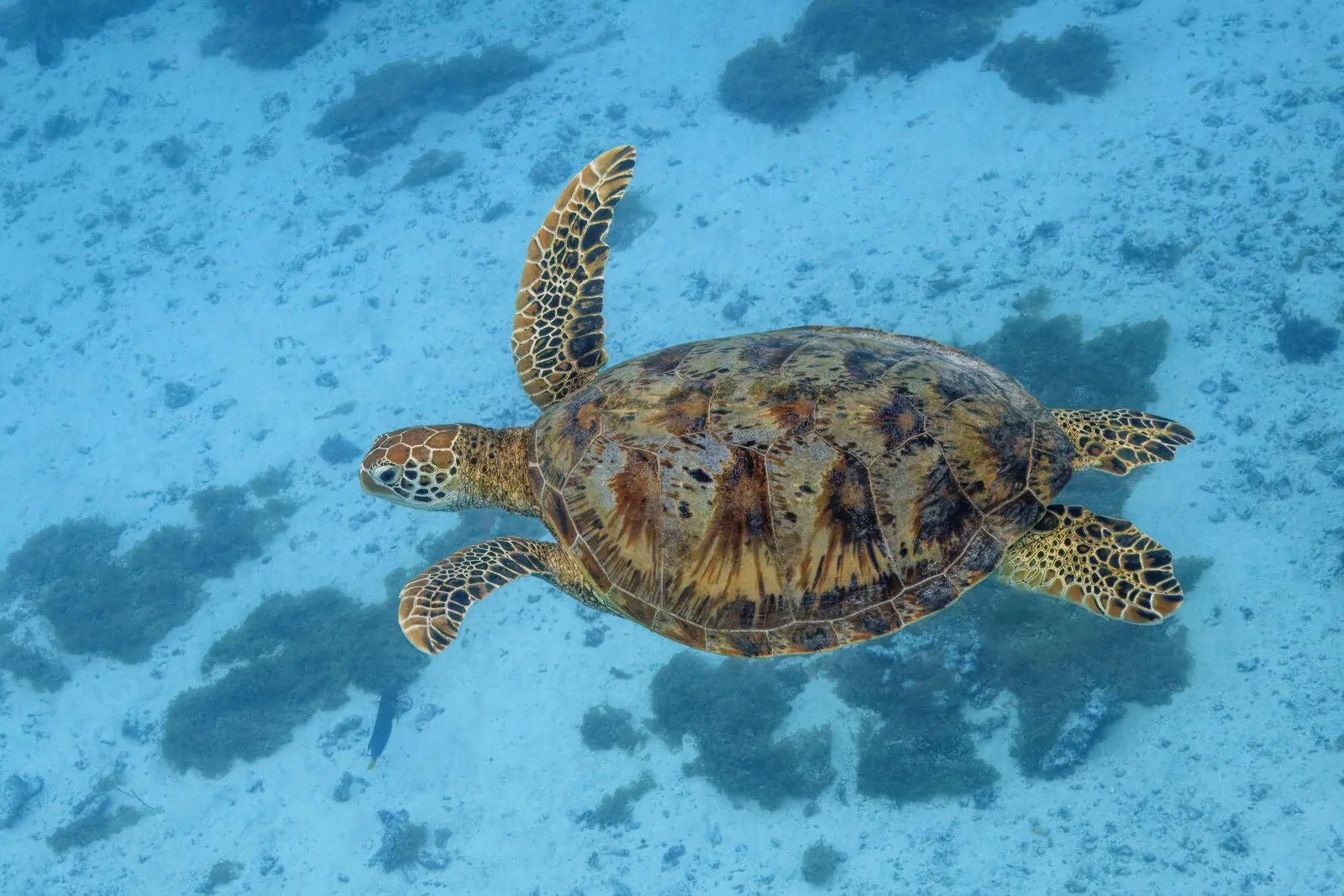
The green turtle is medium to large: in the genus Chelonia, adults usually measure between 70 and 140 cm in straight carapace length and weigh between 50 and 200 kg.9 In Peruvian coastal waters it forms stable feeding aggregations, with individuals that stay in the same place for months.10
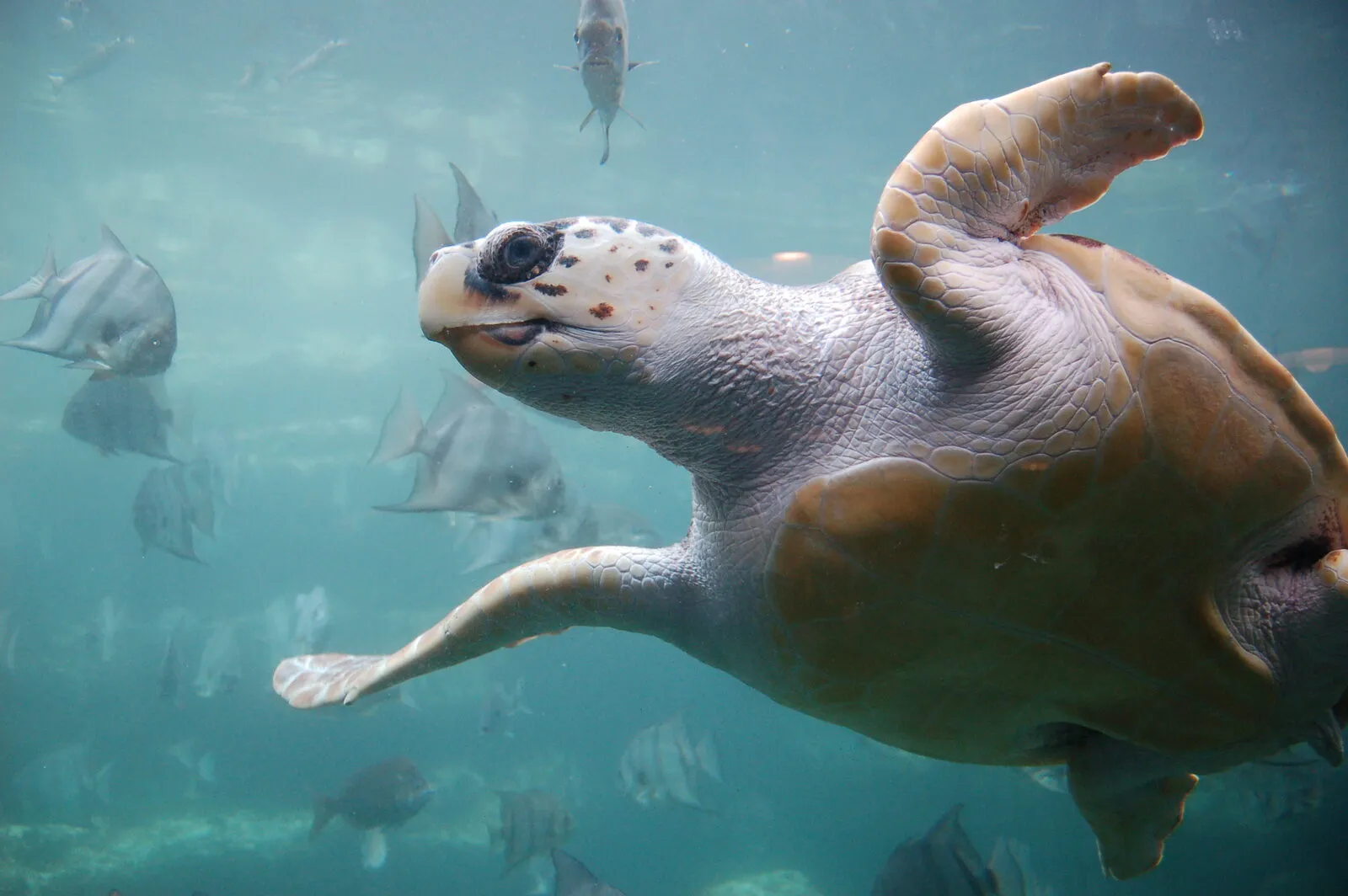
The loggerhead owes its Spanish name, cabezona, to its large head, whose jaws can crush hard prey.3 Almost all the ones measured in Peru are juveniles.11 They were not born here: their haplotypes match those of the females that nest in the southwestern Pacific.12

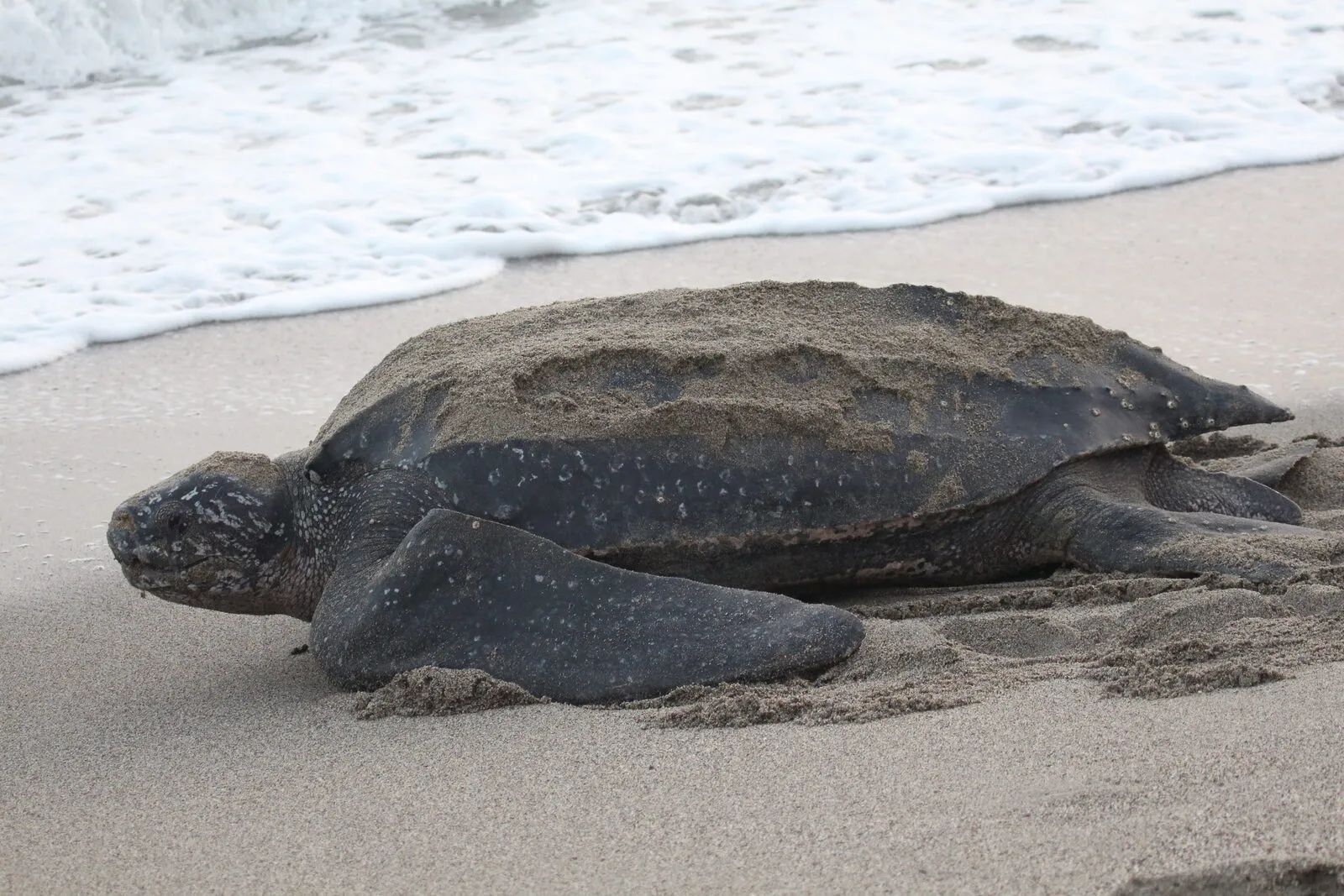
The leatherback is the largest sea turtle and, according to the official observation manual, can reach 3 metres.3 In Peru it is also called tortuga dorso de cuero or tinglada.1 Off the coast it feeds mainly on the jellyfish Chrysaora plocamia.1
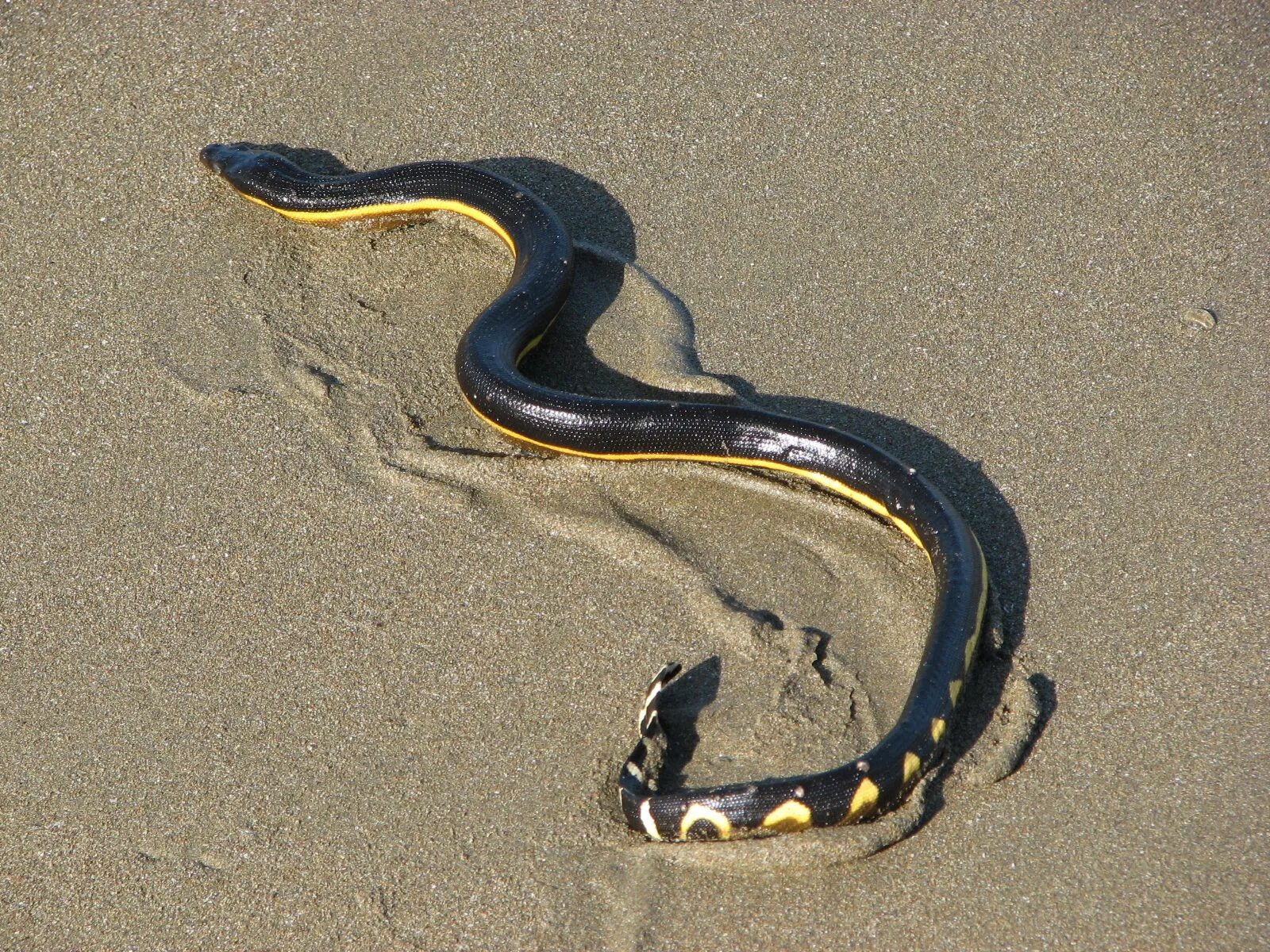
Hydrophis platurus is a venomous snake of the family Elapidae that spends its life on the open sea.13 For a long time it was called Pelamis platurus.13 In Peru almost nothing is known about its ecology or its population size.14
Telling them apart
Among the hard-shelled turtles, the carapace scutes help tell them apart.9 The green turtle has 4 pairs of lateral scutes that do not overlap, and the first one does not touch the precentral scute.9 The loggerhead has 5 pairs of lateral scutes, the first touching the precentral scute, and a broad head that takes up between 23 and 28 % of the carapace length.9 The olive ridley carries 5 to 9 pairs of lateral scutes and 1 or 2 claws on each flipper.8 The hawksbill has scutes that overlap like roof tiles, a serrated carapace edge, an elongated snout and two claws on each front flipper.5
Immature green turtles, with markings that radiate like sunrays across the carapace, are often mistaken for the hawksbill.15 In January 2014 a 47.3 cm juvenile with features of both species was caught at El Ñuro, Piura.5 Its mitochondrial DNA and its morphology showed that it was the cross of a female hawksbill and a male green turtle, the first sea turtle hybrid documented in the southeastern Pacific.5 Because its general appearance was that of a green turtle, the authors warn that other hybrids could go unnoticed without a careful examination.5
With the eastern Pacific green turtle, taxonomy has changed its mind: the FAO catalogue of 1990 treated it as a separate species, Chelonia agassizii, the smallest of the genus, with a carapace narrower and usually more domed than that of the Atlantic and Indo-Pacific green turtles.9 Its adults are typically dark: the carapace ranges from slate grey to black.9 The IUCN Red List assessment of 2025 is published under the name Chelonia mydas.16
The leatherback differs from all the others because it has no scales and no hard shell: its back is thick, rubbery skin crossed by 7 longitudinal ridges.17 On its size the sources disagree.3171 The Peruvian manual says it can reach 3 metres.3 NOAA gives 5 to 6 feet, about 1.5 to 1.8 m, for adults.17 At the port of Pucusana 115 animals were measured, with a mean carapace length of 135 cm, ranging from 112 to 168 cm.1
The sea snake is very different from the turtles: most individuals have a black back, a yellow belly and a paddle-shaped tail.13 The only Peruvian specimen described, an adult male from Máncora, measured 660 mm in total length.14 In Golfo Dulce, Costa Rica, lives an almost entirely yellow population, described as the subspecies Hydrophis platurus xanthos.13 A later study does not consider it prudent to make taxonomic changes for that population.4
Where and when they are recorded in Peru
The olive ridley is more common in the north of the country, where the sea is warmer, and the authors regard Tumbes as the most important region of Peru for the species.18 The olive ridleys that interact with longline fishing appear from the Ecuadorian border to 18° S, with the largest catches between 6° and 8° S.1 The hawksbill has been reported from the Los Manglares de Tumbes National Sanctuary to Pisco, in Ica, and most of its records are from Tumbes and Piura.31 At El Ñuro it is scarce: in 11 in-water campaigns between 2010 and 2014, 186 different green turtles were caught and only 2 hawksbills were seen.5
Green turtles have been studied in places very different from each other.10 El Ñuro, near 4° S, is a transition zone between coastal upwelling and warm equatorial waters, whereas Paracas, near 14° S, is dominated by upwelling.10 Another study compared the Virrila estuary, near 5° S, with La Aguada, near 14° S.19 Sechura Bay is a critically important feeding area for green turtles that have not yet matured.20
The loggerhead is mostly an open-sea animal.21 Between 2000 and 2007, observers aboard the artisanal fleet recorded 323 loggerhead captures between 13° and 22° S, from 46.5 to 637.1 km offshore, and 82 % took place on boats sailing from Ilo.11 Loggerheads tagged with satellite transmitters spent more than 97 % of their time over bottoms deeper than 1000 m.21 A juvenile found in September 2015 at La Aguada, in Paracas, was the first record in a clearly neritic zone of the country.1
The leatherback has been documented in coastal and oceanic waters, with an important aggregation off La Libertad.1 Off Pisco it has been most frequent between December and March.1 In the north, adults arrive mainly in the austral summer, from November to May, and juveniles could be present all year.22

Warm El Niño events are linked to some of the records.23 Off Lambayeque, between 1996 and 1998, the artisanal gillnet fleet caught 383 sea turtles, and 99 % of them fell during the 1997-1998 El Niño, which brought the turtles closer to the fishing grounds.23 The hawksbill's presence in the south would be linked to El Niño or to warm currents.1 Something similar happens to the sea snake: its southern limit in the eastern Pacific lies at about 5° S because of the influence of the cold Peruvian current.14 Its presence in Peru had not been formally confirmed for more than four decades when, on 12 July 2012, a live specimen was stranded south of Máncora during a warm El Niño Modoki event.14

What they eat
The olive ridley is omnivorous: it eats algae, crustaceans, tunicates and molluscs, and can dive to about 150 m to look for invertebrates on the bottom.8 At San Andrés, Pisco, the stomachs of 7 turtles examined between 1999 and 2000 held crabs, molluscs such as the scallop and green algae.1
In the green turtle, diet changes with age and place.19 At La Aguada the turtles were mostly juveniles and ate mainly animal matter, whereas in the Virrila estuary subadults predominated, with a diet dominated by plant matter.19 The authors propose that juveniles first arrive at coastal habitats in southern Peru and, as they grow, move north, where plant food is less caloric but abundant.19
The hawksbill feeds mainly on sponges and corals.3 However, the national plan of 2019 notes that no information on its diet had been recorded in the country.1 The loggerhead feeds in oceanic environments at an intermediate trophic level, and its important prey include cnidarians and molluscs.1 It also eats the jumbo squid and the mackerel used as bait on longlines.1

The leatherback eats mainly the jellyfish Chrysaora plocamia: during the 1987 El Niño, the stomach contents of one animal were 100 % that jellyfish.1 Between 2010 and 2014, the species' annual presence off Peru closely followed the abundance of the jellyfish, with a correlation coefficient of 0.935.1 The sea snake feeds on small fish that it catches opportunistically, floating at the surface.13 It does not drink seawater: it takes fresh water from the lenses that form over the sea after heavy rain.24
Where the ones we see were born
By January 2016, 112 sea turtle nestings had been identified in northern Peru, 75.3 % of them olive ridley, and the beach with the most nestings was El Bravo, between Máncora and Punta Sal, with 58.1 In February 2010 a fisherman saw 80 hatchlings leave the beach at Bomba, in Negritos (Piura), then the known southern nesting limit for the species in the eastern Pacific.1 Females of the species can nest en masse, in arribadas of hundreds or thousands at once, or alone.8
Olive ridleys tracked by satellite from Costa Rica did not use common routes or fixed feeding areas: they stayed on the move almost all the time.25 In Peru, the mitochondrial DNA of 21 turtles caught on the artisanal longline between 2003 and 2009 pointed to nesting beaches in Mexico, Costa Rica and Colombia.1 A turtle tagged in September 1986 at La Escobilla, in Mexico, was caught at Pisco in November of that year.1
The nine eastern Pacific sites with more than 10 hawksbill nests in some season are in Mexico, El Salvador, Nicaragua, Costa Rica and Ecuador.26 Of all the hawksbills reported in Peru, only one was not a juvenile.5 In Sechura Bay, 6 of 8 juveniles with transmitters did not leave the bay, and 2 left and travelled more than 1000 km, passing the Galápagos Islands.27
Peruvian loggerheads share haplotypes with the females that nest in the southwestern Pacific.12 The authors conclude that turtles born in eastern Australia or New Caledonia cross the ocean and spend part of their youth off South America.12 Of 307 animals measured between 2000 and 2007, 91.5 % were classed as juveniles.11 The authors of another study regard many of them as residents of the waters off Peru and Chile.21
Of 46 female leatherbacks tagged with satellite transmitters at Playa Grande, Costa Rica, between 2004 and 2007, the mean distance travelled was 8070 km: after laying they swam south along the same route each year and reached the South Pacific gyre.28 Those that reach Peru belong mainly to the eastern Pacific population, whose main nesting beaches are in Costa Rica and Mexico.1 At the port of Chimbote a female with mature eggs inside her was found.1
Conservation status
The olive ridley is listed as Vulnerable on the IUCN Red List (2008 assessment) and also as Vulnerable on the official Peruvian list of 2014.2930 The hawksbill is Critically Endangered in the global assessment and also on the Peruvian list.3130 The green turtle is listed as Least Concern in the 2025 global assessment.16
The loggerhead is Vulnerable in the global assessment, but is categorised as Endangered in Peru.3230 The leatherback is Vulnerable on the 2013 Red List and is classified as Endangered on the 2014 Peruvian list.3330 In both cases the Peruvian category is higher than the global one.323330
The sea snake is listed as Least Concern.34 A study using ocean-current models suggests that its population across the whole ocean must be enormous.35 In Peru, by contrast, the population size is unknown.14
The Peruvian regulation of 2014 prohibits the hunting, capture, possession, trade, transport or export for commercial purposes of the hawksbill.30 Peru is a party to the Inter-American Convention for the Protection and Conservation of Sea Turtles, whose parties committed in 2015 to conserving the eastern Pacific leatherback population.3 In 2014 the Convention on Migratory Species approved a specific action plan for the South Pacific loggerhead.3
What threatens them
Incidental capture in fishing is one of the main threats to sea turtles.36 With observers at only 3 ports between 2000 and 2007, a catch of about 3200 loggerheads a year was estimated in artisanal fishing, and the authors consider it likely that, adding up all species, the catch in the country reaches tens of thousands of turtles a year.37 Of 51 hooked loggerheads whose wound could be assessed, 41.2 % had serious injuries.11 Turtles tracked by satellite spent 75 % of their time inside the fishing grounds of the Peruvian artisanal longline fleet.21
In Tumbes, observers aboard 160 gillnet trips between 2017 and 2019 recorded that 14 % of the turtles caught were olive ridleys (6 animals).36 The bottom net with a 152 to 229 mm mesh, used for guitarfish and rays, was the deadliest, with 66.7 % mortality.36 In the north, the participatory risk analysis of 2019 identified gillnets as the gear posing the highest risk to the leatherback.22 A 2007 paper brought together 33 records of entangled or hooked leatherbacks noted opportunistically from 1985 to 1999 and 133 documented by observers at the piers from 2000 to 2003.38
Killing for meat also weighs heavily.18 Of the 39 olive ridleys recorded in Tumbes between 2006 and 2011, all the stranded ones were dead and 48.3 % of them had been cut up to sell the meat.18 In the dumps of Pisco, between 2009 and 2015, 97.5 % of the identified olive ridley carapaces came from turtles caught for human consumption.1 Loggerhead meat is sometimes eaten on board or in the fishing coves, or sold in markets, although that consumption is illegal.1137 In 2010, 13 hawksbill shells were counted in the homes of fishers and in restaurants at San Andrés, in Pisco.1 In Tumbes, according to a paper cited by IMARPE researchers, traders or craftspeople ask for hawksbill shells and pay up to 80 soles for each.36

The ingestion of macroplastics rose significantly between 2001–2004 and 2013–2014 in green turtles of Sechura Bay, especially in juveniles.20 In the eastern Pacific, those who protect the hawksbill worry about the conversion of mangroves into shrimp-farming ponds and about tides that flood the nests.26 According to the national plan, which cites the regional action plan of the Laúd OPO network, the eastern Pacific leatherback population has fallen by more than 90 % since 1980.1 On the beaches of eastern Australia, where some of the loggerheads that reach Peru come from, nesting fell by 86 % over 23 years.21
Good practice according to the official guidelines
The Ministry of Foreign Trade and Tourism (MINCETUR) published, with German Cooperation (GIZ), a manual of good practice for sea turtle observation on the Peruvian coast.3 The manual counts among disturbances feeding the turtles, handling them or taking them out of the sea, approaching them and damaging their habitat.3 For anyone in the water, it asks not to touch the turtles or wild marine fauna in general.3 It also asks to let the animals approach by themselves and to avoid chasing, cornering, grabbing or trying to ride them.3
While swimming, the manual sets a minimum distance of three metres from the turtles, with no more than 15 minutes of observation per turtle, and asks to move away if the animal is not comfortable.3 It asks for photos without flash and not to handle the turtle to get a photo or a video.3 For boats it sets the engine off and a minimum distance of 30 metres from the observed animal.3 It rejects feeding the turtles or using bait, because it alters their behaviour.3 As an example, it cites the Greek island of Zakynthos, where some fed turtles began to bite visitors and to look for sponges less in the natural way.3
On nesting beaches, the manual asks not to handle or touch a sea turtle, alive or dead.3 Anyone who wants to watch one must approach from behind and crouching, at a minimum distance of 10 metres, without noise or sudden movements.3 No flash should be used and no one should stay more than 15 minutes beside a turtle that is laying.3 It also asks to limit or turn off direct lighting from lodgings towards the beach during nesting seasons, so as not to disorient the turtles or their hatchlings.3 Sightings on the beach and the presence of nests are reported to the competent body (SERFOR or the ATFFS) or, inside a protected natural area, to the area's management.3
What is still unknown
On the diet of the hawksbill in Peru, the national plan notes that no information had been recorded.1 Of the sea snake almost nothing is known about its ecology, and its population size is unknown because of logistical difficulties and a lack of studies.14 Whether there are more hawksbill-green hybrids in the north cannot be known without a careful examination of each animal.5
Part of what we know depends on where one looks.22 The leatherback habitat model for the north was built from the sightings that fishers marked on maps, and the authors warn of a possible sampling bias.22 In Tumbes, observers made only 3 trips in waters deeper than 200 m, and that may underestimate species with a more oceanic distribution, such as the leatherback.36 Loggerheads live in areas that are hard to reach for research, and what is known about them comes mainly from what observers measured aboard the artisanal fleet.11
The national conservation plan covers 2019-2029 and deals with the five sea turtle species present in the country.1
The species in this article
- Lepidochelys olivacea
- Eretmochelys imbricata
- Chelonia mydas
- Caretta caretta
- Dermochelys coriacea
- Hydrophis platurus
Sources (38)
- SERFOR (2019). Plan Nacional de Conservación de las Tortugas Marinas en el Perú, período 2019-2029. Servicio Nacional Forestal y de Fauna Silvestre (SERFOR), Ministerio de Agricultura y Riego. cdn.www.gob.pe
- Servicio Nacional de Áreas Naturales Protegidas por el Estado (SERNANP) (2026). Plan Maestro de la Reserva Nacional Mar Tropical de Grau 2026-2031. SERNANP; aprobado por RPE N.° 000052-2026-SERNANP. cdn.www.gob.pe
- Ministerio de Comercio Exterior y Turismo (MINCETUR) (2026). Manual de buenas prácticas de gestión de servicio turístico para la actividad de observación de tortugas marinas en el litoral del Perú. MINCETUR, con la Cooperación Alemana (GIZ). cdn.www.gob.pe
- Solórzano-Lopez, A. & Sasa, M. (2024). Notes on the natural history and identity of the pelagic sea snake Hydrophis platurus (Serpentes: Elapidae) from Golfo Dulce, Puntarenas, Costa Rica. Revista de Biología Tropical 72. doi.org
- Kelez, S. et al. (2016). First record of hybridization between green Chelonia mydas and hawksbill Eretmochelys imbricata sea turtles in the Southeast Pacific. PeerJ, e1712. doi.org
- Kelez, S. et al. (2003). New evidence on the loggerhead sea turtle Caretta caretta (Linnaeus 1758) in Peru. Ecología Aplicada 2(1), 2003, 141-142. doi.org
- Bessesen, B. & González-Suárez, M. (2022). Safe from sunburn: The divergent diel pattern of a Hydrophis sea snake. Ecology and Evolution 12. doi.org
- NOAA Fisheries (2026). Olive Ridley Turtle. National Oceanic and Atmospheric Administration, species directory. fisheries.noaa.gov
- Márquez M., R. (1990). FAO species catalogue. Vol. 11: Sea turtles of the world. An annotated and illustrated catalogue of sea turtle species known to date. FAO Fisheries Synopsis No. 125, Vol. 11. Rome, FAO. fao.org
- Velez-Zuazo, X. et al. (2014). Fast Growing, Healthy and Resident Green Turtles (Chelonia mydas) at Two Neritic Sites in the Central and Northern Coast of Peru: Implications for Conservation. PLoS ONE, e113068. doi.org
- Alfaro Shigueto, J. et al. (2008). Demography of loggerhead turtles Caretta caretta in the southeastern Pacific Ocean: fisheries-based observations and implications for management. Endangered Species Research, 129-135. doi.org
- Boyle, M.C. et al. (2009). Evidence for transoceanic migrations by loggerhead sea turtles in the southern Pacific Ocean. Proceedings of the Royal Society B: Biological Sciences, 1993-1999. doi.org
- Bessesen, B.L. & Galbreath, G.J. (2017). A new subspecies of sea snake, Hydrophis platurus xanthos, from Golfo Dulce, Costa Rica. ZooKeys 686, 109-123. doi.org
- Quiñones, J. et al. (2014). Rediscovery of the Yellow-bellied Sea Snake, Hydrophis platurus (Linnaeus, 1766) in Máncora, northern Perú. Check List 10(6), 1563-1564. doi.org
- NOAA Fisheries (2026). Green Turtle. National Oceanic and Atmospheric Administration, species directory. fisheries.noaa.gov
- Wallace, B.P. & Broderick, A.C. (2025). Chelonia mydas: Wallace, B.P. & Broderick, A.C. The IUCN Red List of Threatened Species, version 2025-2: e.T4615A285108125. doi.org
- NOAA Fisheries (2026). Leatherback Turtle. National Oceanic and Atmospheric Administration, species directory. fisheries.noaa.gov
- Vera, M. y Rosales, C.A. (2012). Estructura de tallas de tortuga pico de loro Lepidochelys olivacea (Testudines: Cheloniidae) en Tumbes, Perú. Revista Peruana de Biología, 175-180. doi.org
- Quiñones, J. et al. (2022). Foraging ecology of green turtles (Chelonia mydas) in Peru: relationships with ontogeny and environmental variability. Marine Biology. doi.org
- Santillán, L. et al. (2025). Persistent macroplastics in the stomach contents of the green turtle Chelonia mydas (Linnaeus, 1758) on the northern coast of Peru. Revista Peruana de Biología. doi.org
- Mangel, J.C. et al. (2011). Post-capture movements of loggerhead turtles in the southeastern Pacific Ocean assessed by satellite tracking. Marine Ecology Progress Series, 261-272. doi.org
- Costanza, A.B. et al. (2021). Participatory Risk Assessment of Humpback Whale (Megaptera novaeangliae) and Leatherback Turtle (Dermochelys coriacea) Bycatch in Northern Peru. Frontiers in Marine Science, 776965. doi.org
- Castro, J. et al. (2012). Captura incidental de tortugas marinas durante El Niño 1997-1998, en el norte del Perú. Latin American Journal of Aquatic Research, 970-979. doi.org
- Lillywhite, H.B. et al. (2014). Pelagic sea snakes dehydrate at sea. Proceedings of the Royal Society B 281. doi.org
- Plotkin, P.T. (2010). Nomadic behaviour of the highly migratory olive ridley sea turtle Lepidochelys olivacea in the eastern tropical Pacific Ocean. Endangered Species Research, 33-40. doi.org
- Gaos, A.R. et al. (2017). Living on the Edge: Hawksbill turtle nesting and conservation along the Eastern Pacific Rim. Latin American Journal of Aquatic Research, 572-584. doi.org
- Briggs, M. et al. (2024). Juvenile hawksbill turtle Eretmochelys imbricata movement patterns in Sechura Bay, Peru, assessed with satellite tracking. Marine Ecology Progress Series, 243-252. doi.org
- Shillinger, G.L. et al. (2008). Persistent Leatherback Turtle Migrations Present Opportunities for Conservation. PLoS Biology, e171. doi.org
- Abreu-Grobois, A. & Plotkin, P. (2008). Lepidochelys olivacea: Abreu-Grobois, A & Plotkin, P. (IUCN SSC Marine Turtle Specialist Group). The IUCN Red List of Threatened Species 2008: e.T11534A3292503. doi.org
- Ministerio de Agricultura y Riego (2014). Decreto Supremo N.° 004-2014-MINAGRI: actualización de la lista de clasificación y categorización de las especies amenazadas de fauna silvestre legalmente protegidas. El Peruano (08-04-2014); ficha en SINIA, Ministerio del Ambiente. sinia.minam.gob.pe
- Mortimer, J.A. & Donnelly, M. (2008). Eretmochelys imbricata: Mortimer, J.A & Donnelly, M. (IUCN SSC Marine Turtle Specialist Group). The IUCN Red List of Threatened Species 2008: e.T8005A12881238. doi.org
- Casale, P. & Tucker, A.D. (2015). Caretta caretta: Casale, P. & Tucker, A.D. The IUCN Red List of Threatened Species 2015: e.T3897A119333622 (errata version published in 2017). doi.org
- Wallace, B.P. et al. (2013). Dermochelys coriacea: Wallace, B.P., Tiwari, M. & Girondot, M. The IUCN Red List of Threatened Species 2013: e.T6494A43526147. doi.org
- Guinea, M. et al. (2017). Hydrophis platurus: Guinea, M., Lukoschek, V., Cogger, H., Rasmussen, A., Murphy, J., Lane, A., Sanders, K. Lobo, A., Gatus, J., Limpus, C., Milton, D., Courtney, T., Read, M., Fletcher, E., Marsh, D., White, M.-D., Heatwole, H., Alcala, A., Voris, H. & Karns, D. The IUCN Red List of Threatened Species. doi.org
- Brischoux, F. et al. (2016). Oceanic circulation models help to predict global biogeography of pelagic yellow-bellied sea snake. Biology Letters 12. doi.org
- Vera, M. et al. (2021). Captura incidental y mortalidad de tortugas marinas en la pesca artesanal de enmalle en Tumbes, Perú. Boletín Instituto del Mar del Perú, 156-187. doi.org
- Alfaro-Shigueto, J. et al. (2011). Small-scale fisheries of Peru: a major sink for marine turtles in the Pacific. Journal of Applied Ecology, 1432-1440. doi.org
- Alfaro-Shigueto, J. et al. (2007). Interactions Between Leatherback Turtles and Peruvian Artisanal Fisheries. Chelonian Conservation and Biology, 129-134. doi.org