
Blog · wildlife of Peru · subgroup
Tunas, mackerels and bonitos of Peru, and their deeper-water relatives
Chub mackerel, bonito and skipjack fill Peruvian markets and nets, and beside them are open-ocean tunas and fishes of dark water that almost nobody sees. The guide has accounts of 39 species of the order Scombriformes.
Published

What this group brings together
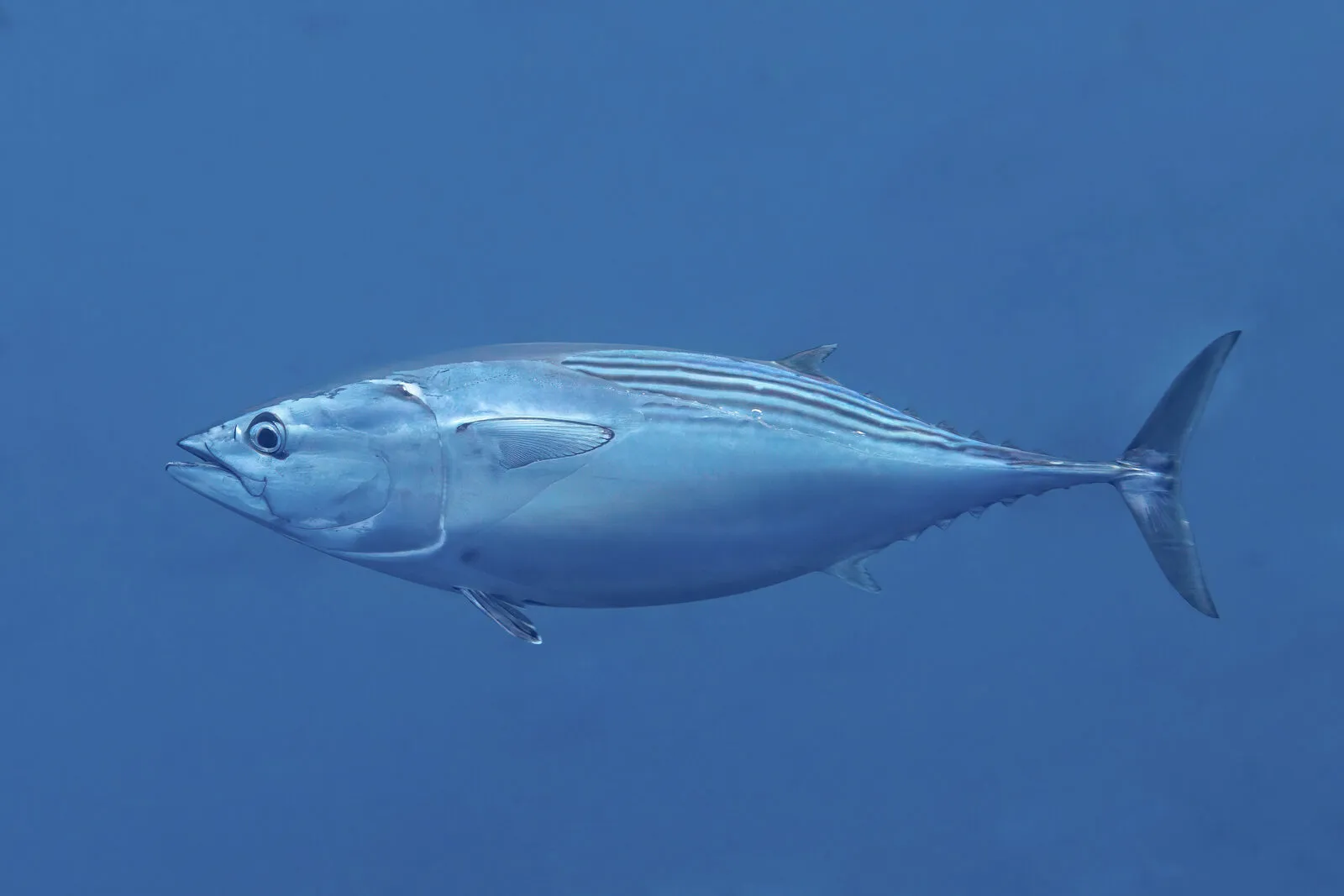
Skipjack tuna, Katsuwonus pelamis, is a small tuna of the family Scombridae, in the order Scombriformes.1 The bluefin driftfish Psenes pellucidus belongs to the Nomeidae, the driftfishes, in the same order.2 Schedophilus haedrichi is a member of the Centrolophidae and Peprilus medius of the Stromateidae.34 The black snake mackerel Nealotus tripes is in the Gempylidae, and Lepidopus caudatus in the Trichiuridae, the cutlassfishes.56 Brama dussumieri belongs to the Bramidae, the pomfrets.7
Among the tunas of the genus Thunnus there are warm-bodied fishes: in a tagging study the authors describe a bigeye that regulates the temperature of its red muscle by routing blood through two vascular heat exchangers.8 Even the slender tuna Allothunnus fallai, described as the most basal tuna species, retains part of the heat it produces while swimming.9 In the black skipjack Euthynnus lineatus, studied in juveniles reared in Panama, the capacity to retain red-muscle heat with counter-current heat exchangers increased with size.10
Psenes sio reaches Peru in the literature through three juveniles caught off its coast that Chirichigno and Vélez examined in 1998.11 The distribution the FAO catalogue gives for Benthodesmus tenuis includes no point in the eastern Pacific, and it sets apart from the species the tropical eastern Pacific fish that once bore that name.12 According to Block and colleagues, the Atlantic bluefin, Thunnus thynnus, occupies the North Atlantic and neighbouring seas; the guide's account, which describes the species across its natural range, found no literature documenting populations in Peru.13
Mackerels, bonitos and small tunas of the coast
The chub mackerel, Scomber japonicus, is a pelagic mackerel that swims in schools near the coast and lives in the warm and temperate waters of the three major oceans.14 In Peru it is called «caballa» or «verle».14 It reaches 50 cm fork length, although about 30 cm is usual.14 For the Peruvian landings of 1996 to 1998 the asymptotic length was estimated at 40.2 to 42.2 cm fork length.15 The population of the south-eastern Pacific was described in 1925 as Pneumatophorus peruanus, a name now regarded as a synonym of Scomber japonicus, although Peruvian papers still write Scomber japonicus peruanus.141516
The Pacific bonito, Sarda chiliensis, is a coastal fish of the eastern Pacific, and its southern population lives from Máncora, in Peru, to Talcahuano, in Chile.14 In Peru the recorded names are bonito, aguadito, cerrajón, chaucha, monillo, monito and mono.14 It has 18 to 30 teeth in the upper jaw and reaches at least 79 cm fork length in the southern hemisphere.14 It should not be confused with the skipjack: the tuna fishery management plan of 1997 uses «barrilete» both for Katsuwonus pelamis and for Auxis rochei.17
The Pacific sierra, Scomberomorus sierra, is a coastal schooling fish of the tropical eastern Pacific, from southern California to the Galápagos and Paita in northern Peru, and in Peru it is known as sierra or verle.14 It reaches about 97 cm fork length and can exceed 5.4 kg, although it is usually no longer than 60 cm.14 The FAO catalogue points out that for a long time several authors treated it as a synonym or subspecies of Scomberomorus maculatus.14 A genetic study with a Peruvian sample of 49 fish collected in 2005 found slight differences between that sample and the genetic groups of the northern and central parts of the range.18
The black skipjack, Euthynnus lineatus, ranges from California to northern Peru, and in Peru it is called barrilete negro and macarela.14 In commercial catches it measures 30 to 65 cm fork length.14 The frigate tunas Auxis thazard and Auxis rochei are told apart mainly by the width of the corselet, the band of large scales behind the head.19 Of the 30 specimens of the eastern Pacific subspecies of Auxis rochei examined in the 1996 revision, none was Peruvian.19 For Auxis thazard, by contrast, the same revision includes a lot of two fish recorded as from Peru in 1958.19
The tunas proper
The yellowfin tuna, Thunnus albacares, is circumtropical, and in the eastern Pacific it has been recorded from Point Conception, in California, to San Antonio, in Chile.20 It is oceanic at every stage of life, confined largely to the upper mixed layer, and rarely occupies coastal waters.20 In very large fish the second dorsal and the anal fins often become greatly elongated.20 Along the South American coast, tagging data show that the fish tend to move south in the warm months and north in the cool ones, between the Gulf of Guayaquil and southern Peru.20
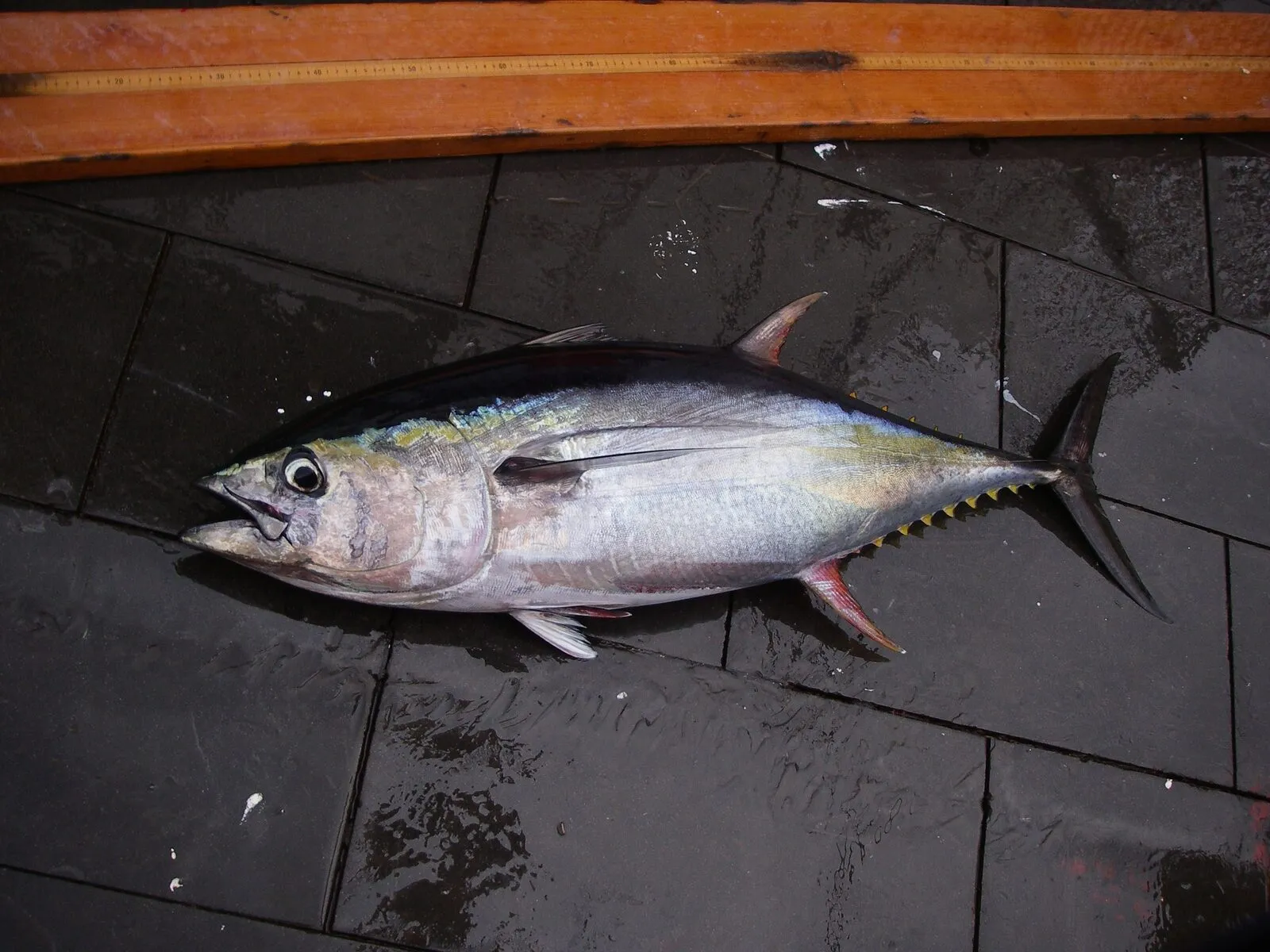

The skipjack, Katsuwonus pelamis, is recognised by the dark bands running along its silvery belly.14 It reaches about 108 cm fork length; 80 cm and 8 to 10 kg are usual.14 In Peru it is called «barrilete», and purse seines take it along with other surface tunas.17 Worldwide it supplies about 40 % of the tuna catch.14
The bigeye, Thunnus obesus, lives in tropical and subtropical waters roughly between 40° N and 40° S, and its vertical range runs from the surface to about 400 m, occasionally exceeding 1000 m.21 In the eastern Pacific, 92 bigeye fitted with data loggers spent 53.6 % of daylight time in water colder than 15 °C.8 According to the authors, by day they typically dive to about 200–300 m.8
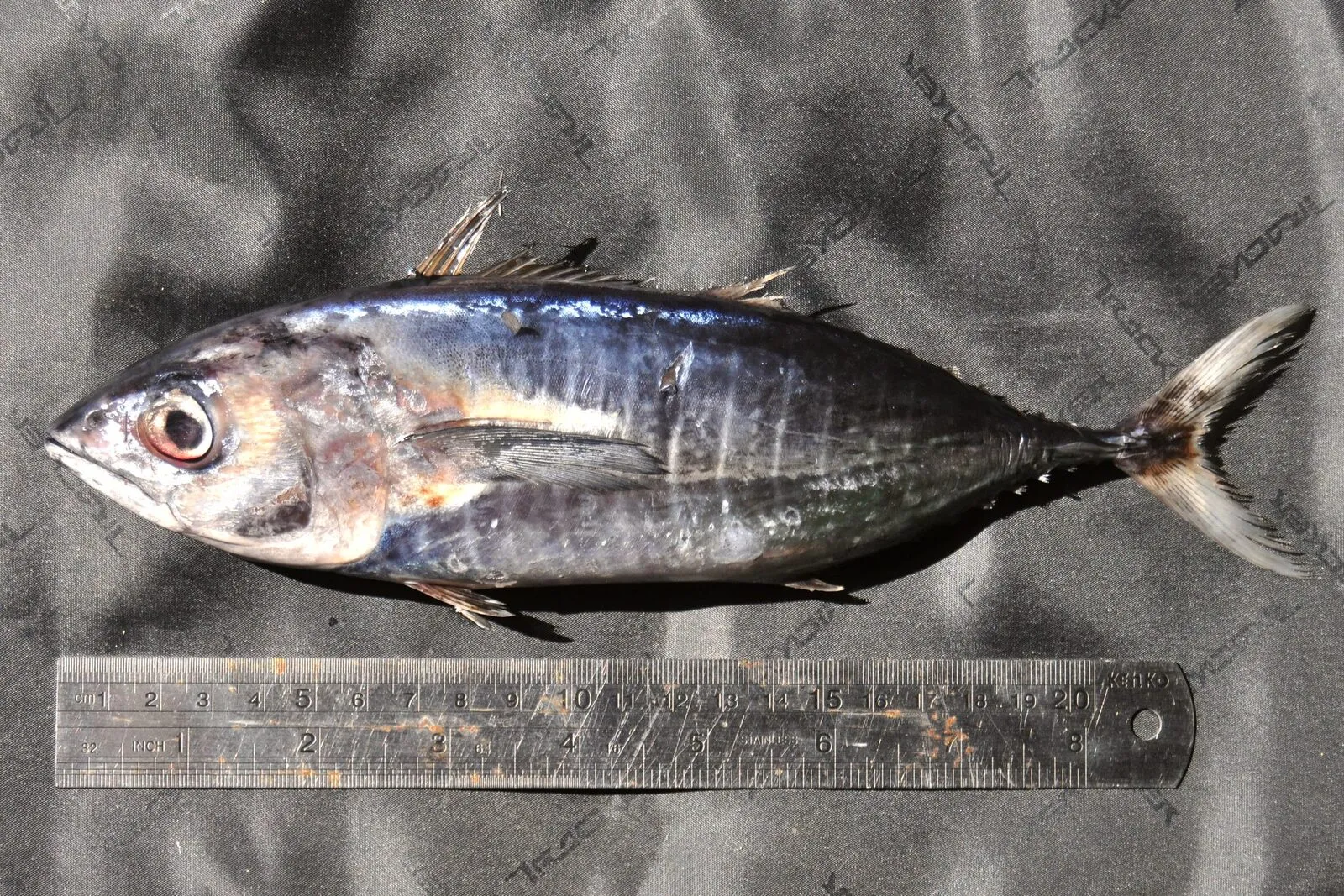

The albacore, Thunnus alalunga, is a tuna of temperate and tropical waters that travels long distances, and mature fish average more than 14 kg.22 It begins to mature at around 80 to 90 cm in length.22 The Pacific bluefin, Thunnus orientalis, is a highly migratory tuna, about 150 cm long and 60 kg in weight for a typical adult, living mostly in temperate waters of the Pacific.23 It spawns in the western Pacific, and part of the juveniles cross the ocean to feed off North America.24 Over more than 60 years of purse seine and longline data there were no records south of about 20° N within 1000 km of the North American coast.24
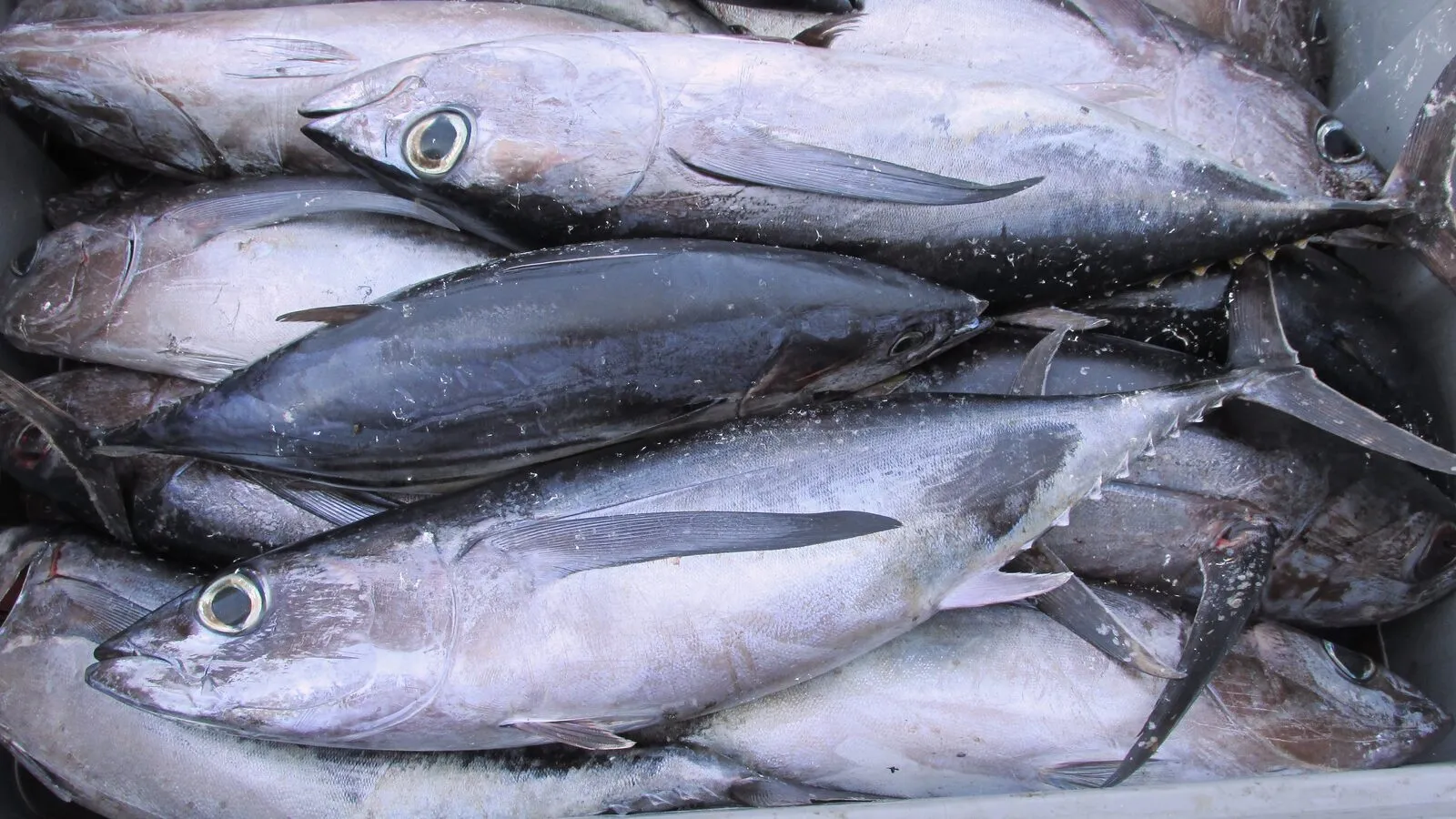

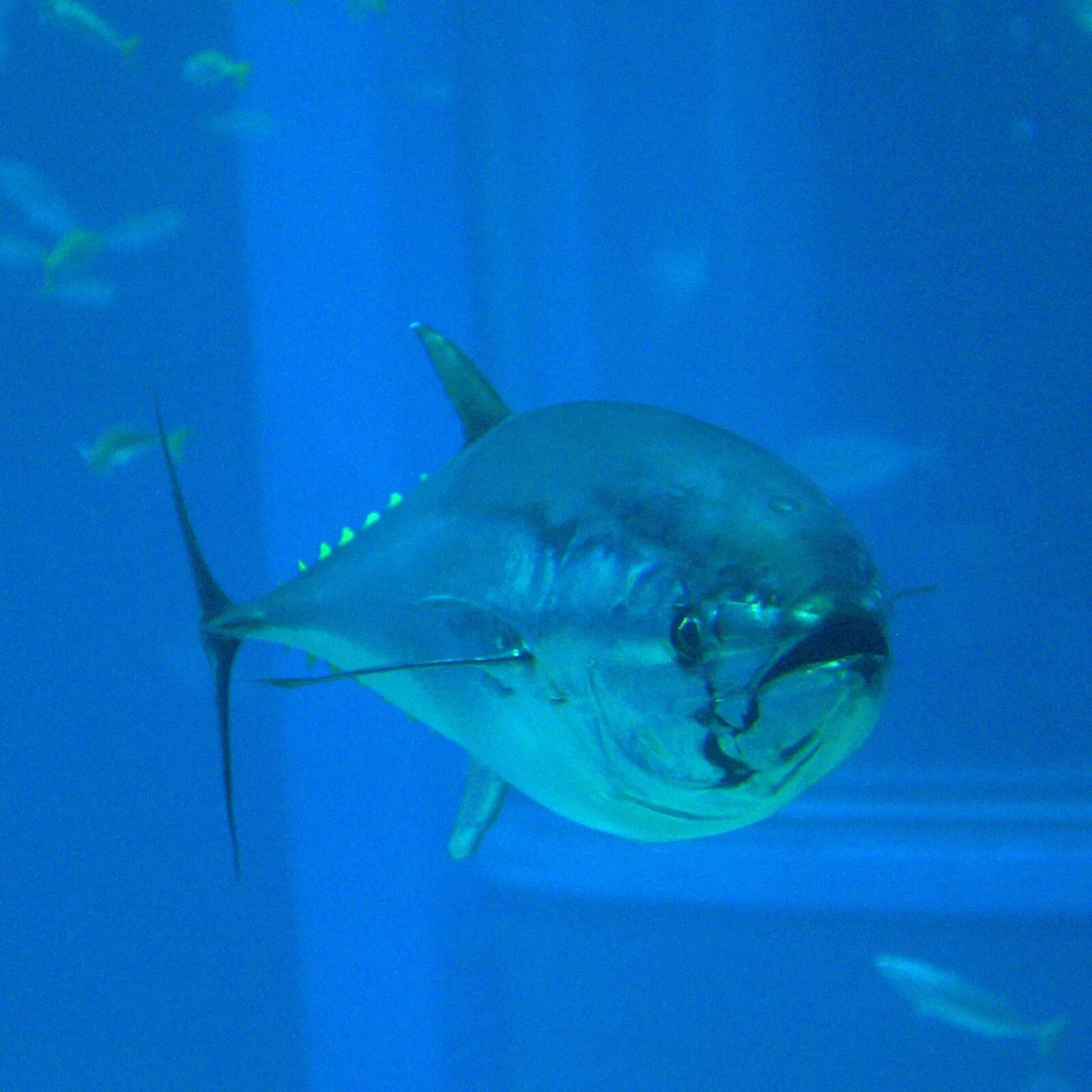

The Atlantic bluefin, Thunnus thynnus, is the largest species of its genus, reaching up to 3.3 m and 725 kg.2513 It lives in the North Atlantic and neighbouring seas, and satellite tags placed on 25 fish off Norway showed, in the 19 with tracks, journeys from Cabo Verde to the Arctic Circle.1326 It appears here because it has an account in the guide, not because populations are documented in Peru; according to Block and colleagues, in the Atlantic it appears to have been extirpated south of the equator.13
At the cold end of the group is the slender tuna Allothunnus fallai, which lives between about 20° S and 54° S and makes a seasonal migration of more than 4000 nautical miles between feeding and spawning areas.27 Gasterochisma melampus lives in a continuous band around the south pole, between 35 and 45 degrees south latitude, and the big adults breed in the south-eastern Pacific.28 Its breeding area was placed between 85 and 130 degrees west longitude and 28 and 41 degrees south latitude.29 The wahoo, Acanthocybium solandri, is the only species of its genus, lives in tropical and subtropical waters of all three oceans and reaches 210 cm fork length.3014
Snake mackerels, cutlassfishes and driftfishes: the deeper families
Gempylus serpens is an oceanic fish with a very long, side-flattened body, about 1 m in standard length although 60 cm is typical, living in tropical and subtropical seas; the adults move up to the surface at night.12 Nealotus tripes usually measures about 15 cm in standard length, reaches 25 cm at most, and also rises to the surface at night.12 Diplospinus multistriatus is a silvery open-sea fish of up to 33 cm, mesopelagic, relatively abundant in the southern eastern Pacific and without a directed fishery.12
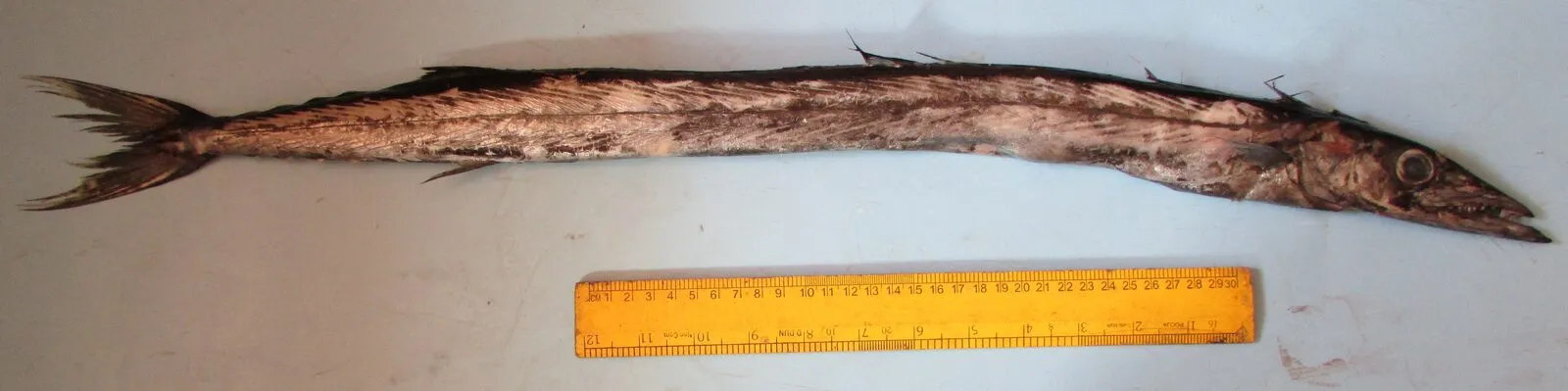

Ruvettus pretiosus is a large, dark brown, oceanic and benthopelagic fish, and FishBase gives it a maximum length of 300 cm.3132 Its flesh is so oily that, eaten in quantity, it acts as a purgative.31 Thyrsites atun, the snoek of the cold southern seas, has been recorded in Chile at up to 160 cm fork length; in Peru there is only one old record, from Ilo, in the far south.33
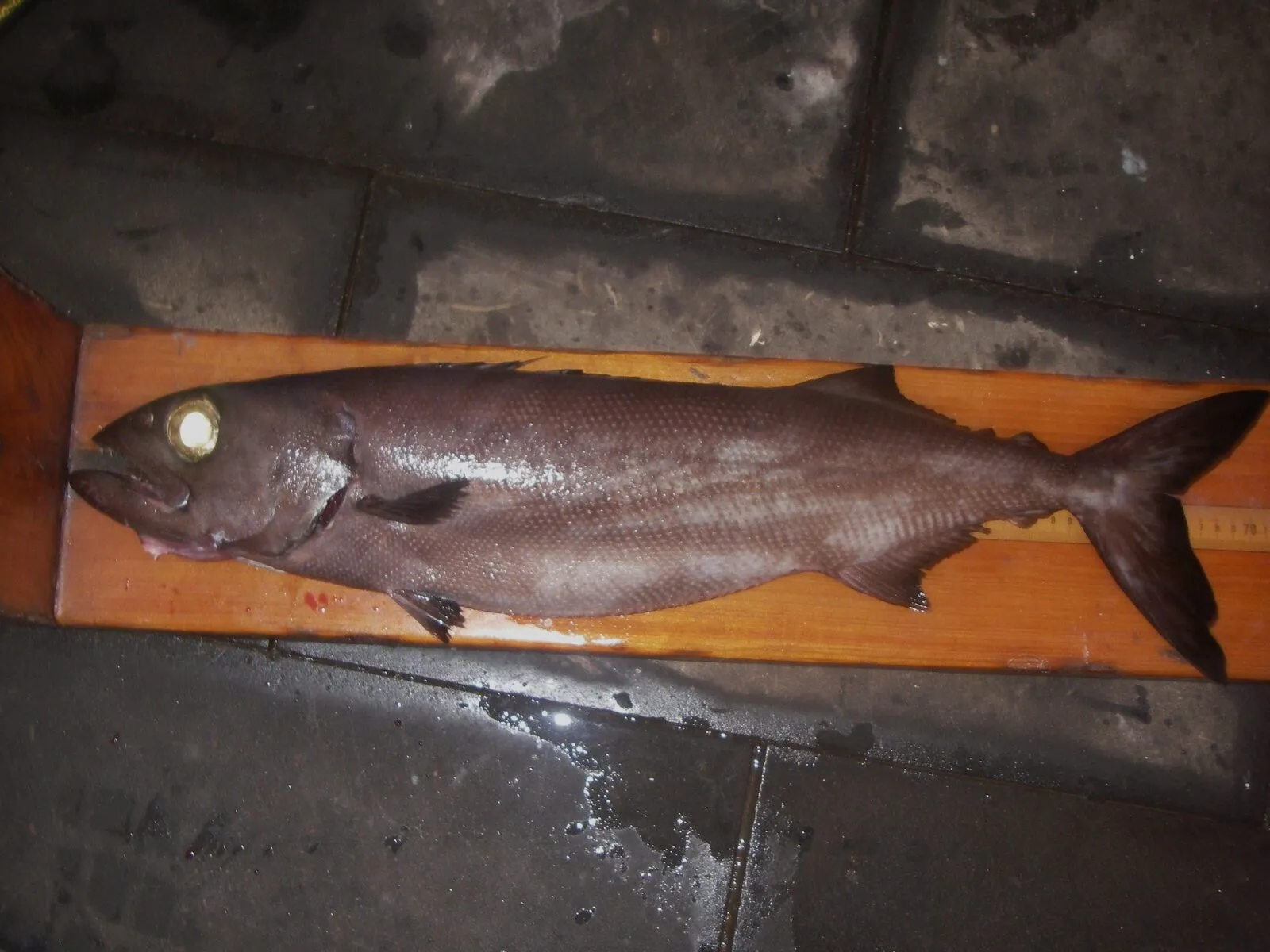

Trichiurus lepturus is ribbon-shaped, very elongated and flattened, with no scales, no pelvic fins and no tail fin; adults commonly measure 50 to 100 cm and the maximum is about 200 cm.34 Lepidopus fitchi was described in 1987, when the California and Mexican specimens that had been called Lepidopus xantusi proved to be something else.35 It is known from Oregon to the Gulf of California and, separately, from southern Ecuador and northern Peru, a distribution the authors present as antitropical.35 The Scripps collection holds specimens with coordinates off northern Peru, at about 3.3° S (1958) and about 7.4° S (1970).36
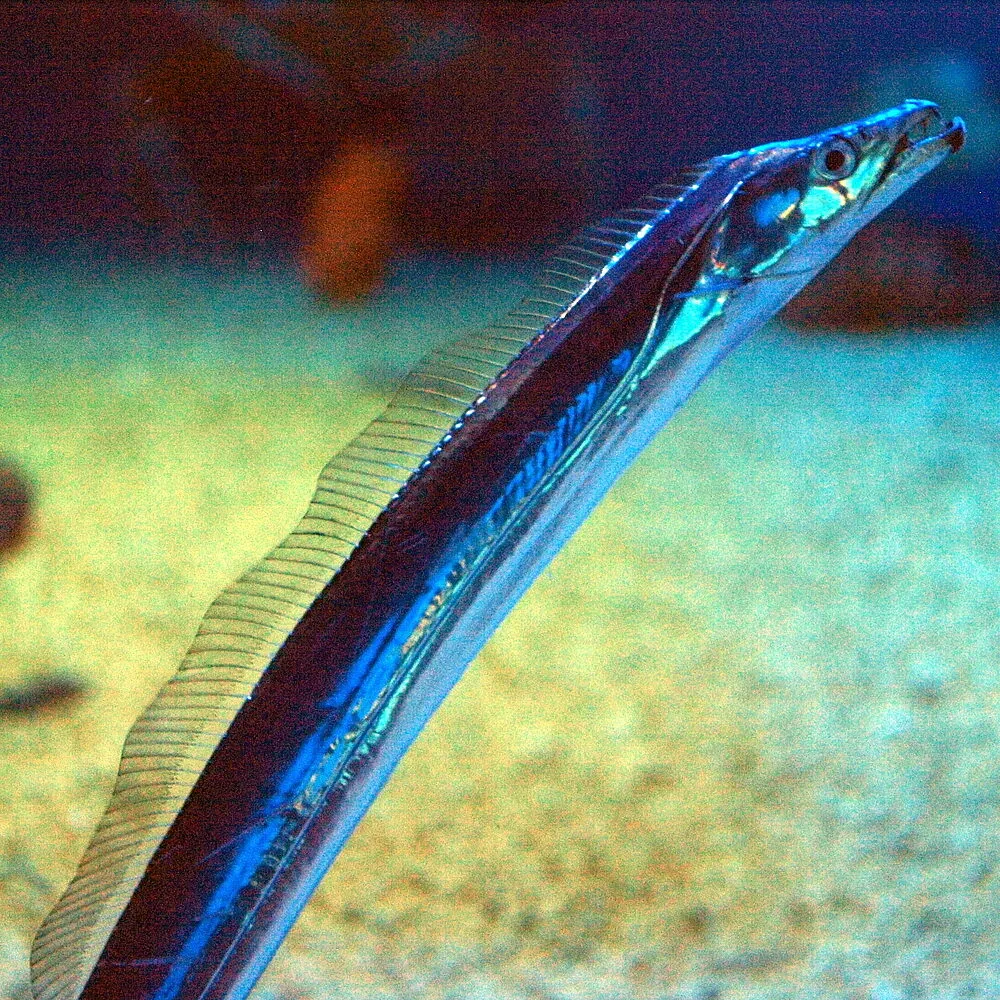

Lepidopus caudatus lives near the seabed on temperate continental shelves and slopes and forms schools; the largest specimen in an Adriatic sample measured 123 cm in total length.3738 Aphanopus intermedius reaches 147.5 cm in total length and is a deep-water fish of the Atlantic.39 Benthodesmus tenuis reaches at least 72 cm standard length and lives close to the bottom on the continental slope.12
Psenes pellucidus reaches about 80 cm, the juveniles are commonly seen under floating objects, and large adults may live near the bottom on continental slopes.40 Cubiceps caeruleus measures up to 28.5 cm, and FishBase cites reports from Nicaragua, Uruguay and Peru without giving further detail on its presence in Peru.41 Schedophilus haedrichi: its holotype is kept at the Instituto del Mar del Perú, and it is known from Peru to the Colombian Pacific, with a specimen from Costa Rica that extended its range to the north-west.34243 According to Chirichigno it would occur only on the coast of Peru between Tumbes and Samanco, while other authors extend it from central Peru to central Ecuador.42
The chilindrina or pampanito, Stromateus stellatus, is the only member of its family along the coasts of Peru and Chile.4445 Peprilus medius reaches 31.6 cm in total length according to FishBase and lives in the eastern Pacific, from Mexico to Peru.46 Brama japonica lives in the Pacific, from Japan and the Bering Sea south to Peru, and is an oceanic fish that is rarely caught near the coast.47 Taractichthys steindachneri is another pomfret, and a specimen caught in 2021 off Lebu, in Chile, was the first record for that country.48
Telling them apart
Among the scombrids, the skipjack has no swim bladder and carries 4 to 6 very conspicuous dark bands on the lower sides and belly.14 The black skipjack, by contrast, has black markings on the back forming 3 to 5 continuous horizontal stripes, teeth on the vomer and 33 to 39 gill rakers on the first arch.14 The chub mackerel Scomber japonicus does have a swim bladder, two well separated dorsal fins, and 5 finlets behind the second dorsal and another 5 behind the anal.14
In the yellowfin the pectoral fins are long and reach or pass the origin of the second dorsal, except in very large fish.20 In the Pacific bluefin, by contrast, the tips of the pectoral fins do not reach the start of the second dorsal fin, and the eyes are small compared with other tunas.23 The two species of Auxis are separated by the corselet: Auxis thazard has five scales or fewer in that band and its scaleless area passes the tip of the pectoral fin, while Auxis rochei has six or more and its scaleless area does not reach the pectoral tip.19
The eastern Pacific population of Auxis rochei has a wider corselet, with 14 to 30 scales under the second dorsal fin, and for that reason it was described as a subspecies.19 Even so, body measurements showed no significant differences from other populations.19 In deep-water fishes, recognition means counting parts: Aphanopus intermedius cannot be told externally from Aphanopus carbo, and separating them requires counting the dorsal fins and the vertebrae, or a genetic test.4939 Gempylus serpens has two lateral lines that start at the same point.12 Lepidopus fitchi has its pelvic fins reduced to a pair of flattened spines.35
The 1997 fishery management plan uses «barrilete» for Katsuwonus pelamis and for Auxis rochei.17 FishBase gives «barrilete negro» as the Peruvian name of Auxis rochei, while the FAO catalogue gives it for Euthynnus lineatus.5014 «Verle» appears in the FAO catalogue as the Peruvian name of both the chub mackerel and the sierra.14 And the trade name shared by Seriolella violacea and Schedophilus haedrichi was the one most often mislabelled in the Peruvian restaurants sampled.51
Where and when they are recorded in Peru
In Peruvian waters the chub mackerel is associated with the Equatorial Surface Waters, and its distribution and concentration depend on which water mass dominates.52 IMARPE's fishery monitoring programme sampled it between 1994 and 2017 along the coast, between 3°23' S and 18°21' S.16 The 1982 and 1983 El Niño affected it little, while the 1997 and 1998 event favoured it through the stronger inflow of Equatorial Surface Waters: single-species schools appeared, it occupied a very wide area and it was found down to 100 m depth.52 A record 383 thousand tonnes was landed in 1998, after a year 1997 with good catches.52
The size at which half of the chub mackerel females mature was lowest during the El Niño events of 1997 to 1999 and 2015 to 2016.16 During the 1992 and 1993 El Niño the gonadosomatic index rose, while body and gonad weight fell.53 Size at maturity was positively related to spawning biomass.16
Towards the north, the bonito of the southern population begins at Máncora.14 The sierra reaches Paita, and the 58 fish of a parasitological study came from the artisanal fishery of Puerto Pizarro, in Tumbes, between October 2019 and August 2022.1454 The black skipjack rarely occurs where surface temperature falls below 23 °C, and its larvae stay almost entirely within about 240 miles of the coast.14 In the tuna purse-seine fishery data for 2005 to 2021, El Niño and La Niña influenced how much of it was caught and widened its range to 150° W.55 And in the summer of 2018 an IMARPE cruise found larvae of Auxis rochei at 10.39 % of stations between 5° S and 9° S, 123 larvae per m² in total.56
Towards the south and the cold water, the snoek can reach lower latitudes by following the cold Humboldt and Benguela currents.33 Juveniles of Allothunnus fallai appear in the south-eastern Pacific mainly between 20° S and 35° S, at surface temperatures of 19 to 24 °C.27 They spawn north of 31° S, in subtropical waters of 17 to 25 °C, and from November to February they migrate south of 38° S to feed.27
The 80 specimens of chilindrina in the Peruvian study were bought at the Chorrillos fishing terminal between December 2008 and September 2009.44 The 115 Peprilus medius were examined between September 2007 and June 2008 at the same terminal.57 The Brama japonica were acquired there in 2011.58 Seriolella violacea was sampled off Lima and Callao between 2012 and 2014.59
What they eat and how they behave
The chub mackerel forms schools by size from about 3 cm long, and adult schools are the most compact.14 It feeds opportunistically, from copepods and other crustaceans to fish and squid, and is preyed on by tunas, billfishes, sharks, sea lions and pelicans, among others.14 In the bonito, in 1404 stomachs from 3 localities, including Pozo de Lisas, near Ilo, the main prey were the squat lobster Pleuroncodes monodon and the anchoveta Engraulis ringens.60 At Pozo de Lisas the squat lobster made up about 33 % of prey by number and about 48 % of weight, and the anchoveta about 30 % and 19 %.60 More than 71 % of the stomachs were empty; the authors describe a diet of little diversity, although they conclude that the species tends to be a generalist, and they link the reduction in the mean size of bonito to the decline of the anchoveta, its preferred prey.60
In the yellowfin, of 3763 stomachs from the eastern Pacific 24 % were empty, and by volume the food was 47 % fish, 45 % crustaceans and 8 % cephalopods, with prey from 43 families of fish.20 It feeds by day and mostly in the surface layers, and at sea it associates with floating objects, with schools of dolphins, with whales and with sharks.20 In the skipjack, 80 or more fish families were counted in the stomachs, with juveniles of the same species among the prey.61 In the bigeye, the diet changed with the size of the tuna: the proportion of lanternfishes fell in large individuals and that of grenadiers rose.21
When oxygen at depth was low, tagged bigeye tuna in the eastern Pacific made more vertical excursions towards shallow water (a median of 41.25 per individual against 19.33 where oxygen was high), which the authors interpret as a way of re-oxygenating.8 In Acapulco Bay, of 262 stomachs of black skipjack 42 % were empty, and in both juveniles and adults fish dominated, mainly anchovies and sardines.62 The black skipjack also forms mixed-species schools with yellowfin and skipjack.14 In the eastern Pacific Auxis thazard is a considerable part of what adult yellowfin eat.63
Gempylus serpens feeds on lanternfishes, flying fishes, sauries and scombrids, as well as squids and crustaceans.12 A sample of Ruvettus pretiosus around the Saint Peter and Saint Paul archipelago in Brazil had 360 stomachs: 225 were empty and 135 held food, with 34 prey taxa, 16 of fish, 17 of cephalopods and 1 of crustaceans.64 The parasites of the chilindrina suggest that it feeds on planktonic invertebrates, and it is part of the diet of the South American sea lion and the blue-footed booby.44 The wahoo, for its part, is often solitary or in small loose groups rather than in compact schools.14
Reproduction, growth and migration
The chub mackerel spawns in batches, and in Peru it does so all year round, most intensely in summer.53 Each female can produce between 100 and 400 thousand eggs in total.14 With 25912 females measured by IMARPE between 1994 and 2017 in the November to March season, half of the females were estimated to be mature at 24.8 cm to the fork, although that value varied between periods from 20.4 to 27.0 cm.16 For the 1996 to 1998 landings, a growth coefficient of 0.38 to 0.39 per year, an annual natural mortality of 0.52 to 0.53 and a longevity of slightly over 7 years were calculated.15
The bonito reaches sexual maturity at about 2 years of age, and in the southern hemisphere it spawns in nearshore waters between September and December, in batches.14 The FAO catalogue estimates about 500000 eggs in a season for a 3 kg specimen.14 In a study of 444 specimens from the cove of Chanavayita, in northern Chile, none of the 224 females was mature, whereas 104 of 205 males were mature.65 The authors point out that this sampling window is too short to reconstruct the full reproductive cycle.65
The yellowfin mostly spawns for the first time in its second year of life, in batches of 1 to 8 million eggs, at least 2 times a year.20 A near-global analysis of larval distribution found that yellowfin larvae were concentrated in water warmer than 25 °C.66 The skipjack matures at about 45 cm fork length and spawns in batches throughout the year in equatorial waters; females of 41 to 87 cm produce between 80000 and 2000000 eggs per season.14 In the eastern Pacific it is thought to originate in equatorial waters, with one group migrating north to Baja California and another entering the fishing grounds of Central and South America; both later return to the equatorial spawning areas.14
In the Pacific bluefin an ocean crossing can take as little as 55 days, and in the California Current the juveniles usually stay 2 to 3 years before returning west.2324 In the albacore, the young make a first migration to high latitudes that largely goes unobserved, and on maturing they move closer to the equator and migrate in spring into tropical waters to spawn.67 In the Atlantic bluefin, every fish tagged off Norway that completed a year returned to Norwegian waters.26
Among the deeper fishes, males of Gempylus serpens mature at 43 cm standard length and females at 50 cm, and the species spawns in tropical waters all year round, with a fecundity of between 300 thousand and 1 million eggs.12 In Trichiurus lepturus off southern Brazil, the length at which half the fish were mature was 63.9 cm in males and 69.3 cm in females.68 The eggs of the chilindrina have not yet been described.69 And for the snoek in northern Chile only juvenile and immature fish have been recorded, and neither breeding areas nor breeding season are known in that country.33
Fisheries and their management in Peru
The chub mackerel is fished in Peru mainly by the industrial purse-seine fleet and used for direct human consumption; landings peaked in the late 1990s at about 380 thousand tonnes, and in the 3 years before 2017 they averaged around 90 thousand tonnes.16 Around 1981, among the countries catching it, Chile and Peru ranked third and fourth.14
Peruvian fishing of the southern bonito population rose from almost nothing in 1940 to a peak of about 110000 t a year in the early 1960s, and fell to about 40000 t in the mid-1970s.14 A recent study cites about 92 t landed in Peru according to PRODUCE in 2020, and reports a decline of Peruvian bonito since 1987.60 In 2024 the Ministry of Production authorised IMARPE to carry out exploratory fishing for bonito with a cap of 750 t and 30 days, in order to gather data on its biology and fishery.70 The rule limits that fishing to artisanal vessels with a hold of up to 10 m3, which must use a purse seine or a curtain net, and requires a fishing logbook to be handed in on landing.70
The tunas have their own management plan, approved in 1997, which sets as an objective the rational and sustained use of the stocks of tunas and related species, both in jurisdictional waters and on the high seas.17 The plan notes that in Peruvian waters tuna was exploited with purse seines and, in recent years, with longlines, the latter mostly by the foreign fleet for bigeye tuna.17 For skipjack in the eastern Pacific, the mean annual catch between 1981 and 1995 was 81000 t, and in the 1996 estimate the region's main tunas totalled 418000 t, of which 26 % was skipjack.17 The yellowfin is managed internationally by four regional fisheries management organisations, among them the Inter-American Tropical Tuna Commission in the eastern Pacific.71 In northern Peru, artisanal fishing communities are receiving training on selective fishing gear for yellowfin tuna.72
The black skipjack is caught incidentally, and in Ecuador and Peru it is also fished by people working from canoes and rafts.14 The Auxis, being smaller, get gilled in the webbing of the yellowfin and skipjack purse seines and are considered a nuisance.14 Stromateus stellatus is usually discarded as bycatch, and its muscle contains a lipid, diacylglyceryl ether, that can cause diarrhoea.45 Gempylus serpens sometimes falls as bycatch in tuna longlines.12
In tunas such as the skipjack, histamine forms if the fish is exposed to high temperatures during or after capture, and it is the cause of scombroid poisoning.73 Seriolella violacea hosts larvae of Anisakis pegreffii: between 2012 and 2014, off Lima and Callao, 22.67 % of 75 fish carried larvae, with a mean intensity of 9.88 larvae.59 In 6 samples analysed in a study of seafood sold in Peru, total mercury averaged 60.44 ng/g wet weight, far below the 300 ng/g screening value of the United States environmental agency.51 And in a survey of 779 fishers at 39 landing sites in Peru and Chile, gillnet meshes of 7.6 cm or more, with this species as a target, were linked with the incidental capture of the Humboldt penguin.74
Conservation, threats and what is still unknown
On the IUCN Red List, the chub mackerel, the Pacific bonito, the skipjack and the Atlantic bluefin are in the global category Least Concern.75767778 The bigeye is listed as Vulnerable.79 Lepidopus caudatus is listed as Data Deficient.80 Brama japonica and Taractichthys steindachneri have not been evaluated by the IUCN.4781
Between 1960 and 2009 the abundance of the eastern stock of the Atlantic bluefin fell by about 70 %.25 ICCAT initiated a rebuilding programme in 2007.26 Reduced total quotas, stronger enforcement, restrictions on international trade and a larger minimum landing size accompanied a recovery of the spawning biomass.13 For the bigeye, landings peaked in the late 1990s and then fell in all oceans.21 In the eastern Pacific catches of young fish at fish aggregating devices are increasing, and as oxygen minimum zones expand, habitat compression could make it more vulnerable to surface fisheries.828
For Peruvian waters, a climate-change vulnerability analysis of 35 fishery resources of the Tropical Eastern Pacific Ecosystem off Peru ranked yellowfin tuna as low vulnerability, the only pelagic species in that group.72 Under the high-emissions RCP8.5 scenario it is projected to become more abundant in the tropical eastern Pacific and its distribution to shift northwards by mid-century.72 The albacore grows slowly and matures late, which makes it more vulnerable to overfishing than tropical tunas.67 Global and regional cutlassfish catches have fallen sharply, probably as a result of long-term fishing.83
For the bonito, one study gives a mean standard length of 39.4 cm in its table and 41.2 cm in its discussion.60 For the chub mackerel, size at maturity showed no trend in the 1994 to 2017 series, so it could not be attributed to fishing pressure, although the highest fishing mortality and the lowest sizes at maturity coincided between 1997 and 2000.16 For Lepidopus caudatus, two Azorean studies describe the growth rate differently, one as fast and the other as slow.8437 For Psenes sio, fin counts differ between the cited sources.11 And for the snoek it is debated whether there is one stock or two in the Benguela system.85
Catches of Auxis are usually not identified to species, so the statistics mix the two.14 For Brama dussumieri there are recent records off Korea and Baja California, but no Peruvian one in the sources consulted.8687 For Psenes arafurensis, the synonymy printed in a Korean paper mentions a key to the marine fishes of Peru published in 1998 that was not examined here.88 And Cubiceps pauciradiatus has been cited in the eastern Pacific as far as Peru, although its distribution in the northeastern Pacific is unclear.89
The species in this article
- Scomber japonicus
- Sarda chiliensis
- Thunnus albacares
- Katsuwonus pelamis
- Scomberomorus sierra
- Seriolella violacea
- Thunnus obesus
- Euthynnus lineatus
- Thunnus thynnus
- Trichiurus lepturus
- Stromateus stellatus
- Psenes pellucidus
- Lepidopus fitchi
- Euthynnus alletteratus
- Lepidopus caudatus
- Peprilus medius
- Auxis rochei
- Auxis thazard
- Cubiceps caeruleus
- Ruvettus pretiosus
- Thunnus alalunga
- Thunnus orientalis
- Psenes sio
- Nealotus tripes
- Schedophilus haedrichi
- Acanthocybium solandri
- Allothunnus fallai
- Benthodesmus tenuis
- Brama dussumieri
- Brama japonica
- Cubiceps capensis
- Cubiceps pauciradiatus
- Gasterochisma melampus
- Gempylus serpens
- Psenes arafurensis
- Taractichthys steindachneri
- Thyrsites atun
- Diplospinus multistriatus
- Aphanopus intermedius
Sources (89)
- WoRMS Editorial Board (2026). Katsuwonus pelamis (Linnaeus, 1758). World Register of Marine Species. marinespecies.org
- WoRMS Editorial Board (2026). Psenes pellucidus Lütken, 1880. World Register of Marine Species. marinespecies.org
- WoRMS Editorial Board (2026). Schedophilus haedrichi Chirichigno F., 1973. World Register of Marine Species. marinespecies.org
- WoRMS Editorial Board (2026). Peprilus medius (Peters, 1869). World Register of Marine Species. marinespecies.org
- WoRMS Editorial Board (2026). Nealotus tripes Johnson, 1865. World Register of Marine Species. marinespecies.org
- WoRMS Editorial Board (2026). Lepidopus caudatus (Euphrasen, 1788). World Register of Marine Species. marinespecies.org
- WoRMS Editorial Board (2026). Brama dussumieri Cuvier, 1831. World Register of Marine Species. marinespecies.org
- Humphries, N.E.; Fuller, D.W.; Schaefer, K.M. (2024). Highly active fish in low oxygen environments: vertical movements and behavioural responses of bigeye and yellowfin tunas to oxygen minimum zones in the eastern Pacific Ocean. Marine Biology, 55. doi.org
- Sepulveda, C.A.; Dickson, K.A.; Bernal, D. (2008). Elevated red myotomal muscle temperatures in the most basal tuna species, Allothunnus fallai. Journal of Fish Biology. doi.org
- Dickson, K.A.; Johnson, N.M.; Donley, J.M. (2000). Ontogenetic Changes in Characteristics Required for Endothermy in Juvenile Black Skipjack Tuna (Euthynnus Lineatus). Journal of Experimental Biology, 3077-3087. doi.org
- Rubio-Rodríguez, U.; Godínez-Pérez, C.A.; Sarmiento-Lezcano, A.N. (2022). First record and new size record for the oceanic species Psenes sio (Actinopterygii: Scombriformes: Nomeidae) in the northern Gulf of California, Mexico. Acta Ichthyologica et Piscatoria 52(4). doi.org
- Nakamura, I.; Parin, N.V. (1993). Snake mackerels and cutlassfishes of the world (families Gempylidae and Trichiuridae). An annotated and illustrated catalogue of the snake mackerels, snoeks, escolars, gemfishes, sackfishes, domine, oilfish, cutlassfishes, scabbardfishes, hairtails, and frostfishes. FAO Species Catalogue Vol. 15. FAO Fisheries Synopsis No. 125. FAO, Rome. fao.org
- Block, B.A.; Aalto, E.A.; Pagniello, C.M.L.S. (2026). Ensuring the future of Atlantic bluefin tuna. Proceedings of the National Academy of Sciences, e2535185123. doi.org
- Collette, B.B.; Nauen, C.E. (1983). FAO species catalogue. Vol. 2. Scombrids of the world. An annotated and illustrated catalogue of tunas, mackerels, bonitos and related species known to date. FAO Fisheries Synopsis No. 125, Vol. 2. FAO, Rome. fao.org
- Caramantin-Soriano, H.; Vega-Pérez, L.A.; Ñiquen, M. (2008). Growth parameters and mortality rate of the Scomber japonicus peruanus (Jordán & Hubb, 1925) along the Peruvian coast, South Pacific. Brazilian Journal of Oceanography, 201-210. doi.org
- Torrejón Magallanes, E.J.; Sánchez Espinoza, J.; Mori Ponce, J.; Bouchón Corrales, M.; Ñiquen Carranza, M. (2017). Estimación y variabilidad temporal de talla de madurez gonadal de la caballa (Scomber japonicus peruanus, Jordán & Hubb, 1925) en el litoral peruano. Revista Peruana de Biología, 391. doi.org
- Ministerio de Pesquería del Perú (1997). Aprueban Plan de Ordenamiento Pesquero del Atún y Especies Afines (Resolución Ministerial N° 1550-97-PE). El Peruano, 11 de octubre de 1997. faolex.fao.org
- López, M.D.; Alcocer, M.U.; Jaimes, P.D. (2010). Phylogeography and historical demography of the Pacific Sierra mackerel (Scomberomorus sierra) in the Eastern Pacific. BMC Genetics, 34. doi.org
- Collette, B.B.; Aadland, C.R. (1996). Revision of the frigate tunas (Scombridae, Auxis), with descriptions of two new subspecies from the eastern Pacific. Fishery Bulletin 94(3), NOAA National Marine Fisheries Service. spo.nmfs.noaa.gov
- Schaefer, M.B.; Broadhead, G.C.; Orange, C.J. (1963). Synopsis on the biology of yellowfin tuna Thunnus (Neothunnus) albacares (Bonnaterre) 1788 (Pacific Ocean). FAO Fisheries Biology Synopsis No. 59. fao.org
- Lin, C.-H.; Lin, J.-S.; Chen, K.-S. (2020). Feeding Habits of Bigeye Tuna (Thunnus obesus) in the Western Indian Ocean Reveal a Size-Related Shift in Its Fine-Scale Piscivorous Diet. Frontiers in Marine Science, 582571. doi.org
- Mondal, S.; Lee, M.-A. (2023). Habitat modeling of mature albacore (Thunnus alalunga) tuna in the Indian Ocean. Frontiers in Marine Science. doi.org
- NOAA Fisheries (2026). Pacific Bluefin Tuna. NOAA Fisheries species page. fisheries.noaa.gov
- Dewar, H.; Snodgrass, O.E.; Muhling, B.A. (2022). Recent and historical data show no evidence of Pacific bluefin tuna reproduction in the southern California Current system. PLOS ONE. doi.org
- Andrews, A.J.; Eriksen, E.F.; Star, B. (2025). Ancient DNA suggests a historical demographic decline and genetic erosion in the Atlantic bluefin tuna. Proceedings of the National Academy of Sciences, e2409302122. doi.org
- Ferter, K.; Pagniello, C.M.L.S.; Block, B.A. (2024). Atlantic bluefin tuna tagged off Norway show extensive annual migrations, high site-fidelity and dynamic behaviour in the Atlantic Ocean and Mediterranean Sea. Proceedings of the Royal Society B: Biological Sciences, 20241501. doi.org
- Reyes, P.R.; Hüne, M.; Olguín, F. (2019). Presencia de atún lanzón en la costa sur de Chile: Potencial nuevo recurso para la pesca artesanal. Revista de Biología Marina y Oceanografía. doi.org
- Itoh, T. (2018). Biological aspects of the butterfly kingfish Gasterochisma melampus: distribution, total catch, size composition and CPUE. Fisheries Science. doi.org
- Itoh, T.; Sawadaishi, S. (2017). Spawning area and season of butterfly kingfish (Gasterochisma melampus), a large scombrid adapted to cooler temperate southern water. Marine and Freshwater Research. doi.org
- WoRMS Editorial Board (2026). Acanthocybium solandri (Cuvier, 1832). World Register of Marine Species. marinespecies.org
- Elbaraasi, H.; Elmariami, M.; Elmeghrabi, M. (2007). First record of oilfish, Ruvettus pretiosus (Actinopterygii, Gempylidae), off the coast of Benghazi, Libya (southern Mediterranean). Acta Ichthyologica et Piscatoria. doi.org
- Froese, R.; Pauly, D. (2026). Ruvettus pretiosus Cocco, 1833 — Oilfish. FishBase. fishbase.se
- Carimán, P.J.; Reyes, P.R. (2019). Estado del conocimiento biológico y pesquero de Thyrsites atun en el hemisferio sur. Revista de Biología Marina y Oceanografía. doi.org
- FAO (2005). Trichiurus lepturus Linnaeus, 1758. ARTFIMED, Food and Agriculture Organization of the United Nations. fao.org
- Rosenblatt, R.H.; Wilson, R.R. (1987). Cutlassfishes of the genus Lepidopus (Trichiuridae), with two new eastern pacific species. Japanese Journal of Ichthyology 33(4). doi.org
- Frable, B. (2025). SIO Marine Vertebrate Collection. GBIF Occurrence Dataset. doi.org
- Mariño-Briceño, G.; Medeiros-Leal, W.; Peixoto, U.I. (2022). Life History and Fishing Aspects of the Deep-Sea Silver Scabbardfish Lepidopus caudatus in the Azores. Biology. doi.org
- Rebac, I.; Ferri, J. (2025). Age and Growth of the Silver Scabbardfish, Lepidopus caudatus (Euphrasen, 1788), in the Eastern Adriatic. Fishes. doi.org
- Vasconcelos, J.; Sousa, R.; Henriques, P. (2020). Two sympatric, not externally discernible, and heavily exploited deepwater species with coastal migration during spawning season: implications for sustainable stocks management of Aphanopus carbo and Aphanopus intermedius around Madeira. Canadian Journal of Fisheries and Aquatic Sciences. doi.org
- Follesa, M.C.; Cabiddu, S.; Sabatini, A. (2006). First record of Psenes pellucidus (Perciformes, Actinopterygii) in the Sardinian waters (central western Mediterranean). Acta Ichthyologica et Piscatoria 36. doi.org
- Froese, R.; Pauly, D. (2026). Cubiceps caeruleus, Blue fathead. FishBase. fishbase.se
- Tobón-López, A.; Rubio, E.A. (2008). Presencia de Schedophilus haedrichi Chirichigno, 1973 (Osteichthyes: Centrolophidae) en el Pacífico colombiano y ampliación de su rango de distribución geográfica. Latin American Journal of Aquatic Research 36(1). doi.org
- Angulo, A. (2014). First record, and range extension, of the Mocosa ruff Schedophilus haedrichi (Perciformes: Centrolophidae) from the Pacific coast of Costa Rica. Marine Biodiversity Records 7. doi.org
- Iannacone, J.; Cárdenas-Callirgos, J.; Alvariño, L. (2010). Ecología comunitaria de los parásitos de la chilindrina Stromateus stellatus (Cuvier, 1829) (Perciformes: Stromateidae) de la zona costera de Chorrillos, Lima, Perú. Neotropical Helminthology. doi.org
- Angulo, F.E.; Pedrero-Pacheco, R.; Nuñez, J.J. (2025). The Complete Mitochondrial Genome of Stromateus stellatus (Scombriformes: Stromateidae): Organization, Gene Arrangement, and Phylogenetic Position Within the Suborder Stromateoidei. Genes. doi.org
- Froese, R.; Pauly, D. (2026). Peprilus medius, Pacific harvestfish. FishBase. fishbase.se
- Froese, R.; Pauly, D. (2025). Brama japonica, Pacific pomfret. FishBase. fishbase.se
- Carvalho Filho, A.; Wiff, R.; Milessi, A.C. (2023). New records of Bramidae in Chilean waters: the sickle pomfret (Taractichthys steindachneri) and the rough pomfret (Taractes asper). Latin American Journal of Aquatic Research. doi.org
- Tuset, V.M.; Piretti, S.; Lombarte, A. (2010). Using sagittal otoliths and eye diameter for ecological characterization of deep-sea fish: Aphanopus carbo and A. intermedius from NE Atlantic waters. Scientia Marina. doi.org
- Froese, R.; Pauly, D. (2026). Auxis rochei, Bullet tuna. FishBase. fishbase.se
- Biffi, D.; López-Mobilia, A.; Kelez, S. (2020). Mislabelling and high mercury content hampers the efforts of market-based seafood initiatives in Peru. Scientific Reports, 20390. doi.org
- Dioses, T.; Dávalos, R.; Zuzunaga, J. (2002). El Niño 1982-1983 and 1997-1998: Effects on Peruvian Jack Mackerel and Peruvian Chub Mackerel. Investigaciones Marinas. doi.org
- Caramantin-Soriano, H.; Vega-Pérez, L.A.; Ñiquen, M. (2009). The influence of the 1992-1993 El Niño on the reproductive biology of Scomber japonicus peruanus (Jordán & Hubb, 1925). Brazilian Journal of Oceanography, 263-272. doi.org
- Ferré-Alcántara, K.; Minaya, D.; Alvariño, L. (2023). Ectoparasitic community of the gills of Pacific sierra Scomberomorus sierra Jordan & Starks, 1895 (Actinopteri: Scombridae) from northern Peru. Revista del Museo Argentino de Ciencias Naturales, 333-344. doi.org
- Godínez-Padilla, C.J. (2025). Insights Into the Relationship of Climate Events With the Distribution of Black Skipjack (Euthynnus lineatus) Catches in the Eastern Pacific. Fisheries Oceanography, 89-106. doi.org
- Correa, J.; Nakazaki, C. (2019). Volúmenes del zooplancton, distribución y abundancia de ictioplancton, eufáusidos y paralarvas, verano 2018. Boletín del Instituto del Mar del Perú 34(2): 456-472. revistas.imarpe.gob.pe
- Iannacone, J.; Alvariño, L. (2008). Influencia del tamaño y sexo de Peprilus medius (Peters) (Stromateidae: Perciformes) capturados en Chorrillos, Lima, Perú, sobre su comunidad parasitaria. Neotropical Helminthology 2(2). doi.org
- Iannacone, J.; Alvariño, L. (2013). Índices parasitológicos de la reineta Brama japonica Hilgendorf, 1878 (Osteichthyes, Bramidae) adquiridos del terminal pesquero de Chorrillos Lima, Perú. Neotropical Helminthology. doi.org
- Martínez-Rojas, R.; Mondragón-Martínez, A.; De-Los-Santos, E.R. (2021). Molecular identification and epidemiological data of Anisakis spp. (Nematoda: Anisakidae) larvae from Southeastern Pacific Ocean off Peru. International Journal for Parasitology: Parasites and Wildlife, 138-144. doi.org
- Pepe-Victoriano, R.; Aravena-Ambrosetti, H.; Huanacuni, J.I. (2022). Feeding Habits of Sarda chiliensis chiliensis (Cuvier, 1832) in Northern Chile and Southern Perú. Animals. doi.org
- Matsumoto, W.M.; Skillman, R.A.; Dizon, A.E. (1984). Synopsis of biological data on skipjack tuna, Katsuwonus pelamis. NOAA Technical Report NMFS Circular 451 (FAO Fisheries Synopsis No. 136). repository.library.noaa.gov
- Sandoval Ramírez, J.; Cerdenares Ladrón de Guevara, G.; Rojas Herrera, A.A. (2020). Feeding habits of the fishes Euthynnus lineatus and Scomberomorus sierra (Perciformes: Scombridae) in the Eastern Tropical Pacific. Revista de Biología Tropical, 1073-1083. doi.org
- Uchida, R.N. (1981). Synopsis of biological data on frigate tuna, Auxis thazard, and bullet tuna, A. rochei. NOAA Technical Report NMFS Circular 436 (FAO Fisheries Synopsis 124). fao.org
- Viana, D.L.; Tolotti, M.T.; Porto, M. (2012). Diet of the oilfish Ruvettus pretiosus (Perciformes: Gempylidae) in the Saint Peter and Saint Paul archipelago, Brazil. Brazilian Journal of Oceanography. doi.org
- Pepe-Victoriano, R.; Godoy, M.; Kush, K. (2025). First Gonadal Stages of Bonito, Sarda chiliensis (Perciformes: Scombridae) on the Pacific Coast of Northern Chile. F1000Research. doi.org
- Buenafe, K.C.V.; Neubert, S.; Scales, K.L. (2025). Near-global spawning strategies of large pelagic fish. Nature Communications, 8146. doi.org
- Anderson, G.; Hampton, J.; Smith, N. (2019). Indications of strong adaptive population genetic structure in albacore tuna (Thunnus alalunga) in the southwest and central Pacific Ocean. Ecology and Evolution. doi.org
- Silva Martins, A.; Haimovici, M. (2000). Reproduction of the cutlassfish Trichiurus lepturus in the southern Brazil subtropical convergence ecosystem. Scientia Marina, 97-105. doi.org
- Herrera, G.A.; Zavala-Muñoz, F.; Landaeta, M.F. (2018). Observations on the ontogeny of butterfish Stromateus stellatus larvae (Pisces: Stromateidae) off central Chile. Revista de Biología Marina y Oceanografía. doi.org
- Ministerio de la Producción (2024). Resolución Ministerial N.° 000363-2024-PRODUCE. Autorizan al IMARPE la ejecución de pesca exploratoria del recurso bonito (Sarda chiliensis chiliensis). El Peruano, 8 de septiembre de 2024. busquedas.elperuano.pe
- Muñoz-Abril, L.; Torres, M.L.; Valle, C.A. (2022). Lack of genetic differentiation in yellowfin tuna has conservation implications in the Eastern Pacific Ocean. PLOS ONE, e0272713. doi.org
- Ramos, J.E.; Tam, J.; Aramayo, V. (2026). Vulnerability of fishery resources to climate change in the Tropical Eastern Pacific Ecosystem off Peru. Scientific Reports, 23567. doi.org
- Food and Agriculture Organization of the United Nations; World Health Organization (2013). Public health risks of histamine and other biogenic amines from fish and fishery products. FAO/WHO Expert Meeting highlights, July 2013. fao.org
- Segura-Cobeña, E.; Alfaro-Shigueto, J.; Colodro, V. (2025). Use of rapid assessments of fishery bycatch of Humboldt penguins Spheniscus humboldti in Peru and Chile to help identify conservation priorities. Royal Society Open Science, 250319. doi.org
- Collette, B.B.; Nakatsuka, S.; Suzuki, J. (2022). Scomber japonicus. The IUCN Red List of Threatened Species 2022: e.T170306A170083106. doi.org
- Collette, B.B.; Canales Ramirez, C.; Hinton, M. (2021). Sarda chiliensis. The IUCN Red List of Threatened Species 2023: e.T170352A170089277. doi.org
- Collette, B.B.; Boustany, A.; Fox, W. (2021). Katsuwonus pelamis. The IUCN Red List of Threatened Species 2021: e.T170310A46644566. doi.org
- Collette, B.B.; Boustany, A.; Fox, W. (2021). Thunnus thynnus. The IUCN Red List of Threatened Species 2021: e.T21860A46913402. doi.org
- Collette, B.B.; Boustany, A.; Fox, W. (2021). Thunnus obesus. The IUCN Red List of Threatened Species 2021: e.T21859A46912402. doi.org
- Iwamoto, T. (2013). Lepidopus caudatus. The IUCN Red List of Threatened Species: e.T198721A42691759. doi.org
- Froese, R.; Pauly, D. (2026). Taractichthys steindachneri (Döderlein, 1883). FishBase. fishbase.se
- Chávez, E.A.; Escobar-Toledo, F.D.; Ortega-García, S. (2013). Optimum harvesting scenarios for the management of the bigeye tuna Thunnus obesus at the Eastern Pacific Ocean. Revista de Biología Marina y Oceanografía, 235-243. doi.org
- Lin, H.-C.; Tsai, C.-J.; Wang, H.-Y. (2021). Variation in global distribution, population structures, and demographic history for four Trichiurus cutlassfishes. PeerJ, e12639. doi.org
- Figueiredo, C.; Diogo, H.; Pereira, J.G. (2014). Using information-based methods to model age and growth of the silver scabbardfish, Lepidopus caudatus, from the mid-Atlantic Ocean. Marine Biology Research. doi.org
- Griffiths, M.H. (2003). Stock Structure of Snoek Thyrsites Atun in the Benguela: A New Hypothesis. African Journal of Marine Science. doi.org
- Lee, W.J.; Kim, J.-K. (2015). New Record of Brama dussumieri (Pisces: Bramidae) from Korea, as Revealed by Morphological and Molecular Analyses. Fisheries and Aquatic Sciences 18(3). doi.org
- De La Cruz-Agüero, J.; Moncayo-Estrada, R.; Cota-Gómez, V.M. (2016). Unusual records of deepwater teleosteans trawled off the western coast of Mexico. Journal of Fish Biology 89. doi.org
- Lee, W.J.; Ryu, J.-H.; Yoon, M. (2016). New Korean record of the Banded Driftfish, Psenes arafurensis (PISCES: Nomeidae). Fisheries and Aquatic Sciences. doi.org
- Love, M.S.; Bizzarro, J.J.; Cornthwaite, A.M. (2021). Checklist of marine and estuarine fishes from the Alaska–Yukon Border, Beaufort Sea, to Cabo San Lucas, Mexico. Zootaxa. doi.org