
Season · July to October
Humpback whale season in Los Órganos
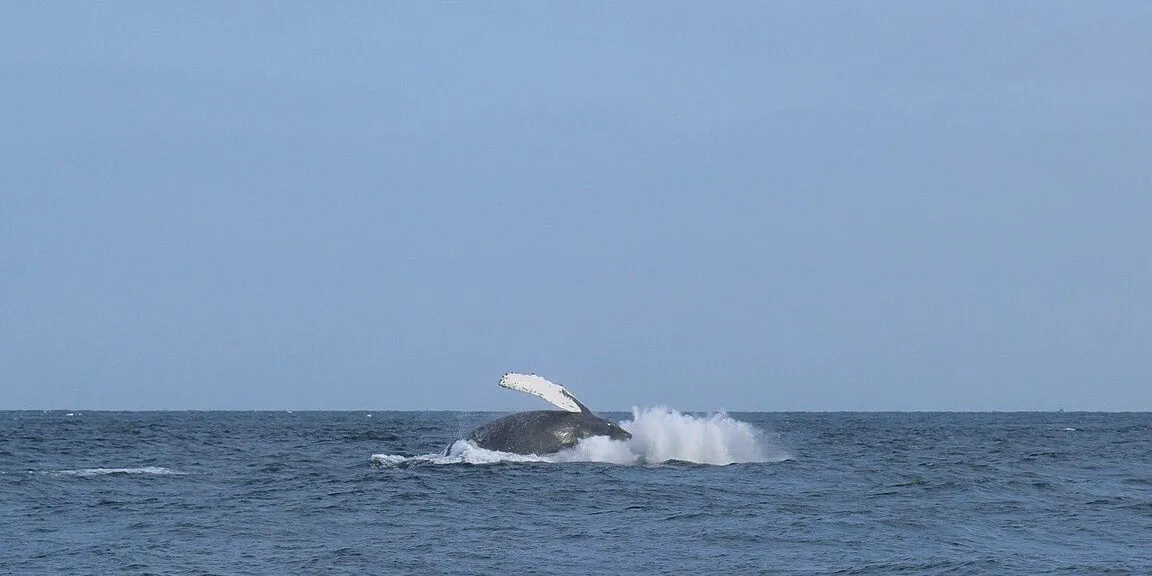
Every year between July and October, humpback whales (Megaptera novaeangliae) take centre stage off the coast of Los Órganos. They travel the whole length of the Peruvian coast looking for warm water in which to mate and give birth to their calves.

Where they come from and what they do here
The humpbacks on this coast belong to the Southeast Pacific population, known as "stock G". Northern Peru is the southern edge of its breeding range, which reaches up to Costa Rica.14 They feed off the Antarctic Peninsula and in Chilean Patagonia15 and travel some 8,000 km between the two ends.4 A photo-identification study covering 18 seasons found that whales feeding off the Antarctic Peninsula turn up mostly in the southern part of the breeding range, between northern Peru and Colombia.5
They come here to court, mate, give birth and nurse.1 They gather in shallow water, 20 to 50 m deep, and mothers with calves keep closest to shore, where the water is calmer.12 In the Los Órganos studies, 98% of sightings were over the continental shelf, in less than 200 m of water.4
Breaching
In the Los Órganos studies, the breach was the most common aerial display, followed by tail slaps and flipper slaps, and pairs of whales put on the most displays.3 Of 53 groups of three or more whales, 15 were competitive, with breaches and charges.4
Song
Only males are thought to sing, mostly on the breeding grounds. The song has a structure: repeated phrases grouped into themes. A session can last from five minutes to more than 24 hours, and males in the same area sing the same version. Exactly what it is for is still not well understood.6
Size and calves
- Adult
- Up to about 18 m long and about 40 tonnes.7
- Gestation
- About 11 months.7
- Calf at birth
- 4 to 5 m.7
- Lifespan
- About 80 to 90 years.7
Be a good tourist
In Peru, Ministerial Resolution R.M. N.° 451-2019-PRODUCE sets the minimum distances for approaching whales and dolphins. The humpback counts as a cetacean over 5 m long.8
| Situation | Minimum distance |
|---|---|
| Small cetaceans (dolphins, for example) | 50 m |
| Cetaceans over 5 m, such as the humpback | 100 m |
| Small cetaceans feeding or socialising | 150 m |
| Cetaceans over 5 m feeding or socialising | 300 m |
Under the resolution, breaches, repeated flipper slaps, tail slaps, aggressive chasing and head-out displays are signs of socialising: with a breaching humpback the distance is 300 m, not 100.8
Mothers with calves. Heading towards or approaching a mother with a calf, or a group with calves, is prohibited. If you come across them by chance, move away slowly until you are at least 300 m off.8
If you see an injured or entangled whale, or there is a collision, the resolution requires it to be reported to IMARPE, Peru's marine research institute, and to the coastguard authority (DICAPI).8
Good practice if you go
Choosing a trip
- Choose a registered, formal operator, and ask before boarding whether they keep the legal distances and what they do if a mother with a calf turns up.118
- Wear your life jacket the whole time and follow the guide's instructions.11
What to ask for on the water
Where the resolution is silent, good practice fills in. The Peruvian Society for Environmental Law (SPDA) advises:11
- no more than 3 boats per animal;
- going slower than the animal being watched;
- watching for no more than 30 minutes.
What not to do
- Don't try to swim with them or touch them.11
- Don't ask the boat to move closer to a breaching whale or a mother with a calf: there the resolution requires 300 m.8
- If you see irresponsible behaviour, the SPDA advises reporting it to DICAPI or SERNANP.11
These are wild animals that move freely: no trip can guarantee you will see whales, or see them breach.
Other species in the season
On whale-watching trips from Los Órganos between 2010 and 2017, from late July to late October, 13 species of cetaceans were recorded.910 The humpback was the most frequent, and the long-beaked common dolphin (Delphinus capensis) came second. Close to shore there were bottlenose dolphins (Tursiops truncatus) and Bryde's whales (Balaenoptera brydei); further out, blue whales, Risso's dolphins, short-finned pilot whales and orcas, among others.10
The Cabo Blanco – El Ñuro sector is also a feeding and resting area for green and olive ridley turtles.1 More on that on our page about the El Ñuro sea turtles.
ORKA's records this season
Published humpback whale records in : .
- First record
- Latest record
Further reading
- The species account: humpback whale in ORKA's marine life guide.
- If you are coming to the area: how to get to Los Órganos.
- Questions about this page or about diving with us? Write to us through the contact form.
Reviewed 21 October 2026
Sources (11)
- SERNANP. Plan Maestro de la Reserva Nacional Mar Tropical de Grau 2026–2031 (annex to R.P.E. N.° 000052-2026-SERNANP/PE). PDF on gob.pe
- Pacheco, A.S., Silva, S. and Alcorta, B. (2009). Winter distribution and group composition of humpback whales off northern Peru. Latin American Journal of Aquatic Mammals 7: 33–38. doi:10.5597/lajam00131
- Pacheco, A.S. et al. (2013). Aerial behavior of humpback whales Megaptera novaeangliae at the southern limit of the southeast Pacific breeding area. Revista de Biología Marina y Oceanografía 48(1). doi:10.4067/S0718-19572013000100016
- Guidino, C. et al. (2014). Patterns of spatial and temporal distribution of humpback whales at the southern limit of the Southeast Pacific breeding area. PLoS ONE 9: e112627. doi:10.1371/journal.pone.0112627
- Acevedo, J. et al. (2017). Migratory preferences of humpback whales between feeding and breeding grounds in the eastern South Pacific. Marine Mammal Science 33(4): 1035–1052. doi:10.1111/mms.12423
- NOAA National Marine Sanctuaries (A. Marchand, September 2022). «Unraveling Mysteries of Humpback Whale Song at Olympic Coast NMS». sanctuaries.noaa.gov
- NOAA Fisheries. Humpback Whale, Species Directory. fisheries.noaa.gov
- Ministerio de la Producción. R.M. N.° 451-2019-PRODUCE, 21 October 2019. PDF on gob.pe
- Pacheco, A.S. et al. (2019). Cetacean diversity revealed from whale-watching observations in northern Peru. Aquatic Mammals 45(1): 116–122. doi:10.1578/AM.45.1.2019.116
- Mongabay Latam (A. Vélez Zuazo). «Cetáceos en Perú: costa norte…», 18 March 2019. es.mongabay.com
- Actualidad Ambiental (SPDA; C. Cordero and J. Carranza). «Temporada de avistamiento de ballenas: 10 consejos para un turismo responsable», 25 July 2025. actualidadambiental.pe