
El Ñuro · before you go
Swimming with turtles at El Ñuro: what to know first
Which turtles live by the El Ñuro pier, how the turtle swim is done today and why it worries us, what the official good practice asks if you go anyway, and what Peruvian law protects.

Which species you see
Five of the world's seven sea turtle species occur in Peru: the green or black turtle (Chelonia mydas), the olive ridley (Lepidochelys olivacea), the loggerhead (Caretta caretta), the hawksbill (Eretmochelys imbricata) and the leatherback (Dermochelys coriacea).5
Green turtle: the one at the pier
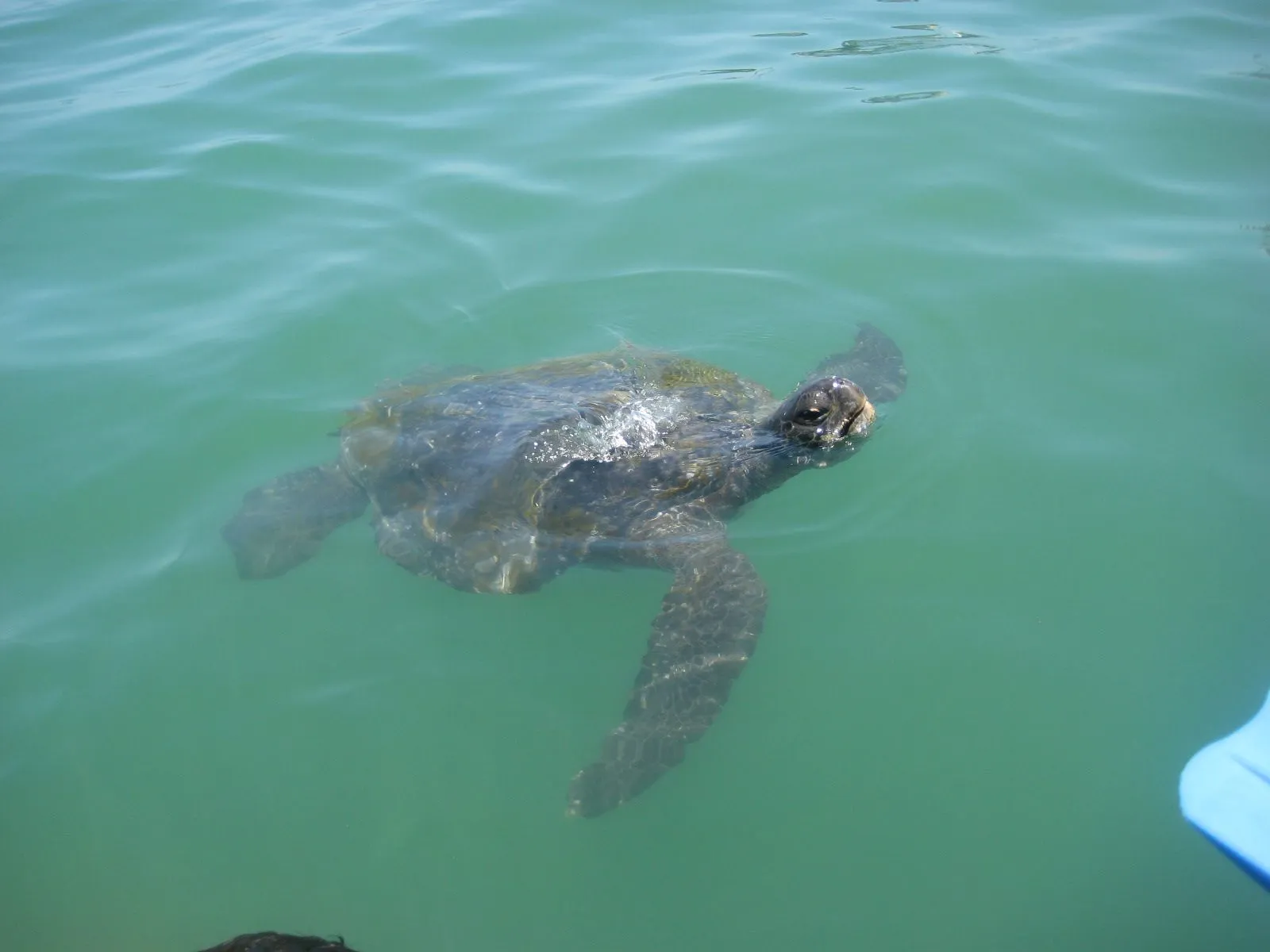
The turtle you see at El Ñuro is the green turtle. Shaleyla Kelez of ecOceánica calls it the most common species and the easiest to see, because it keeps closer to the coast.9 MINCETUR's manual calls it the “only species that is part of tourism in Peru”.1 Green turtle species account in the wildlife guide.
They are not passing through. Between 2010 and 2013 researchers identified 154 different green turtles in 228 captures: 15.3% juveniles, 74.9% subadults and 9.8% adults. They stayed in the area between 121 and 1,015 days (331 on average), grow fast and are in good body condition.3
Olive ridley and hawksbill
The reserve's management plan describes the Cabo Blanco–El Ñuro sector as a feeding and resting area for olive ridleys and green turtles, with “important congregations, especially near the El Ñuro artisanal pier”.2 Across the Mar Tropical de Grau National Reserve as a whole, the olive ridley is the most abundant;2 at the pier, it is the green turtle. Olive ridley species account.
Hawksbills are rare: in 11 in-water surveys between 2010 and 2014, 186 different green turtles were caught and only 2 hawksbills were seen. In January 2014 a hawksbill–green turtle hybrid was caught at El Ñuro, the first documented in the Southeast Pacific.8 Hawksbill species account.
How the turtle swim is done today, and why it worries us
Some 350 artisanal fishers use the pier. The researchers who study these turtles suggest, as a hypothesis, that they feed on fish and squid discarded while catches are landed.3 MINCETUR describes a feeding area, mostly of green turtles, next to the piers of El Ñuro, Los Órganos, Máncora and Cancas.1
The other reason is the worrying one. According to MINCETUR's official manual, since around 2014 more turtles have been coming to the landing sites, partly because pier users and tour providers feed them, mostly squid and fish, to gather them for swims and photos. The manual gives this as its authors' own observation.1 The same manual calls the practice “counterproductive”: it teaches visitors the wrong way to treat wildlife.1
What feeding and touching do
- Health. Green turtles eat mainly seagrass and algae. A diet of squid is high in phosphorus and low in calcium; in captive turtles it has caused demineralised bones and fractures. Turtles fed on fish and squid develop chronic anaemia.1
- Behaviour. On Zakynthos (Greece), where turtles are fed, some have become more aggressive, biting visitors, and forage less for their natural food.1
- Disturbance. Touching disturbs them. The signs: the turtle stops feeding, turns aggressive (biting, flipper slaps) or dives abruptly when someone comes too close or too fast.1
- What SERNANP says. The management plan cites evidence that turtle swims “including touching and feeding them” change their migratory habits, says the activity must be put in order inside the protected area, and lists “touching animals” and “feeding of turtles by tour operators” among the pressures from tourism.2
The researchers also warn that snorkelling with turtles has become common and could affect their feeding and migratory behaviour, and that living so close to the pier exposes them to litter and to boat strikes.3
What is not yet regulated
We have found no binding, specific regulation for swimming with turtles at El Ñuro. MINCETUR's guidelines are official guidance, not a rule with penalties,1 and we have found no specific sanction for feeding turtles either. Putting the turtle swim in order is one of the goals of the 2026–2031 management plan: a pending task, not a rule in force.2 MINCETUR's own manual notes that more visitors come for the turtle swim every year “despite the lack of order in those tourism activities”.1 Back in 2018, WWF Peru regretted “the lack of order in tourism activities”.9
Why ORKA does not offer turtle swims
With all that on the table, ORKA does not offer or promote swimming with the turtles at the pier. Until the activity is put in order, we do not want to be part of it as it is done today. If you want to see turtles, we suggest another way: underwater, on a try dive.
See them on a dive, without feeding them
- Underwater, with a PADI instructor beside you the whole time and never more participants per instructor than PADI allows for Discover Scuba Diving.
- No feeding, no touching, and keeping our distance: we let the turtles come to us, as the official guidelines ask.1
- Where they live. El Ñuro's green turtles are resident,3 and the El Ñuro reefs are among our beginner sites (to 8 m, ORKA's figure). We do not promise they will show up: they are wild animals. Ask us which site your try dive will visit.
- No experience needed: from age 10, after a medical questionnaire.
If you go to the pier anyway: good practice
If you decide to swim with them, these are the guidelines in MINCETUR's good-practice manual, reviewed by SERFOR.1 Inside a protected area, the manual also defers to that area's own rules.1
How to choose who to go with
- Ask first whether they feed the turtles or use bait to draw them in. Good practice says not to.1 If the answer is yes, or you see it happening at the pier, do not get in the water with that group.
- Insist on turns: no more than 10 people at a time, for 15 minutes, in a space of about 10 × 5 m; everyone else waits on the pier or the boat.1
- Insist on a life jacket, mask and snorkel at all times.1
- If you go by boat: engine off and at least 30 m from the turtle to watch it; nobody enters the water until the engine is completely off.1
Important: what not to do in the water
- Do not touch them. Let them come to you. Never chase, corner, grab or try to ride one.
- Do not feed them or use bait of any kind.
- Keep at least 3 m from each turtle, always from behind, and no more than 15 minutes with any one. If it seems bothered, move away.
- Leave them alone while they feed, float or rest. Swim calmly, without sudden moves or noise.
- Use the ladder; do not jump from the pier or the boat where turtles are.
- No flash and no closer than 3 m for photos. No drones without authorisation.
Source: MINCETUR 2026, pp. 52–54.1
The same manual also asks for:1
- Avoiding fins and strong kicks.
- Not standing on the rocks where turtles are, staying 1 m off the bottom where there are fragile organisms, and leaving 1 m between swimmers.
Single-use plastics are banned throughout the Cabo Blanco–El Ñuro sector.2 If you see turtles being mistreated or caught, you can report it through Alerta SERFOR.1
Rules and legal protection in Peru
Touching or feeding a turtle goes against official good practice. Catching one or trading in it is against the law:
- Supreme Decree 004-2014-MINAGRI. Prohibits hunting, capturing, keeping, trading, transporting or exporting for commercial purposes the threatened species it lists.7, 1 All five of Peru's sea turtles are listed as threatened:1 the green turtle as Endangered (EN), the olive ridley as Vulnerable (VU) and the hawksbill as Critically Endangered (CR).2
- Supreme Decree 026-2001-PE. Upholds the ban on the targeted catch of any sea turtle species in Peruvian waters, first set by Ministerial Resolution 103-95-PE in 1995.6
- Souvenirs. Buying souvenirs made from wild marine animals is a crime under the Peruvian Penal Code.1 All five species have been on CITES Appendix I since 1977.1
- Mar Tropical de Grau National Reserve. The whole Cabo Blanco–El Ñuro sector, 16,618.66 ha, is a Direct Use Zone. Wildlife watching there must follow the rules of the competent authority and the protected area's management instruments.2
Where El Ñuro is and how deep it is
- Distance
- The fishing cove of El Ñuro is 8 km south of Los Órganos, in Talara province.2
- On our boat
- About 15 minutes from Los Órganos to the El Ñuro reefs (ORKA's figure).
- Bottom
- Mostly sand with scattered rocky reef and Caulerpa algae; the deep end of the researchers' net was at about 5 m.3 We take beginners to 8 m at most (ORKA's figure).
- Snorkel or scuba
- The management plan treats turtle swimming and recreational diving as separate activities in the sector.2 For the swim, MINCETUR asks for a life jacket, mask and snorkel at all times.1
We do not publish pier fees or hours because we have not been able to confirm them. For the trip to Los Órganos, see getting here; for the site itself, El Ñuro in the wildlife guide (Spanish); and for anything else, write to us through the contact form.
Local research
ecOceánica recorded 350 turtles over nine years of study at El Ñuro and Los Órganos (Mongabay, 2019).4 One of them, “Silvia”, was first recorded at El Ñuro in July 2012 as a 75.6 cm subadult; she was seen again in 2013, 2014 and, in March 2018, as a 90 cm adult female. On 6 February 2019 she was found nesting at Las Bachas, on Santa Cruz island in Galápagos.4 At least 30 El Ñuro fishers have moved into turtle tourism.4
The 2014 study in PLoS ONE tagged the turtles with metal flipper tags, without photo-identification, and notes that illegal capture is rare at El Ñuro and that local people look after the turtles.3
On humpback whales, see what to know before a whale-watching trip in Los Órganos.
Reviewed 21 October 2026
Sources (9)
- MINCETUR (2026). Manual de buenas prácticas de gestión de servicio turístico para la actividad de observación de tortugas marinas en el litoral del Perú, 3.ª ed., mayo de 2026. gob.pe (PDF)
- SERNANP (2026). Plan Maestro de la Reserva Nacional Mar Tropical de Grau 2026–2031. gob.pe (PDF)
- Velez-Zuazo, X. et al. (2014). Fast growing, healthy and resident green turtles (Chelonia mydas) at two neritic sites in the central and northern coast of Peru. PLoS ONE 9(11): e113068. PubMed Central
- Carrere, M. (19-03-2019). Article on the turtle “Silvia”, from El Ñuro to Galápagos. Mongabay Latam. es.mongabay.com
- SERFOR (2019). Plan Nacional de Conservación de las Tortugas Marinas en el Perú, 2019–2029. gob.pe (PDF)
- Decreto Supremo N.° 026-2001-PE (28-06-2001). FAOLEX (PDF)
- Decreto Supremo N.° 004-2014-MINAGRI, list of legally protected threatened wildlife species. SINIA (MINAM)
- Kelez, S., Velez-Zuazo, X. & Pacheco, A.S. (2016). First record of hybridization between green Chelonia mydas and hawksbill Eretmochelys imbricata sea turtles in the Southeast Pacific. PeerJ 4: e1712. Europe PMC
- Sierra Praeli, Y. (30-07-2018). Tortugas marinas en riesgo en el Perú. Mongabay Latam. es.mongabay.com